Warm Up
Test your knowledge of global temperature change and its impact on Earth's climate.
Congratulations!
You're !
You scored
out of
9.
Although most locations on the planet have recorded increased temperatures since
1880, changes in global ocean and atmospheric circulation patterns have created
small-scale temperature decreases in a few local regions.
Some of the fastest-warming regions on the planet include Alaska, Greenland and
Siberia. These Arctic environments are highly sensitive to even small
temperature increases, which can melt sea ice, ice sheets and permafrost, and
lead to changes in Earth's reflectance ("albedo").
For the past few decades, scientists have had the benefit of global satellite
data. We have accurate ground-based measurements that reach back just over a
century. "Proxy" methods, such as tree ring and ice core analysis, are used to
reconstruct climate records before the rise of modern instruments.
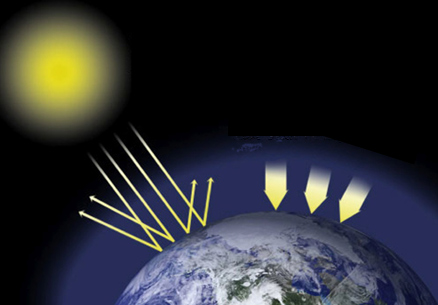
Air pollution can take the form of fine particles called "aerosols," which both
absorb and scatter the sun's radiation. Both natural and man-made aerosols, such
as dust, sea salt, soot and sulfates, affect the climate by reflecting radiation
that is transmitted through the atmosphere.
The greenhouse effect is a naturally occurring physical process that warms the
Earth's surface with energy from the atmosphere. Without the effect, Earth's
average surface temperature would be well below freezing.
Heat-trapping greenhouse gases absorb and emit radiation within the thermal
infrared range. Water vapor, carbon dioxide and methane are Earth's most
abundant greenhouse gases. Nitrogen, which makes up 80 percent of Earth's
atmosphere, is not a greenhouse gas. This is because its molecules, which
contain two atoms of the same element (nitrogen), are unaffected by infrared
light.
Although some think that the "Medieval Warm Period" (approx. 800 – 1200 AD) was
a global phenomenon, recent studies, including one by Neukom et al. 2019, show
that there is no evidence that there were uniform warm and cold periods on Earth
over the last 2,000 years.
Higher temperatures give rise to a more active water cycle, which means faster
and greater evaporation and precipitation and more extreme weather events.
Some people mistakenly believe water vapor is the main driver of Earth’s current
warming. But increased water vapor doesn’t cause human-produced global warming.
Instead, it’s a consequence of it. Increased water vapor in the atmosphere
supercharges the warming caused by other greenhouse gases, such as carbon
dioxide, followed by methane.