What proportion of the Earth’s land is covered by cities and urban areas?
Today, over half of the world’s population lives in cities and urban areas and
this is predicted to grow to 67 percent by 2050 (United Nations 2012). However,
urban regions still cover only about 3 percent of the Earth’s total land area.
Ever since their emergence, cities have been important hubs of economic, social
and political activity, but such activity can come at a price for the
environment, for example through pollution and the loss of natural ecosystems.
Scientists are working to better understand the impacts of future climate change
on city dwellers.
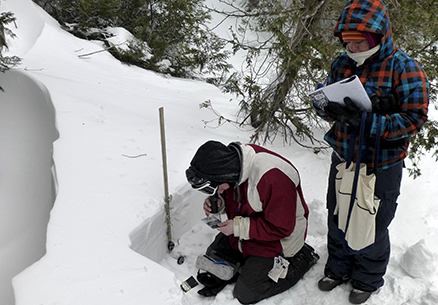
Earth's ice sheets and glaciers are made up of thousands of years of accumulated
snowfall tightly compacted into ice. Snow located on top of sea ice offers
important habitats for animals such as seals that use the snow to hide their
young from predators. Snowfall on mountains and its subsequent melt increases
stream flow and provides people all around the world with vital freshwater.
Which of the following things can we accomplish by observing our home planet
from space satellites?
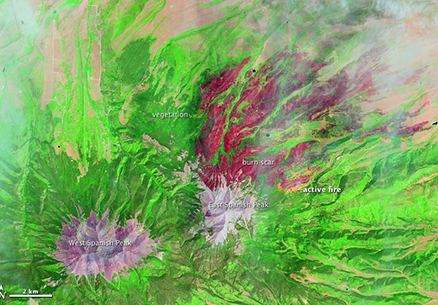
The Landsat satellite, a joint mission between NASA and the U.S. Geological
Survey, can detect both visible and infrared light that are reflected off the
surface of the Earth. This light allows us to measure the heat radiating from
land that has been burned, assess how much plants are photosynthesizing to make
food and distinguish coral reefs from other landforms across the globe.
Aerosols are tiny solid or liquid particles suspended in the atmosphere. How can
large concentrations of aerosols affect the temperature of Earth’s atmosphere?
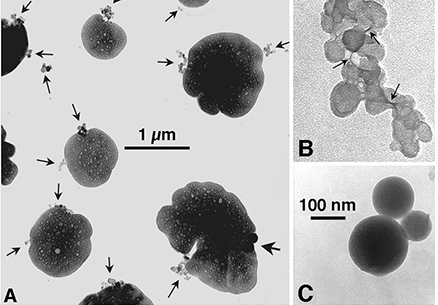
Although most aerosols reflect sunlight, some also absorb it. An aerosol’s
effect on light depends primarily on the composition and color of the particles.
Broadly speaking, bright-colored or translucent particles tend to reflect
radiation in all directions and back towards space, cooling the atmosphere.
Examples are sulfates, nitrates and salt particles. Darker aerosols – like soot
particles, or “black carbon” – can absorb significant amounts of light, warming
the atmosphere but also shading the surface.
The pull of gravity is the same everywhere on Earth.
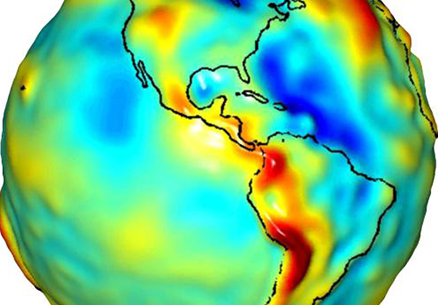
Gravity is determined by mass. Earth’s mass – for example, mountain ranges, ice
caps and water stored underground – is not distributed equally and changes over
time. The U.S./German Gravity Recovery and Climate Experiment (GRACE) and
Gravity Recovery and Climate Experiment Follow-On (GRACE-FO) satellites, are
tracking Earth’s gravitational field in unprecedented detail and tell us that
since 1993, Earth’s ice sheets are melting at an alarming average rate of 428
billion metric tons per year.
Which has more land: the Northern or Southern Hemisphere?
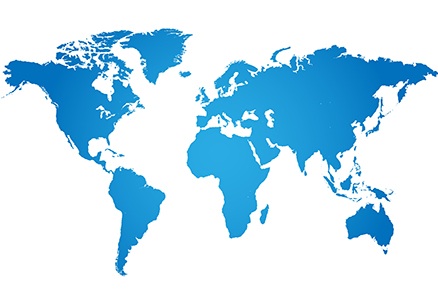
The Northern Hemisphere contains more than twice the amount of land. While the
Northern Hemisphere is almost 40 percent land and 60 percent water, the Southern
Hemisphere is about 20 percent land and 80 percent water.
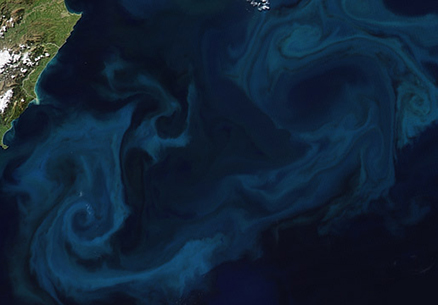
A phytoplankton bloom consists of a large number of microscopic plants floating
on the upper, sunlit layers of the ocean. Such blooms indicate the onset of:
Phytoplankton thrive on sunlight and nutrients. Winds over the ocean help bring
up nutrient-rich water from the deep ocean by driving currents away from the
coast and equator. The warmer the surface waters become, the less mixing there
is between those waters and deeper, more nutrient-rich water. As nutrients
become scarce at the surface, where phytoplankton grow, productivity declines.
El Niño reduces the amount of nutrient-rich water brought to the surface and
therefore the amount of phytoplankton, while La Niña does the opposite and is
characterized by more phytoplankton than normal.
Where have some of the strongest and earliest impacts of global warming
occurred?
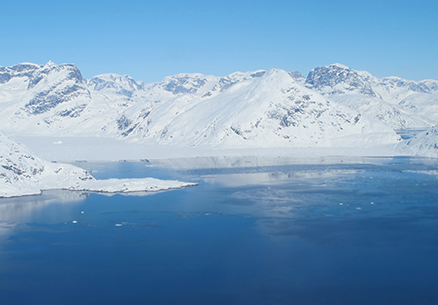
Some of the fastest-warming regions on the planet include Alaska, Greenland and
Siberia. These Arctic environments are highly sensitive to even small
temperature increases, which can melt sea ice, ice sheet and permafrost, and
lead to changes in Earth’s reflectance (or “albedo”).
Sea level is rising at the same rate all over the world.
As the planet warms up, the world’s average sea level is rising. Since 1993,
when the satellite data record began, sea level has risen by about 4 inches.
This is the result of both the global warming-related expansion of ocean waters
as well as the melting of land ice around the world. Although all of Earth's
oceans are interconnected, sea level and sea level rise can vary significantly
from one place to another. This is due to several reasons, including the ocean's
uneven surface and changes in ocean currents driven by wind, heating,
evaporation, and precipitation.