





















Happy Anniversary, GRACE!
Fourteen years ago, a rocket launched a pair of satellites known as the Gravity Recovery and Climate Experiment (GRACE) from the Plesetsk Cosmodrome in Russia. Though just 487 kilograms (1,074 pounds) each, the satellites have produced out-sized scientific advances. As we noted in 2012, few hydrologists believed the satellites would be able to detect—no less measure—changes in groundwater when they launched. As the map below shows, scientists working with GRACE data have shown otherwise.

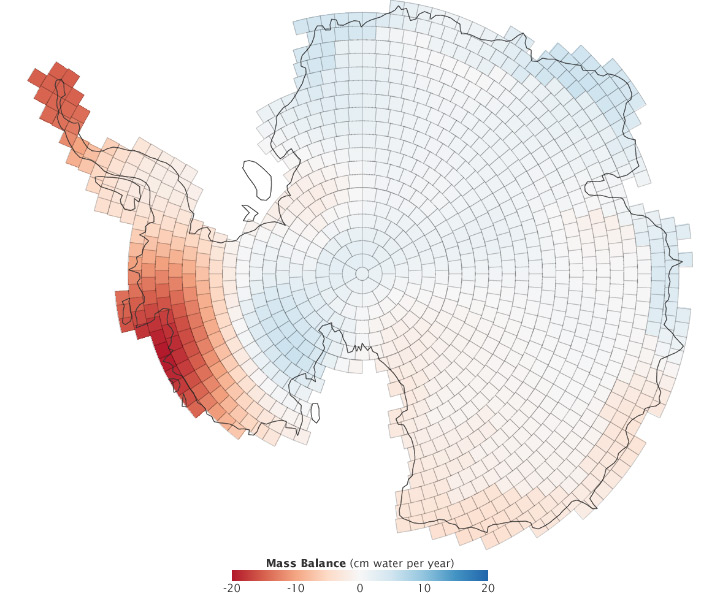
GRACE has observed a number of significant changes in the water cycle. For instance, the mission revealed losses in ice mass on Greenland (where the loss is dramatic), Alaska, and Antarctica. The gravity measurements revealed how much the melting glaciers are contributing to sea level rise by recording both ice lost from land and the mass gained in the ocean. The image below shows changes in the Antarctic ice sheet between 2003 and 2010 as measured by GRACE.
As seen in the set of maps below, GRACE-based measurements can also be combined with ground-based measurements to map water at the surface, in the root zone, and as groundwater.

Thank you, GRACE! Here’s to many more years of observations. You can learn more about the mission here. Launch and clean room photos available here.
