


















A Handful of Galaxies and a Gravitational Lens
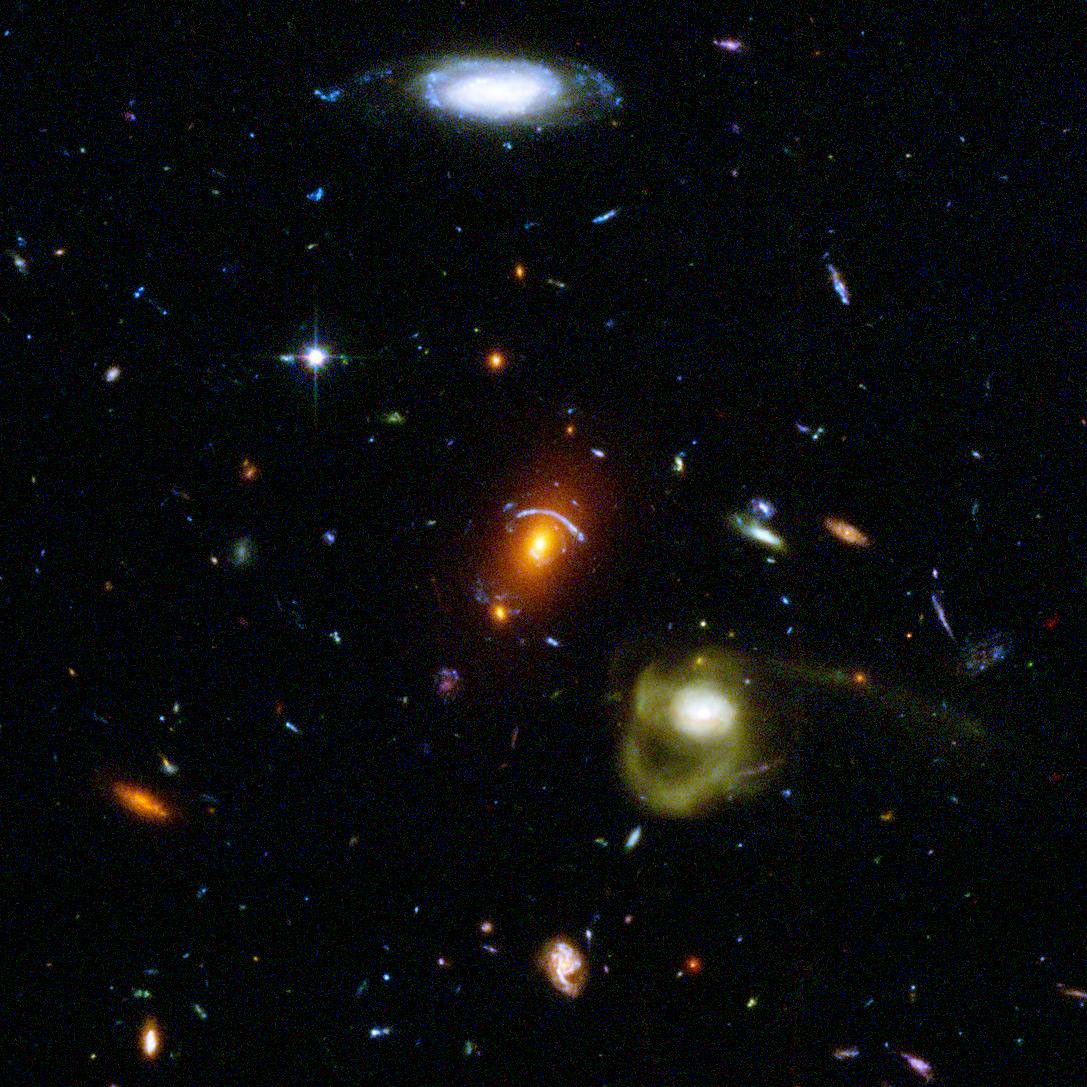
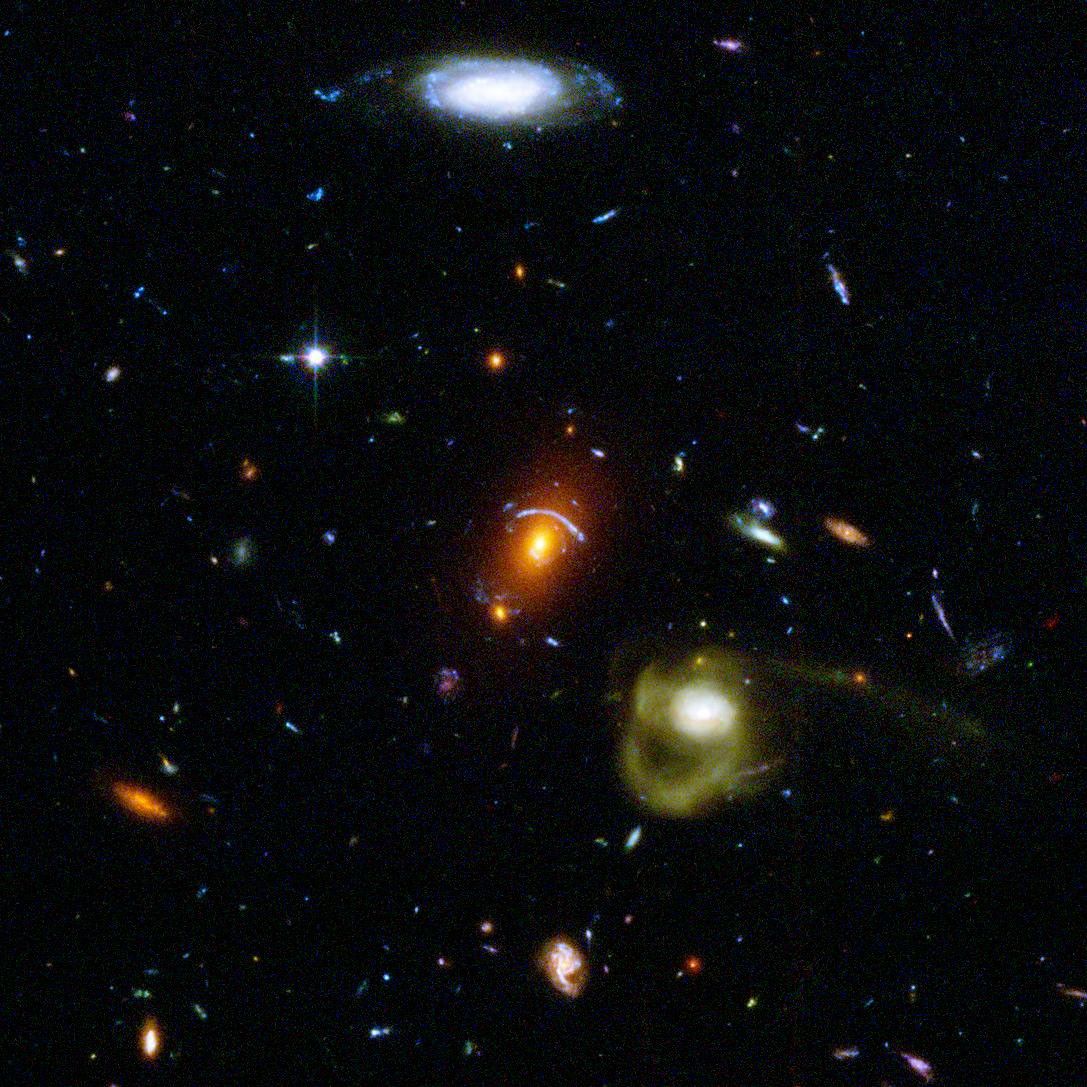
The jumble of galaxies in this Hubble Space Telescope image, taken in September 2003, includes a yellow spiral whose arms have been stretched by a possible collision (lower right); a young, blue galaxy (top) bursting with star birth; and several smaller, red galaxies. But the most peculiar-looking galaxy of the bunch — the dramatic blue arc in the center of the photo — is actually an optical illusion. The blue arc is an image of a distant galaxy that has been smeared into the odd shape by a phenomenon called gravitational lensing. This "funhouse-mirror effect" occurs when light from a distant object is bent and stretched by the mass of an intervening object. In this case the gravitational lens, or intervening object, is a red elliptical galaxy nearly 6 billion light-years from Earth. The red color suggests that the galaxy contains old, cool stars.
Image Credit: NASA, ESA, J. Blakeslee and H. Ford (Johns Hopkins University)
- X
https://science.nasa.gov/image-detail/amf-f7aa128d-6a72-4308-97a9-5d8331901eea/
Image CreditNASA, ESA, J. Blakeslee and H. Ford (Johns Hopkins University)
Size1087x1087px