



















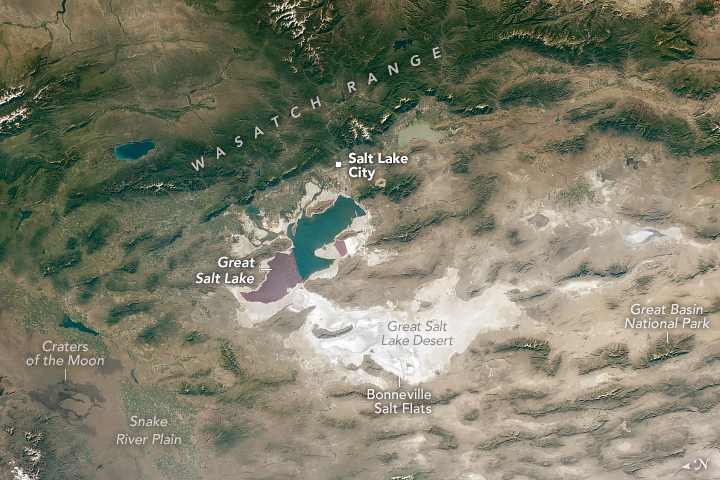
An astronaut aboard the International Space Station captured this wide-view photograph looking nearly straight down over the Great Salt Lake in northwestern Utah. Salt Lake City is visible as the small, rectangular, tan and green strips between the lake and the Wasatch Range. Craters of the Moon National Monument and Preserve, a lava field with over 60 lava flows and a former NASA Apollo crew training site, lies north of the lake, within Idaho’s Snake River Plain. Bright tan and white salt flats and drainage basins fill the low-lying areas within the image.
The lake lies within the eastern portion of the Great Basin Desert in the U.S. Southwest. Defined by its temperate desert climate, the Great Basin Desert encompasses most of Nevada, half of Utah (including the Great Salt Lake Desert), and reaches into Oregon, California, and Idaho. The green-toned, rugged Wasatch Range and smooth, brown-colored Snake River Plain bound the Great Basin Desert on the upper and left sides of the image, respectively. Outside of the frame, California’s Sierra Nevada bound the basin to the west.
The Great Salt Lake displays two primary colors in this image, a burgundy-red northern arm and a blue-green southern arm. A railroad causeway forms a boundary between the two arms. In salty lakes, algae can change the apparent color of the water, with different algal species determined by salinity and temperature differences. North of the railroad divider, the waters are highly saline and mineral-rich, conditions that support pinkish-red phytoplankton. The southern arm has a lower concentration of salt and different algal species, resulting in the water’s green-blue appearance.
Adjacent to the bi-colored lake, the Bonneville Salt Flats stretch westward. These salt flats are remnants of the ancient Lake Bonneville lakebed, which was formed 10,000–32,000 years ago. The Great Salt Lake and the surrounding bright, light-toned salt flats contrast against the darker-toned, mountainous landscapes. Astronauts have been fascinated by these features for decades, capturing thousands of images of the region from Skylab (1973), the space shuttle (1992), and the space station (2017).
References & Resources
Astronaut photograph ISS073-E-248539 was acquired on June 13, 2025, with a Nikon Z 9 digital camera using a focal length of 24 millimeters. It is provided by the ISS Crew Earth Observations Facility and the Earth Science and Remote Sensing Unit at NASA Johnson Space Center. The image was taken by a member of the Expedition 73 crew . The image has been cropped and enhanced to improve contrast, and lens artifacts have been removed. The International Space Station Program supports the laboratory as part of the ISS National Lab to help astronauts take pictures of Earth that will be of the greatest value to scientists and the public, and to make those images freely available on the Internet. Additional images taken by astronauts and cosmonauts can be viewed at the NASA/JSC Gateway to Astronaut Photography of Earth . Caption by Sara Schmidt, GeoControl Systems, JETS II Contract at NASA-JSC.