

























Meet Sentinel-6B Satellite
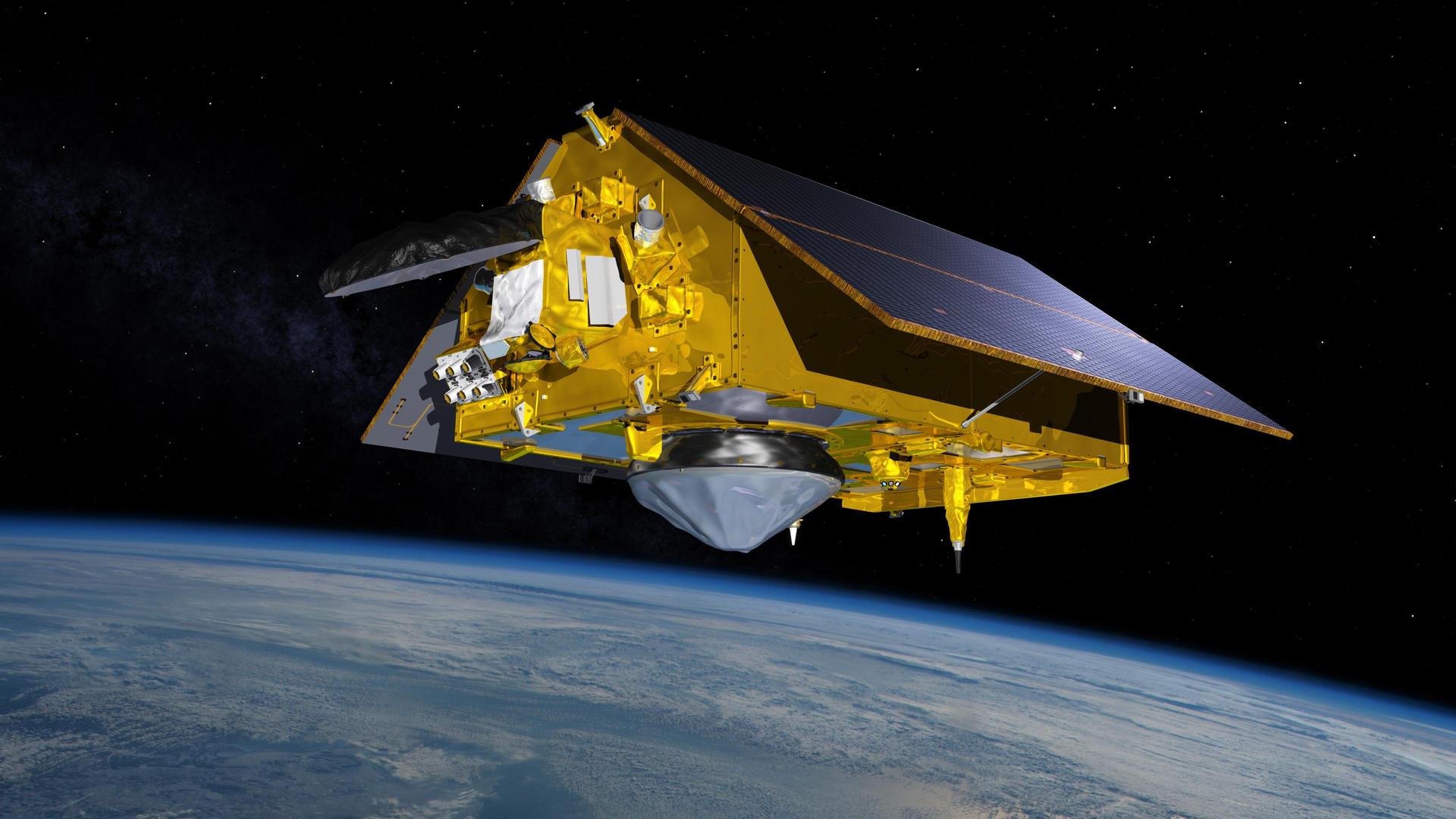
Once Sentinel-6B launches, the satellite and its six science instruments are expected to spend the next 5.5 years in orbit collecting data on the rising sea levels and the impacts for us on Earth.
The satellite is about the size of a small pickup truck at 19.1 feet (5.82 meters) long, 7.74 feet (2.36 meters) high, and 14.2 feet (4.33 meters) wide. Sentinel-6B weighs 2,623 pounds (1,192 kilograms), including onboard propellant at launch.
The satellite has two fixed solar arrays, plus two deployable solar panels, and will travel in a longitude direction around Earth in a non-Sun-synchronous orbit. That means the satellite will pass the same part of Earth repeatedly, but not at the same time during each orbit.
Following a cross-calibration period, Sentinel-6B will take over for its twin spacecraft Sentinel-6 Michael Freilich, which launched from Vandenberg Space Force Base in California Nov. 21, 2020.
Copernicus Sentinel-6/Jason-CS (Continuity of Service) is a collaboration between NASA, ESA (the European Space Agency), the European Union, EUMETSAT (European Organisation for the Exploitation of Meteorological Satellites), and U.S. National Oceanic and Atmospheric Administration (NOAA). The European Commission provided funding support, and the French space agency CNES (Centre National d’Études Spatiales) contributed technical support.
NASA’s Jet Propulsion Laboratory in Southern California, managed for the agency by Caltech in Pasadena, California, contributed three science instruments for each Sentinel-6 satellite: the Advanced Microwave Radiometer for Climate, the Global Navigation Satellite System – Radio Occultation, and the Laser Retroreflector Array. The agency is also contributing launch services, ground systems supporting operation of the NASA science instruments, the science data processors for two of these instruments, and support for the international ocean surface topography community.
NASA’s Launch Services Program, based at the agency’s Kennedy Space Center in Florida, manages the launch service for the mission.
Liftoff remains on track for just under 30 minutes at 12:21 a.m. EST, Monday, Nov. 17, (9:21 p.m. PST, Sunday, Nov. 16) from Space Launch Complex 4 East at Vandenberg.
