
















NASA’s SPHEREx Mission Tracks Brightening of Interstellar Comet

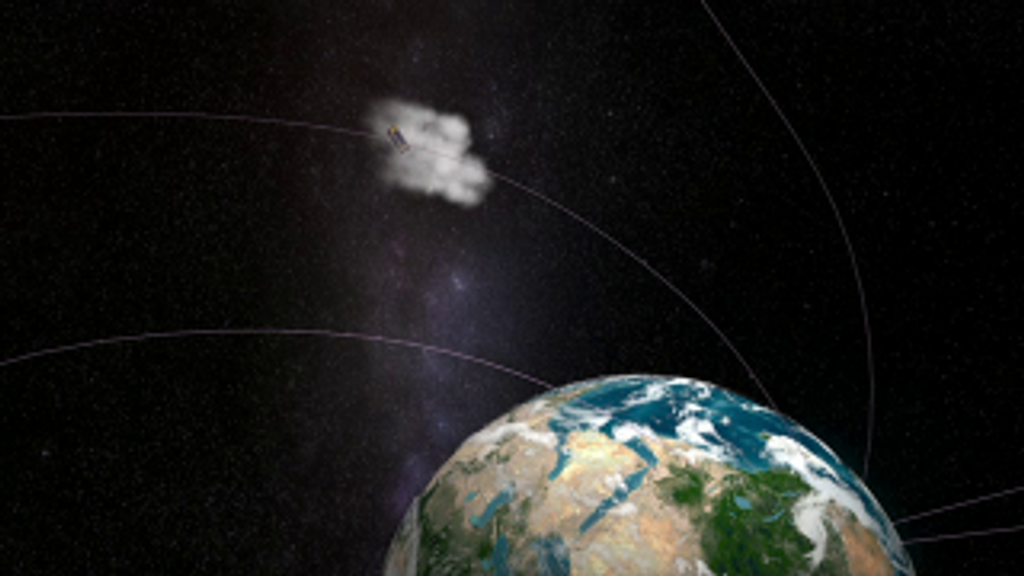
NASA’s SPHEREx mission turned its infrared gaze on interstellar comet 3I/ATLAS in December 2025, adding to the deep pool of information the agency has gathered on what is only the third such object to be discovered passing through our solar system.
In a new research note, mission scientists describe the detection of organic molecules, such as methanol, cyanide, and methane. On Earth, organic molecules are the foundation for biological processes but can be created by non-biological processes as well. The researchers also note a dramatic increase in brightness two months after the icy body had passed its closest distance to the Sun, a phenomenon associated with comets as they vent water, carbon dioxide, and carbon monoxide into space.
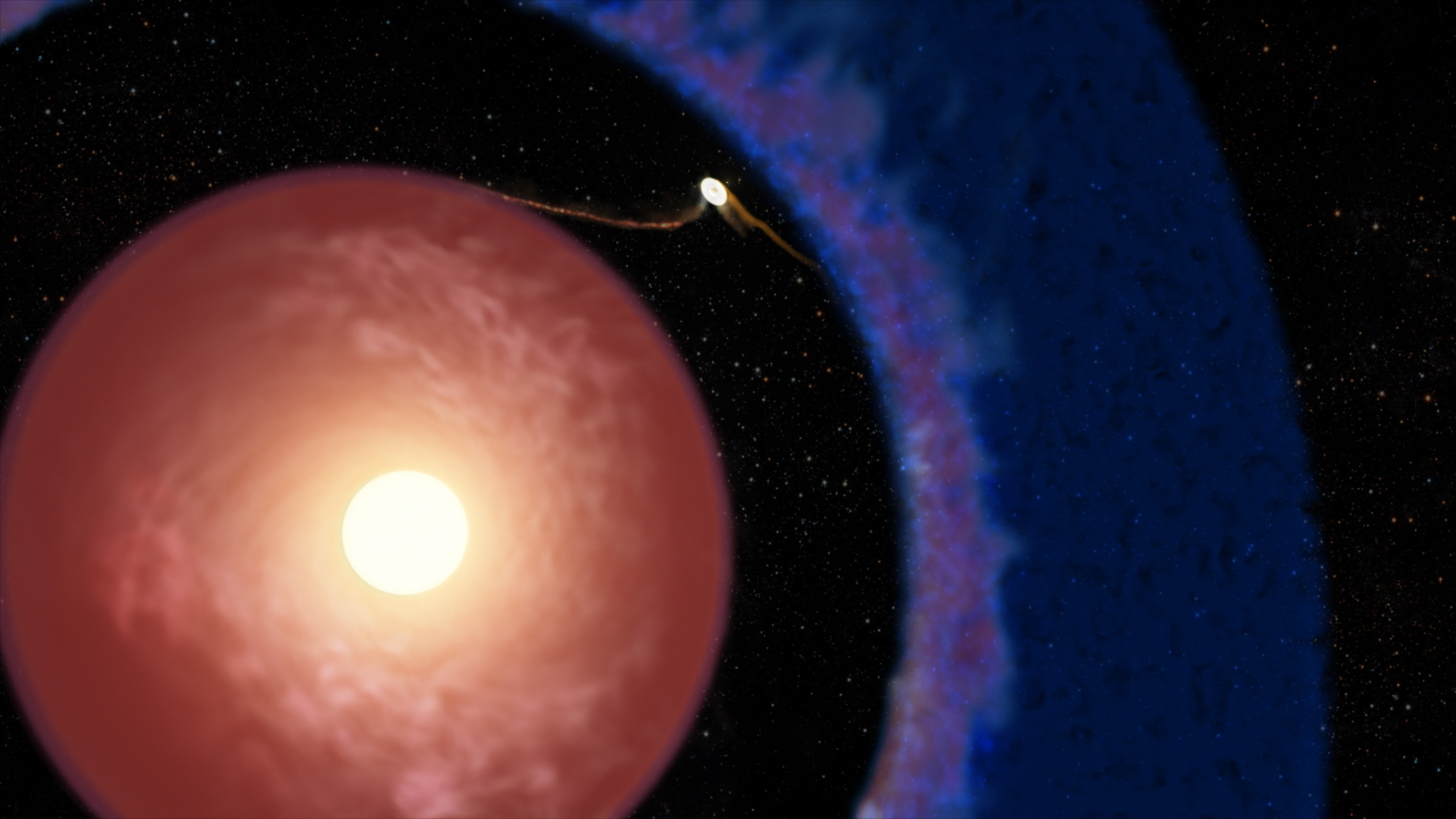
As a comet approaches the Sun after traveling from deep space, its frozen surface heats up and sublimates, which is when ice turns from a solid to a gas without passing through the liquid phase. These gases can escape into space to form an atmosphere surrounding the comet’s nucleus, known as a coma.
“Comet 3I/ATLAS was full-on erupting into space in December 2025, after its close flyby of the Sun, causing it to significantly brighten. Even water ice was quickly sublimating into gas in interplanetary space,” said study lead Carey Lisse of Johns Hopkins Applied Physics Laboratory in Laurel, Maryland. “And since comets consist of about one-third bulk water ice, it was releasing an abundance of new, carbon-rich material that had remained locked in ice deep below the surface. We are now seeing the usual range of early solar system materials, including organic molecules, soot, and rock dust, that are typically emitted by a comet.”
Delayed venting
When the comet is closest to the Sun in its orbit, it experiences peak heating, but that’s not necessarily when peak sublimation activity occurs. Because the Sun’s heat takes time to travel through the outer layers of the comet, ices deep below the surface may not begin sublimating until long after the comet was closest to the Sun. This seems to be the case with comet 3I/ATLAS.
Short for Spectro-Photometer for the History of the Universe, Epoch of Reionization and Ices Explorer, SPHEREx observed a coma containing huge amounts of carbon dioxide, a little carbon monoxide, and some water in August. The December observations show a far more active and diverse coma, which is being supplied by erupting subsurface water ice mixed with other ices, organics, and rocky material.
“The comet has spent ages traversing interstellar space, being bombarded by highly energetic cosmic rays, and has likely formed a crust that’s been processed by that radiation,” said Phil Korngut, the mission’s instrument scientist at Caltech in Pasadena, California. “But now that the Sun’s energy has had time to penetrate deep into the comet, the pristine ices below the surface are warming up and erupting, releasing a cocktail of chemicals that haven’t been exposed to space for billions of years.”
The SPHEREx observations also suggest that rocky material is being ejected as 3I/ATLAS’s activity increases. The comet only appears to have a small pear-shaped dust tail, which forms when dust from an active comet gets swept back by solar radiation pressure. This means that the comet is ejecting large grains and BB-size chunks of material (typically, the material is in the form of dust grains finer than human hair) that are too massive to be pushed far from the vicinity of the comet’s nucleus by the Sun’s radiation pressure.
Right place, right time
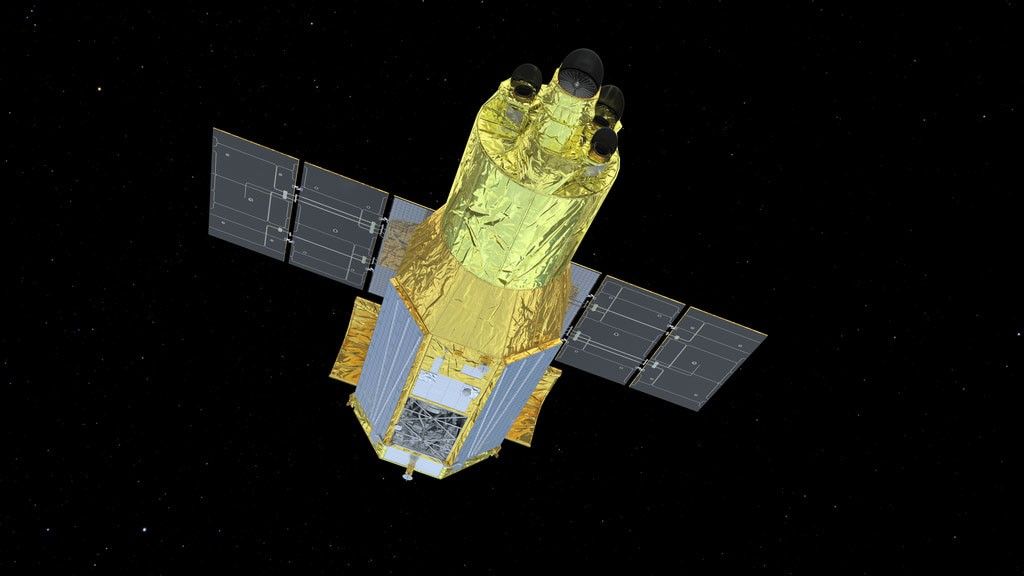
The SPHEREx comet observations are a side benefit of the space telescope’s location during its near-polar low-Earth orbit and its all-sky perspective. Managed by NASA’s Jet Propulsion Laboratory in Southern California, the mission launched March 11, 2025, to study the origins of the universe and the history of galaxies, and to search for the ingredients of life in our galaxy.
In late 2025, SPHEREx completed the first of four all-sky infrared maps of the cosmos that will help humanity better understand the universe. The space telescope has the singular capability of seeing the sky in 102 colors, each color representing a wavelength of infrared light that provides unique information about galaxies, stars, planet-forming regions, and other cosmic features, including the various gases seen in the coma of 3I/ATLAS.
“Our unique space telescope is gathering unprecedented data from across the universe,” said Yoonsoo Bach, deputy study lead from the Korea Astronomy and Space Science Institute. “But in this case, our galaxy delivered a piece of a faraway star system to us only a few months after launch, and SPHEREx was ready to observe it. Science is sometimes like that: You’re in the right place at the right time.”
Comet 3I/ATLAS was discovered by the NASA-funded ATLAS (Asteroid Terrestrial-impact Last Alert System) survey telescope in Rio Hurtado, Chile, and reported to the Minor Planet Center on July 1, 2025. Scientists quickly determined that comet 3I/ATLAS was interstellar because of its high velocity and its trajectory. Since then, many of NASA’s missions have tracked and studied the object, helping to refine its path through the solar system and better understand what it is made of. It’s just one example of the way NASA’s space telescopes help support the agency’s ongoing mission to find, track, and better understand comets and asteroids — including near-Earth objects — that travel through our solar system.
More about SPHEREx
The mission is managed by NASA JPL for the agency’s Astrophysics Division within the Science Mission Directorate in Washington. The telescope and the spacecraft bus were built by BAE Systems. The science analysis of the SPHEREx data is being conducted by a team of scientists at 13 institutions across the U.S. and in South Korea and Taiwan, led by Principal Investigator Jamie Bock, who is based at Caltech with a joint JPL appointment, and by JPL Project Scientist Olivier Dore. Data is processed and archived at IPAC at Caltech in Pasadena, which manages JPL for NASA. The SPHEREx dataset is freely available to scientists and the public.
For more information about the SPHEREx mission visit:
https://science.nasa.gov/mission/spherex/
News Media Contacts
Ian J. O’Neill
Jet Propulsion Laboratory, Pasadena, Calif.
818-354-2649
ian.j.oneill@jpl.nasa.gov
Alise Fisher / Molly Wasser
NASA Headquarters, Washington
202-617-4977 / 240-419-1732
alise.m.fisher@nasa.gov / molly.l.wasser@nasa.gov
2026-009