



















APOD
Astronomy Picture of the Day
Discover the cosmos! Each day a different image or photograph of our fascinating universe is featured, along with a brief explanation written by a professional astronomer.
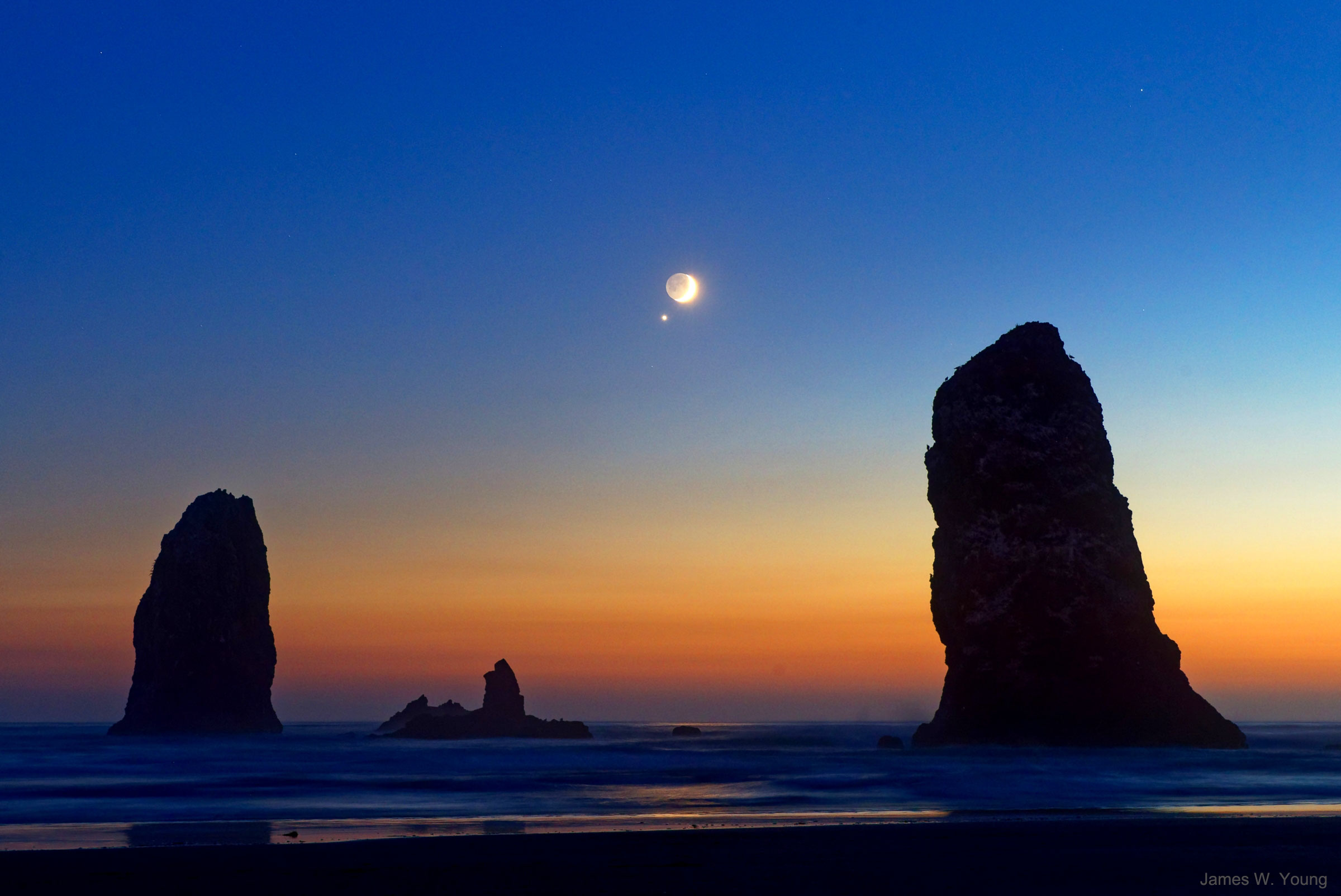
Moon and Venus over Cannon Beach
Explanation: What's that spot next to the Moon? Venus . Two days ago, the crescent Moon slowly drifted past Venus, appearing within just one degree at its closest. This conjunction , though, was just one of several photographic adventures for our Moon this month ( moon-th ), because, for one, a partial solar eclipse occurred just a few days before , on July 12. Currently, the Moon appears to be brightening, as seen from the Earth, as the fraction of its face illuminated by the Sun continues to increase. In a few days, the Moon will appear more than half full, and therefore be in its gibbous phase . Next week the face of the Moon that always faces the Earth will become, as viewed from the Earth, completely illuminated by the Sun . Even this full phase will bring an adventure, though, as a total eclipse of this Thunder Moon will occur on July 27. Don't worry about our Luna getting tired, though, because she'll be new again next month (moon-th) -- August 11 to be exact -- just as she causes another partial eclipse of the Sun. Pictured, Venus and the Moon were captured from Cannon Beach above a rock formation off the Oregon ( USA ) coast known as the Needles . About an hour after this image was taken, the spin of the Earth caused both Venus and the Moon to set .
| Date | July 17, 2018 |
|---|---|
| Credit | Image Credit & Copyright: James W. Young |
| Authors & editors: | Robert Nemiroff (MTU) & Jerry Bonnell (UMCP) |
| A service of: |
ASD at NASA / GSFC, NASA Science Activation & Michigan Tech. U. |