




















Jupiter’s Great Red Spot
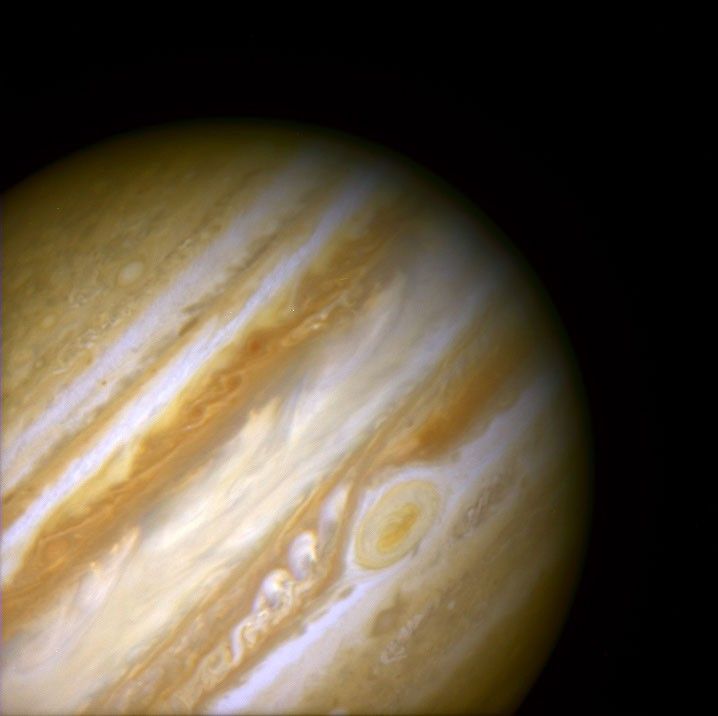
When 17th-century astronomers first turned their telescopes to Jupiter, they noted a conspicuous reddish spot on the giant planet. This Great Red Spot is still present in Jupiter's atmosphere, more than 300 years later. It is now known that it is a vast storm, spinning like a cyclone. Unlike a low-pressure hurricane in the Caribbean Sea, however, the Red Spot rotates in a counterclockwise direction in the southern hemisphere, showing that it is a high-pressure system. Winds inside this Jovian storm reach speeds of about 270 miles per hour. The Red Spot is the largest known storm in the solar system. With a diameter of 15,400 miles in this 1999 image, it is almost twice the size of the entire Earth and one-sixth the diameter of Jupiter itself.
Image Credit: The Hubble Heritage Team (STScI/AURA/NASA) and Amy Simon (Cornell U.)
- X
https://science.nasa.gov/image-detail/amf-52e49f67-8dd5-4f26-8a8c-3d238040867a/
Image CreditThe Hubble Heritage Team (STScI/AURA/NASA) and Amy Simon (Cornell U.)
Size718x716px