



















Description

Map Projected Browse Image
Click on the image for larger version
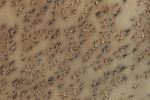
A layer of dry ice covers the South Polar layered deposits every winter. In the spring, gas created from heating of the dry ice escapes through ruptures in the overlying seasonal ice, entraining material from the ground below. The gas erodes channels in the surface, shown in this image, generally exploiting weaker material.
The ground likely started as polygonal patterned ground (common in water-ice-rich surfaces), and then escaping gas widened the channels. Fans of dark material are bits of the surface carried onto the top of the seasonal ice layer and deposited in a direction determined by local winds.
The University of Arizona, Tucson, operates HiRISE, which was built by Ball Aerospace & Technologies Corp., Boulder, Colo. NASA's Jet Propulsion Laboratory, a division of Caltech in Pasadena, California, manages the Mars Reconnaissance Orbiter Project for NASA's Science Mission Directorate, Washington.