














The Network For Life Detection (NFoLD)
The goal of NFoLD is to promote communication, coordination, and synergy among researchers in the fields relevant to life detection. The diverse expertise needed to develop and implement strategies to search for evidence of life beyond Earth is distributed across multiple science and technology disciplines, some of which are not primarily focused on astrobiology questions. NFoLD aims to build a cohesive life detection community whose research and expertise becomes integral to all stages of astrobiology-themed solar system and exoplanet mission activity, from inception to operations.
Organizational Structure
Current co-Leads:
- Alfonso Davila, NASA Ames Research Center
- Heather Graham, NASA Goddard Space Flight Center
- Brook Nunn, University of Washington
Early Career Chairs:
- Erin Gibbons, NASA Goddard Space Flight Center
- Ashley Hannah, University of Maryland
- Osama Alian, NASA Jet Propulsion Laboratory
- Taylor Plattner, Georgia Institute of Technology
NASA POC:
- Michael Lienhard, Planetary Science Division, PESTO
NASA RCN Support Liaison:
- Willow Houck, NASA Ames Research Center
Advancing Life-Detection
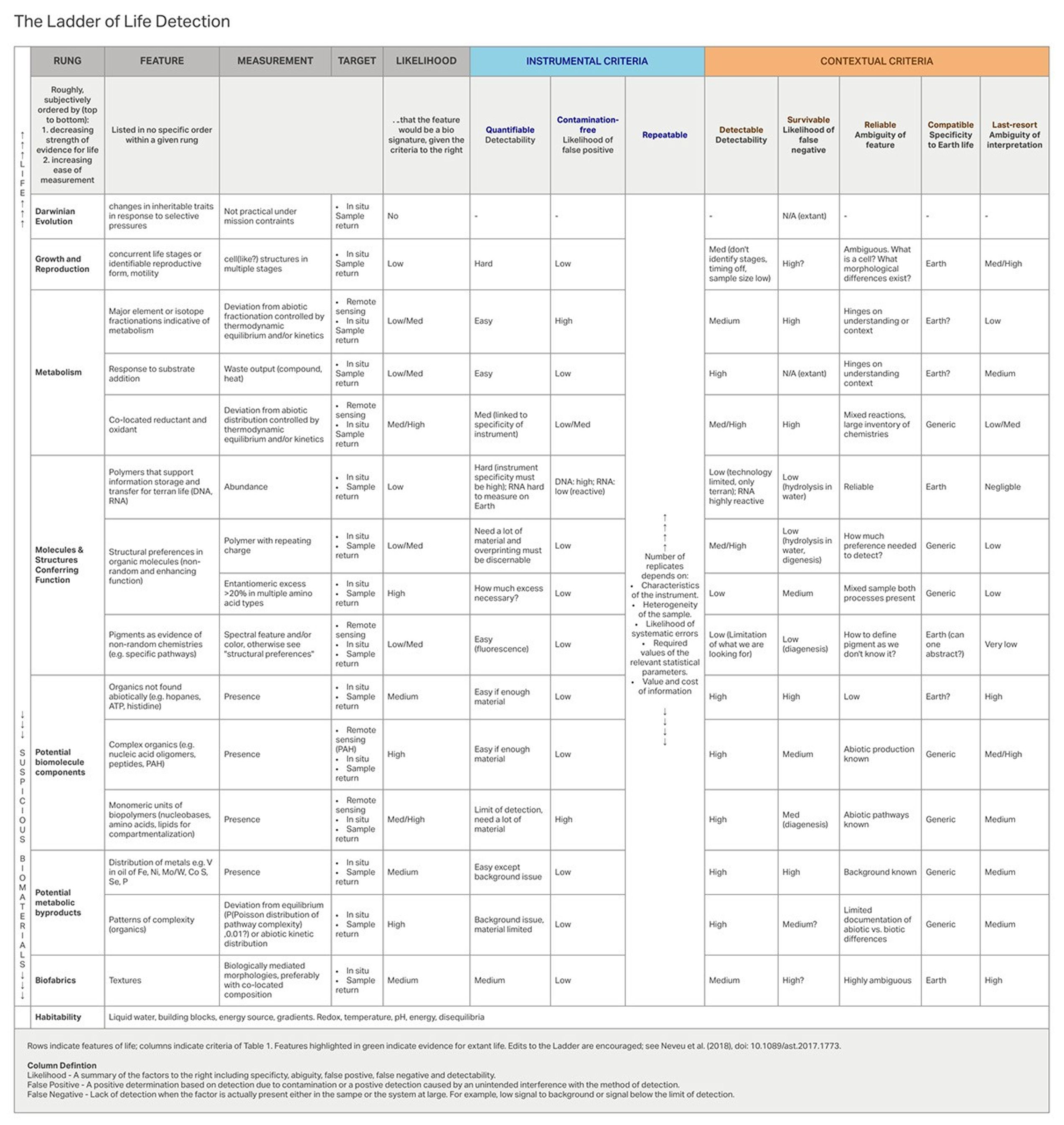
NFoLD has played a key role in advancing knowledge of the interconnections between life-detection science and technology through coordinating events like workshops and seminars. NASA Astrobiology maintains a page dedicated to resources that have been developed to benefit scientists working on life detection missions and technology.
Click here to visit the Resources for Life Detection Missions about Advancing Life-Detection