



















NASA’s TESS Reobserves Comet 3I/ATLAS
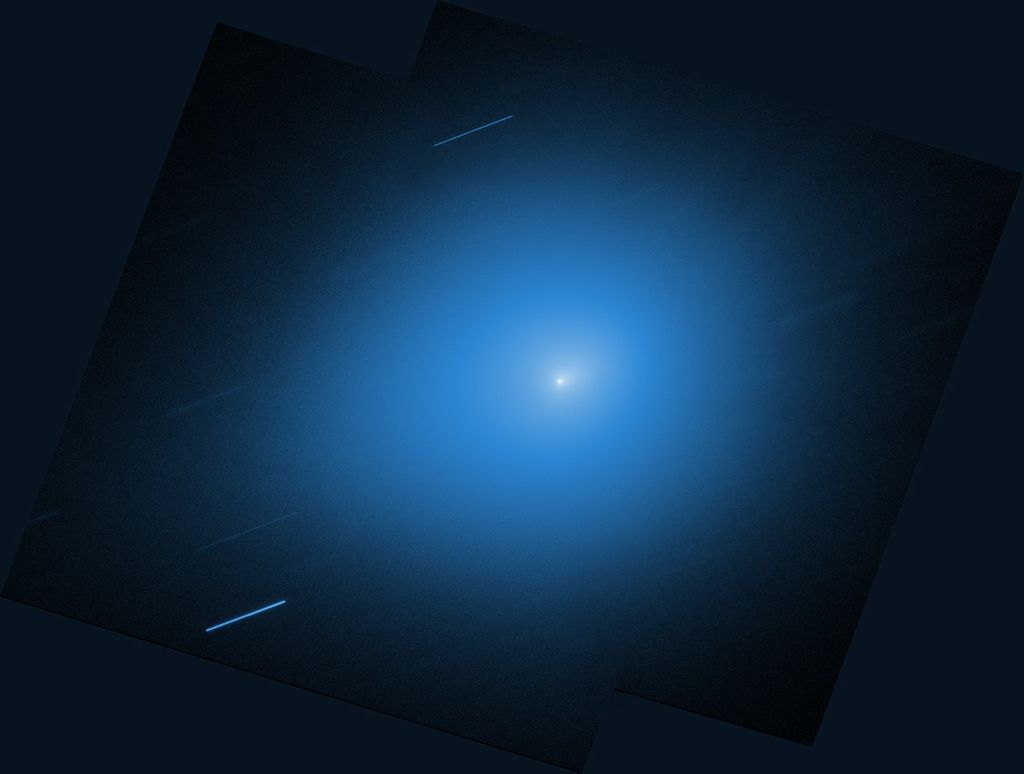
NASA’s TESS (Transiting Exoplanet Survey Satellite) observed the interstellar comet 3I/ATLAS during a special observation run from Jan. 15 to 22. Scientists will use the data to study the comet’s activity and rotation.
Using TESS data from Jan. 15 and Jan. 18 to 19, Daniel Muthukrishna, a research scientist at the Massachusetts Institute of Technology in Cambridge, compiled a series of images into a short video that shows 3I/ATLAS as a bright moving dot with a tail.
The comet’s brightness is around 11.5 in apparent magnitude, or approximately 100 times fainter than what humans can see with the unaided eye.
All the TESS data from Jan. 15 through 22 are publicly available on the Mikulski Archive for Space Telescopes as of Tuesday. The initially calibrated measurements from Jan. 15 used for the brightness estimate and the video were posted on Jan. 19.
The TESS spacecraft scans a wide swath of the sky for about a month at a time, looking for variations in the light from distant stars to spot orbiting exoplanets, or worlds beyond our solar system. This technique also allows TESS to identify and monitor comets and asteroids out to large distances.
The mission’s wide field of view previously happened to observe 3I/ATLAS in May 2025, almost two months before it was discovered. Astronomers looking back at the TESS data were able to identify the faint comet by stacking multiple observations to track its movement.
The recent 3I/ATLAS observations were temporarily interrupted from Jan. 15 to 18 when TESS entered a safe mode following an issue with its solar panels.
By Jeanette Kazmierczak
NASA’s Goddard Space Flight Center, Greenbelt, Md.
Media contacts:
Claire Andreoli
(301) 286-1940
NASA’s Goddard Space Flight Center, Greenbelt, Md.
Alise Fisher
202-358-2546
NASA Headquarters, Washington
