













Where are the stars?
Vishnu, an Earth Observatory reader, posed a great question after viewing “The Six-Million Mile View of Earth and Moon“:
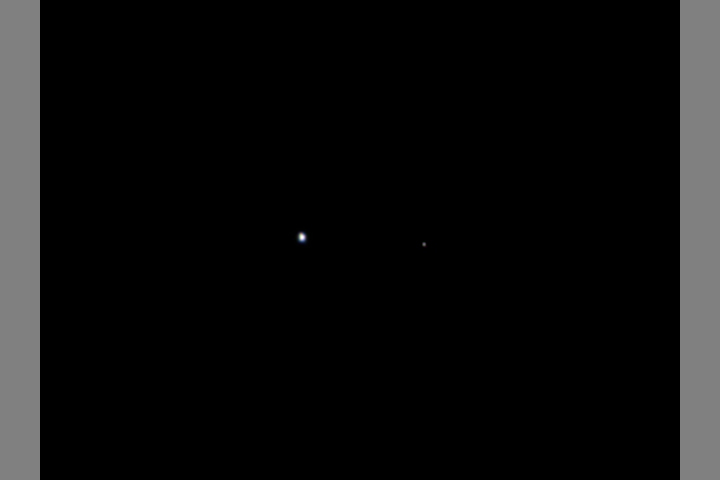
“I’ve never seen a photo like that. Was the background beyond Earth ‘photoshopped’ to remove background stars, or is that angle so narrow and the background space so coincidentally ’empty’ that no visible stars are there to be seen?”
Our colleague D.C. Agle from the Jet Propulsion Laboratory worked with the Juno science team to provide this answer:
“The exposure time for the image — it’s actually three images: red, green and blue — was too short for any stars to be seen. Earth and the Moon were bright enough that a short-duration exposure was all that was needed. The brighter an object is, the shorter the exposure time required to capture an image of it. It’s similar to why you don’t really see stars in Apollo photos from the moon – the subjects being photographed were so much brighter than the background stars that the exposures weren’t long enough to capture the stars.
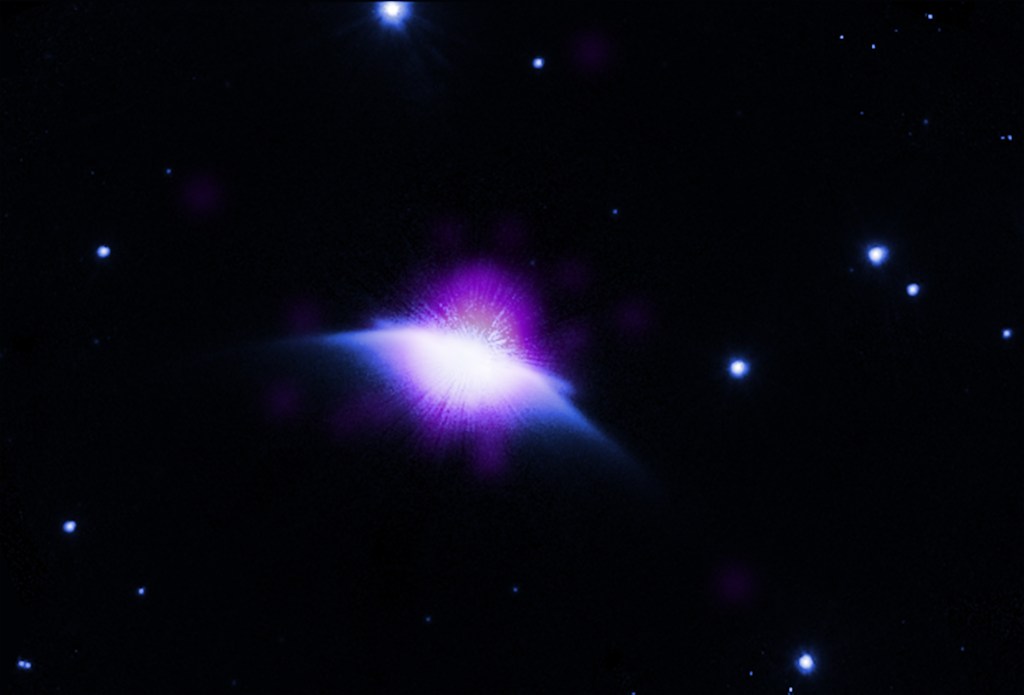
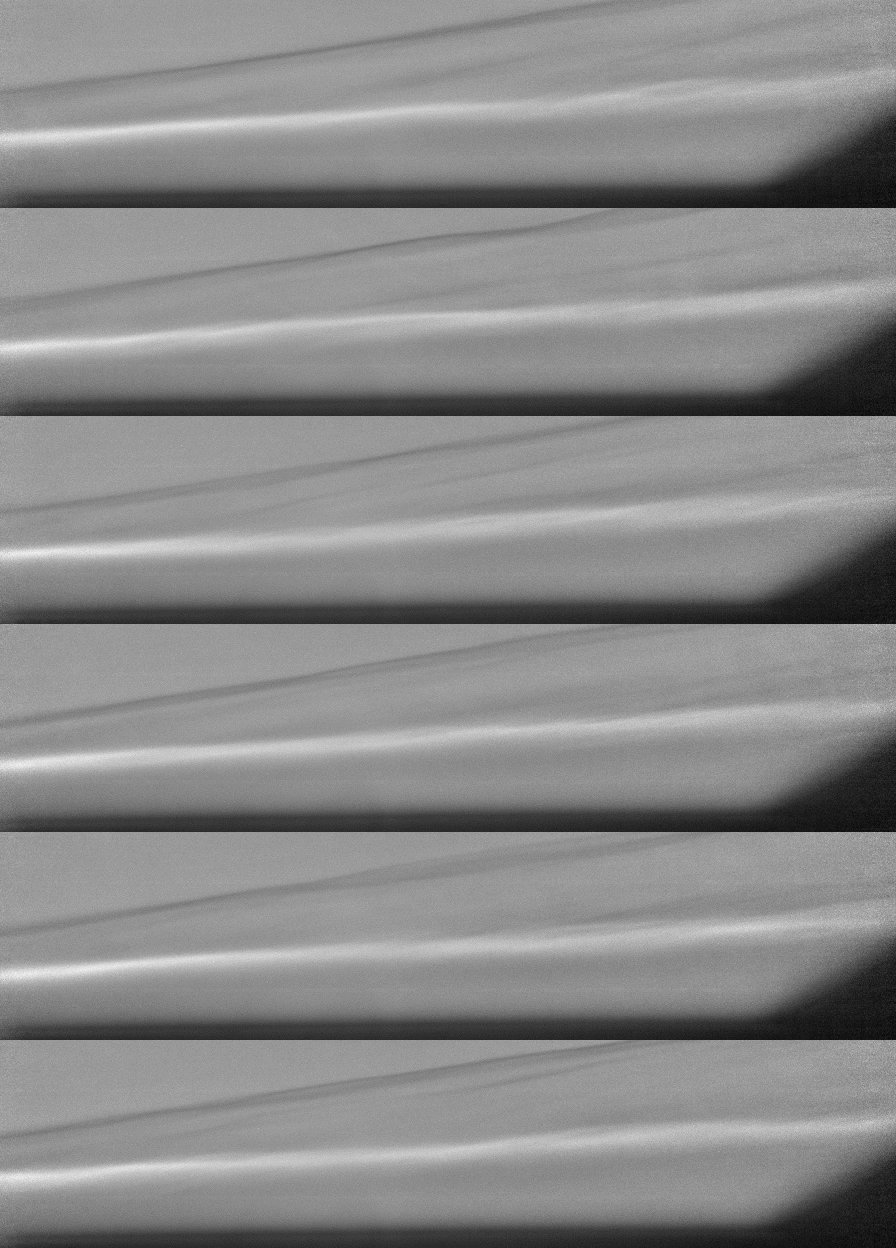
Here are two examples from the Cassini mission to Saturn showing long exposures that did capture stars. In both cases, the stars show up as streaks because of the relatively long exposures required to capture a good image of the moons.
+ Tethys in Eclipse
+ Iapetus by Saturn Shine
Cassini stays locked onto its target and actually turns very slightly during the exposures. Meanwhile the stars move slowly across the sky, and their images are smeared out as streaks.
Interestingly, the Voyager spacecraft took this remarkable image from about 7 million miles away in 1977. The difference is that Voyager was a survey and flyby mission, and its cameras were like long-range telescopes. Juno is an orbiter that will get extremely close to Jupiter every 11 days, and its camera is designed for that. It will take amazing wide-angle views from only a few thousand miles above the cloud tops. So that’s why Juno’s camera has a field of view about 130 times wider than Voyager, and thus why Eath seems so much smaller even though Voyager was a little farther away when it took its Earth-moon image.”
******************************************
Along those same lines, another reader (Norton) pointed out the lack of stars in a shot closer to Earth: “I was curious to see stars in this image of earth, yet in most other images the stars aren’t visible.
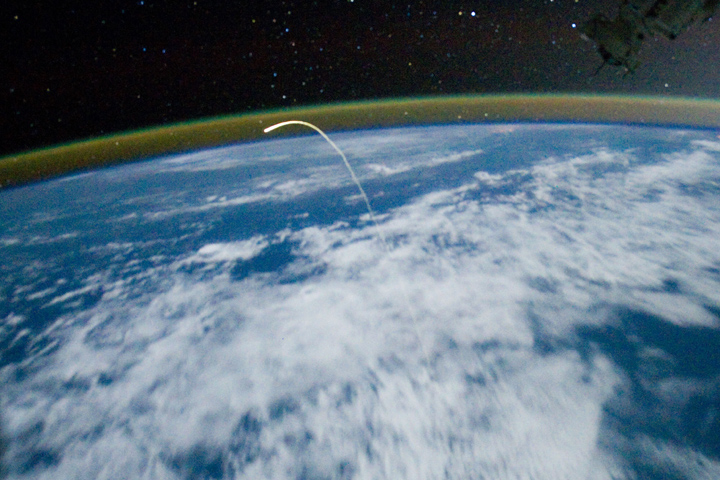
In one of your images of the day a week or two later, there are no stars visible. Is this solely due to how much light is captured by the camera and the stars are a weaker source; or is something else occurring that the stars aren’t visible?”
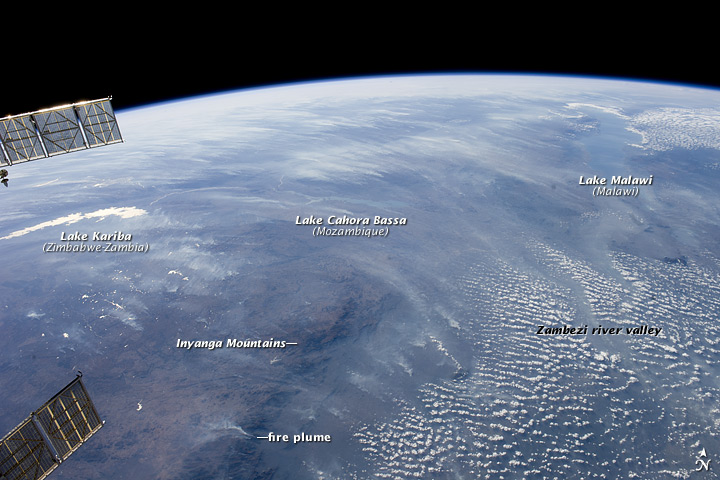
Our colleague Will Stefanov of the ISS Crew Earth Observations Team at NASA’s Johnson Space Center offered this explanation:
“It’s dependant on the camera settings, and to some degree the camera itself. The Nikon D3 cameras the astronauts often use are designed to be more sensitive in low-light situations, so you are more likely to capture some bright stars in the imagery. Images taken with long exposures and/or wide apertures will also record more starlight due to the greater amount of light on the camera sensor. Shorter exposure imagery of the Earth — the majority of daytime images — typically do not record stars as they are too dim compared to the brightness of the planet.
The astronauts generally follow a set procedure, with defined camera settings, for Crew Earth Observations imagery. But occasionally they will change those settings for a specific purpose or for personal experimentation. This can lead to images in which the stars are more visible for the reasons described above.
