























Arctic Report Card
On December 5, 2012, the National Oceanic and Atmospheric Administration (NOAA) released its annual Arctic Report Card, covering late 2011 through late 2012. The report listed a number of significant events in a record-breaking and sometimes sobering year.
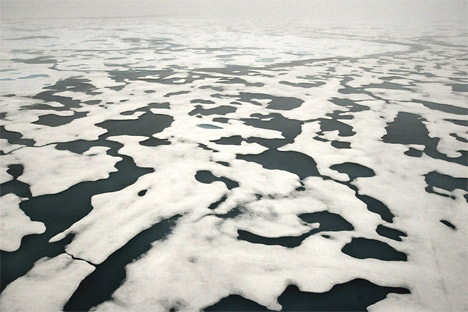
One of the biggest stories was the record-low sea ice extent in the Arctic Ocean. Arctic sea ice shrinks and grows every year, typically reaching its minimum in September. The last decade, however, has seen a series of below-normal extents, with new records set in 2002, 2005, 2007, and 2012. By mid-September 2012, Arctic sea ice had dropped to 3.41 million square kilometers (1.32 million square miles), which was significantly below the 2007 record of 4.17 million square kilometers (1.61 million square miles). (See Visualizing the 2012 Sea Ice Minimum for prior Earth Observatory coverage of this event.)
NOAA data for high latitudes during June indicated that snow cover extent has declined by 17.6 percent per decade—an even faster rate of decline than the sea ice extent. From June 2008 to June 2012, North America experienced three record-low snow cover extents, and Eurasia experienced five straight record lows.
The summer of 2012 also brought widespread melting on the Greenland Ice Sheet. An estimated 97 percent of the ice surface was melting at some point on July 11–12. July 2012 also brought an unusually high melt index—calculated by multiplying the number of days when melt occurred by the area that melted. Compared to the 1979–2012 average, the 2012 melt index was +2.4, nearly twice the previous melt index record set in 2010. (See Satellites Observe Widespread Melting Event on Greenland for prior Earth Observatory coverage of this event.)
The Greenland melting was linked to a drop in albedo—the amount of sunlight reflected back into space—on the ice sheet in 2012. A drop in albedo can set up a feedback loop; as the ice surface melts, it grows darker, absorbing more sunlight and melting more ice.
Other highlights of the 2012 Arctic Report Card include an increase in the length of the high-latitude growing season, record-high permafrost temperatures, a giant phytoplankton bloom under the ice in the Chukchi Sea, the threat of extinction to the Arctic fox, and severe weather events. (including a strong storm off Alaska and a strong summer storm over the Arctic.)
Reflecting on the year’s events, Mark Serreze, director of the National Snow and Ice Data Center, remarked: “The year 2012 was nature’s kick in the pants. Arctic sea ice and snow cover were at record lows and nearly the entire Greenland ice sheet saw surface melt. Climate change is here and Mother Nature is giving us a stern warning of bigger changes to come.”
For more information, see NOAA ClimateWatch Magazine, which offers report card highlights.
