















Australia’s Angry Summer
Australia is no stranger to fires, floods, drought, and heat. But a new report from the Australian Climate Commission not only points out that fire hazards and extreme weather events are worsening, it links them to a warming climate.
The report focuses on what it calls the “Angry Summer” of 2012/2013. The 90-day period included 123 broken records for maximum temperatures, heat waves, floods, and daily rainfall amounts. “The summer of 2012/2013 was Australia’s hottest summer since records began in 1910,” the report stated. The Angry Summer brought the highest area-averaged maximum temperature in Australia: 40.30°C (104.54°F). The summer also brought the longest stretch of high temperatures: for seven straight days (January 2–8), the average daily maximum temperature for the entire continent exceeded 39°C (102.2°F). This broke the previous record of four straight days above 39°C.
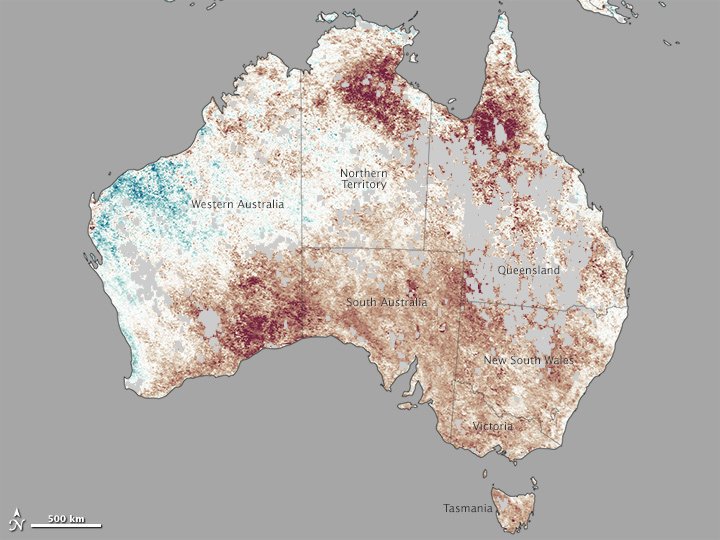
The report also made a starker point: “There have only been 21 days in 102 years where the average maximum temperature across Australia has exceeded 39°C; eight of these days happened this summer.”
High temperatures exacerbate fire danger, and the Australian summer of 2012/2013 brought major bushfires in New South Wales, Victoria, and Tasmania. Based on air temperature, humidity, drought, and wind speed, Australia’s forest fire danger index has historically used a scale from 1 to 100 to gauge the danger of bushfires. Starting in 2009, the index added a new fire danger rating above 100, termed “catastrophic,” reflecting a new fire-danger regime.
While some parts of Australia were on fire, other parts were under water. The Climate Commission discussed heavy rainfall, including torrential rains from cyclone Oswald that flooded parts of the Queensland coast in January 2013. The report stated that parts of the east coast broke rainfall records for the entire month in just the seven days of the storm. The report linked recent extreme rainfall events in eastern Australia to higher sea surface temperatures, which increase atmospheric water vapor and lead to greater precipitation.
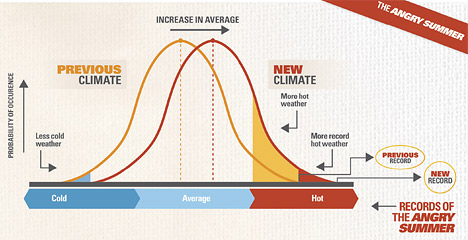
The Climate Commission pointed out that Australia’s average temperature has increased by 0.9°C (1.6°F) since 1910, and went on to say that, while that temperature increase might seem small, “When the average temperature shifts, the temperatures at the hot and cold ends (tails) of the temperature range shift too. A small increase in the average temperature creates a much greater likelihood of very hot weather and a much lower likelihood of very cold weather.”
See the full report at http://climatecommission.gov.au/report/the-angry-summer/
