















January Puzzler Answer: Ellesmere Island’s Oobloyah Valley
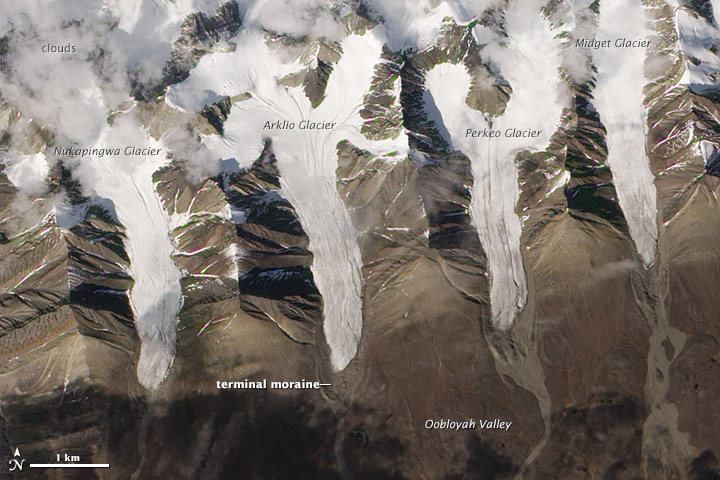
Congratulations to Dillion and Eric J.F. Kelijssen for solving the January Puzzler the fastest. The answer is Oobloyah Valley on Canada’s Ellesmere Island. The image features four glaciers—Nukapingwa, Arklio, Perkeo, and Midget—flowing into the valley from the Krieger mountains to the north. At the end of each glacier, all of which are retreating, there are heaps of rock, gravel, and sand known as terminal moraines. As we explained in our Image of the Day on January 18, 2014, the moraines are of interest to ecologists because they offer an ideal natural laboratory for studying how plant species colonize recently exposed terrain.
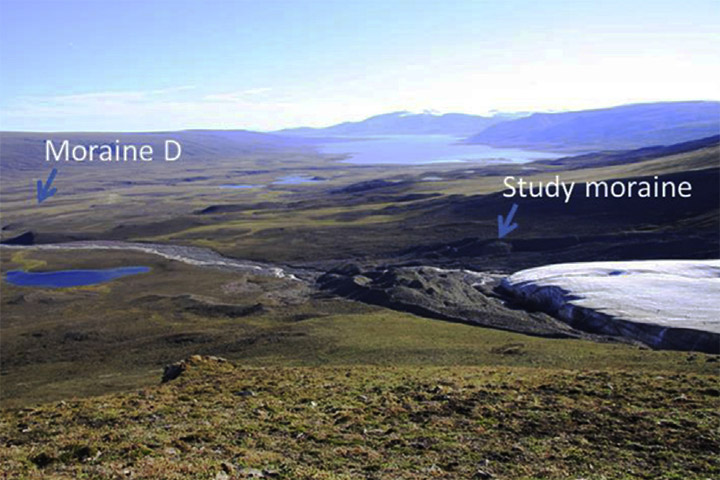
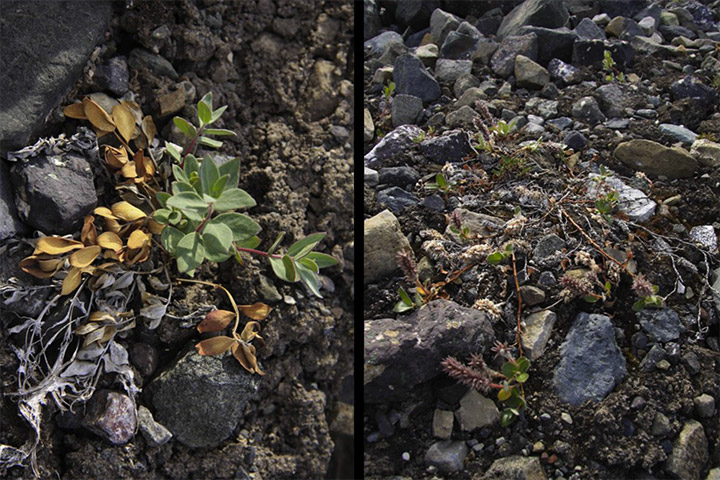
One team of researchers led by Yokohama National University’s Akira S. Mori focused their search for Arctic plants on the moraine created by Arklio Glacier, the second to the left in the image above. (The Advanced Land Imager acquired this image of the glacier on June 19, 2012.) The moraine, which formed during the Little Ice Age, appears as a lobe-shaped bulge around the end of glacier. The light brown feature south of the moraine is a stream bed. The scientists found two dominant pioneer species living on the rocky, virtually soil-free moraine. The first is Epilobium latifolium, a flowering plant in the evening primrose family known as Dwarf fireweed. The second is Salix arctic, a type of creeping willow.
See Arklio’s terminal moraine and Epilobium latifolium (right) and Salix arctic (left) in the photographs below.