











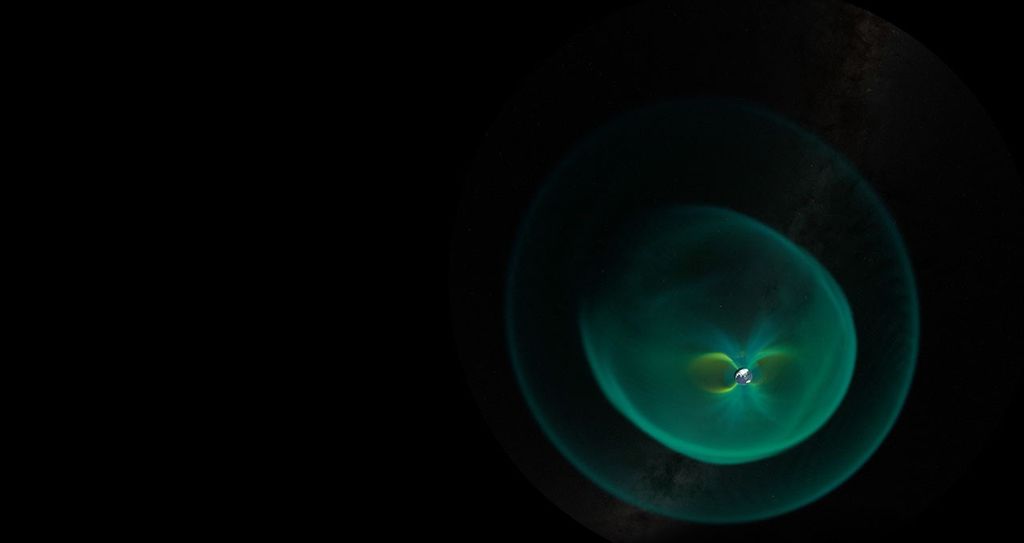











NASA’s Next-Gen Near-Earth Asteroid Space Telescope Takes Shape
The Near-Earth Object (NEO) Surveyor — NASA’s first infrared space telescope purposely designed to discover potentially hazardous asteroids and comets — is undergoing integration and testing. With launch set for no earlier than September 2027, teams across the United States are hard at work building the spacecraft’s components, planning the kind of survey and science it will do, and developing the software to process the huge quantity of data the mission will generate.
In 2005, Congress tasked NASA with discovering potentially hazardous near-Earth objects, or NEOs, but many of these objects are difficult to find with ground-based surveys. Some are as dark as charcoal, others are tiny, and many lurk in the glare of the Sun, where ground-based optical telescopes can’t see. To mitigate this, NEO Surveyor is being custom-built to scan the solar system to detect objects that will glow in the infrared as they are heated by the Sun — as opposed to the optical light they reflect, which is what ground-based surveys measure — to provide enough advance warning for humanity to do something about them, if necessary.
The spacecraft will travel about a million miles (1.5 million kilometers) from our planet in the direction of the Sun to a region of gravitational stability called the Sun-Earth Lagrange point (or L1 point), continuously scanning large swaths of the sky for at least five years in search of NEOs that have yet to be found.
“NEO Surveyor is a one-of-a-kind mission designed to solve a specific challenge: finding asteroids and comets that pose the greatest risk to Earth,” said Jim Fanson, the mission’s project manager at NASA’s Jet Propulsion Laboratory in Southern California. “Our focus is on deploying a robust observatory to the Sun-Earth L1 point, where it will conduct a continuous, multi-year infrared survey. By identifying objects that ground telescopes can miss, this mission will provide the critical data we need to safeguard our planet for years to come.”
Modular approach
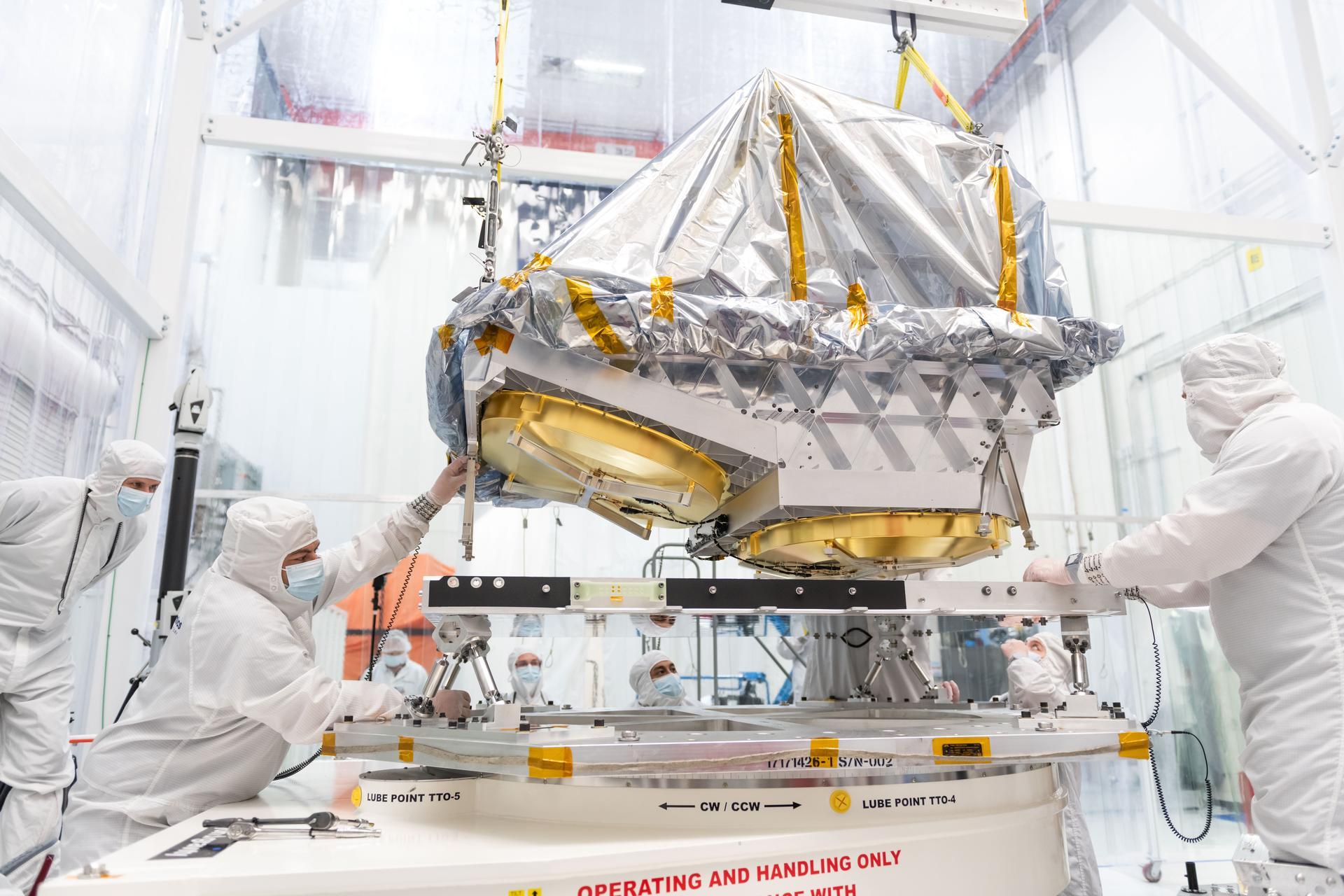
Having been assembled at JPL, both the spacecraft’s infrared telescope and its instrument enclosure are undergoing integration and testing at Utah State University’s Space Dynamics Laboratory (SDL) in Logan. An angular structure measuring 12 feet (3.7 meters) long, the instrument enclosure protects the spacecraft’s telescope and removes heat that could otherwise affect the heat-sensitive infrared observations. Project engineers plan to carry out focus tests in a chamber at SDL that simulates the extreme environment of deep space to ensure the instrument works as designed and the camera remains in focus at very cold temperatures and in zero gravity.
The camera is composed of two detector arrays, tuned to generate detailed images of asteroids and comets within two infrared bands. Each array creates a 16-megapixel mosaic of the sky. Imaging the same part of the sky over the two infrared bands enables the instrument to measure an asteroid or comet’s temperature, yielding an estimate of the object’s size.
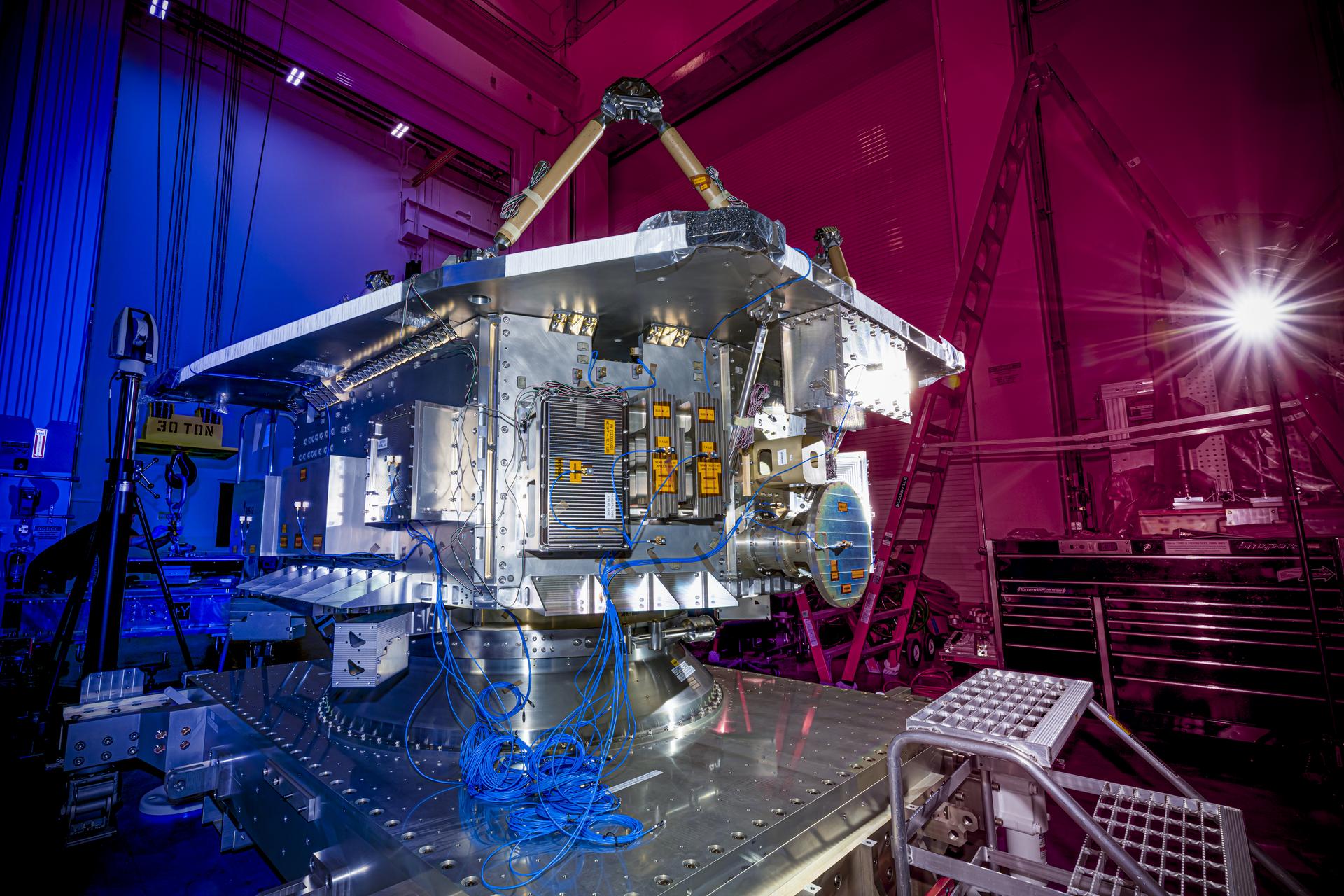
The spacecraft will also sport a 20-foot-long (6-meter-long) sunshade that allows it to look close to the Sun by blocking glare from entering the telescope’s aperture. By far the largest feature of NEO Surveyor, the structure also has solar panels on its Sun-facing surface to generate the electricity to power the spacecraft’s systems.
At BAE Systems Space & Mission Systems in Boulder, Colorado, the sunshade is currently undergoing tests with the spacecraft’s bus, which houses power, propulsion, avionics, and communication subsystems. The integrated telescope and enclosure will from SDL to travel to BAE Systems, where they will complete the spacecraft.
Science, data, survey strategy
Meanwhile, the mission’s science team is busy planning ways to harness the full capabilities of this cutting-edge spacecraft.
“We have a multi-institutional team, from seasoned scientists to undergraduate students, with a broad expertise in infrared mission design,” said Amy Mainzer, the mission’s lead at University of California, Los Angeles (UCLA). “We are currently working to develop the most efficient survey strategy that the mission will use to detect some of the hardest-to-find asteroids in our solar system, plus any comets that may be headed our way.”
When the mission’s data comes to Earth via NASA’s Deep Space Network, it will go to the NEO Surveyor Survey Data Center at Caltech’s IPAC in Pasadena, California. Responsible for processing and calibrating the huge number of observations that the spacecraft delivers, the center will also produce images and source catalogs for archiving at the NASA/IPAC Infrared Science Archive.
After identifying the moving objects in the data, IPAC will report them to the Minor Planet Center (MPC), the international clearinghouse for all position measurements of minor bodies in our solar system and responsible entity for designating new discoveries. This data can then be used by planetary defense groups, including JPL’s Center for Near Earth Object Studies (CNEOS), which calculates the orbits for all known asteroids and comets while also predicting the impact risk for hazardous objects many years into the future. The Department of Earth, Planetary, and Space Sciences at UCLA will plan the survey and deliver measurements of the asteroid and comet sizes and other physical properties to public archives every six months.