
















Suggested Searches

New Horizons

    Radio Signals from Earth Probe Pluto’s Atmosphere
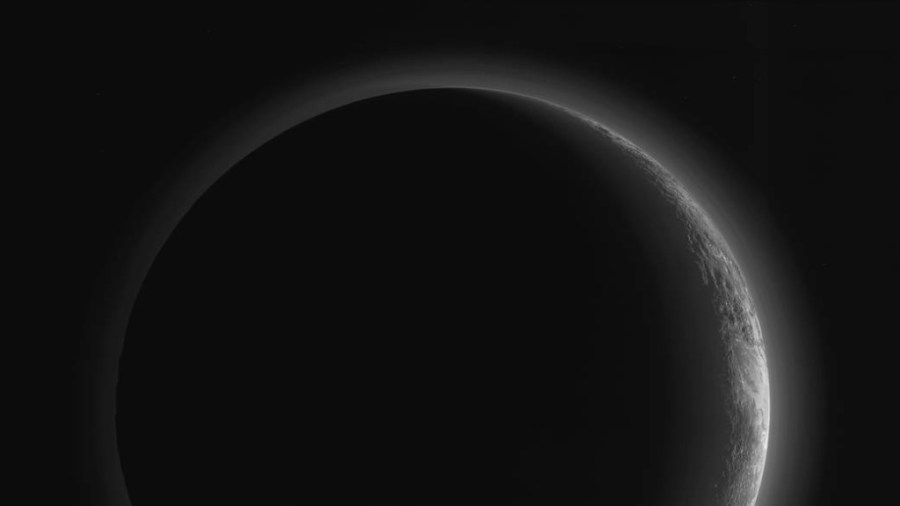
    Pluto's atmosphere

    Today's post is from William Woods, a doctoral candidate in Electrical Engineering at Stanford University. He investigates radioscience and remote sensing, with a focus on signal processing for the radioscience experiment (REX) onboard New Horizons. He studies both engineering and science under Dr. Ivan Linscott and Dr. Howard Zebker at Stanford. I study remote sensing …

    Read Full Post

    In the Shadows of Pluto and Charon

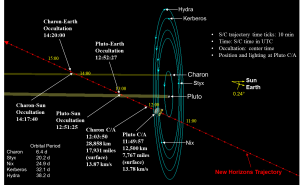
    occultations of Pluto and Charon

    Today's post is written by Josh Kammer, a New Horizons postdoctoral researcher at the Southwest Research Institute (SwRI) in Boulder, Colorado. Josh came to SwRI directly after his PhD in planetary science from Caltech; his undergrad work in chemistry was at Texas A&M. Josh's work on New Horizons focuses on analysis of ultraviolet spectra acquired …

    Read Full Post

    A Planet for All Seasons

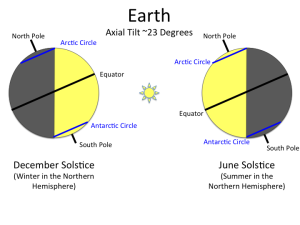
    Earth diagram

    Today's post is written by one of the early career members of the New Horizons Science Team. Alissa Earle is a graduate student in Planetary Science at the Massachusetts Institute of Technology. Her work focuses on the long-term seasonal variations that may be affecting what we see on Pluto's surface. Pluto's diverse surface, typified by …

    Read Full Post

    The Impact of Craters

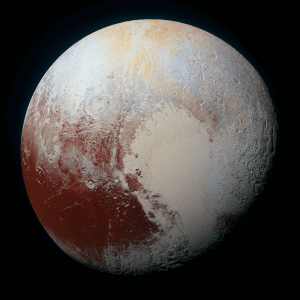
    Pluto

    Hello! It's Kelsi Singer again from the New Horizons science team to talk about one of my favorite planetary geologic features –impact craters. They may just look like holes in the ground, but amazingly, craters can give us all sorts of useful clues to a planet's history. There are many ways scientists investigate a planet …

    Read Full Post

    Pluto’s Small Moons Nix and Hydra

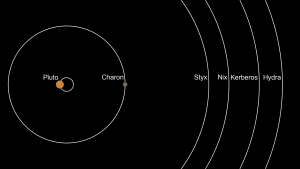
    Pluto schematic

    Today's post is written by Simon Porter, a New Horizons postdoctoral researcher at the Southwest Research Institute in Boulder, Colorado. Simon's work focuses on the small satellites of Pluto. This week's beautiful Charon images remind us that Pluto is not just one body; it's a whole system of worlds. Pluto and its largest moon Charon …

    Read Full Post

    Pluto at Twilight

    Pluto landscape in twilight

    Today's post is written by Alex Parker, a research scientist at the Southwest Research Institute in Boulder, Colorado, working on NASA's New Horizons mission. It's approaching dusk on an alien world, and the only eyes to witness the scene belong to a machine that has traveled billions of miles to be here at just this …

    Read Full Post

    Art Meets Science in New Pluto Aerial Tour

    pluto-flyby

    I'm Stuart Robbins, a research scientist at the Southwest Research Institute in Boulder, Colorado. NASA's New Horizons spacecraft made hundreds of individual observations during its flyby of the Pluto system in mid-July. The spacecraft is now sending back lots of image and composition data; over the past two weeks, New Horizons has returned to Earth …

    Read Full Post

    New Horizons Probes the Mystery of Charon’s Red Pole

    Pluto's moon Charon

    Hi, I'm Carly Howett, a senior research scientist at the Southwest Research Institute in Boulder, Colorado. I've been working on NASA's New Horizons mission since 2012, focusing on an instrument named Ralph, which among other things provides the color "eyes" for the spacecraft. When I started looking at Ralph images of Pluto and its largest …

    Read Full Post

    To Pluto and Beyond: Animating New Horizons’ Flight Through the Pluto System

    Stuart Robbins

    An exhilarating, pioneering journey came to fruition on July 14, 2015, as NASA's New Horizons spacecraft made its successful flight through the Pluto system, recording 60 gigabits of data that it is beginning to send to Earth. I'm Stuart Robbins, a research scientist at the Southwest Research Institute in Boulder, Colorado. While I only came onto …

    Read Full Post