

Countdown clocks are holding for 15 minutes in the final built-in hold of the night.
T-4 Minutes and Holding
Read Full Post














Countdown clocks are holding for 15 minutes in the final built-in hold of the night.
Although the countdown will pause at the T-4 minute mark, the team's work will not. During this 15-minute planned hold, we can expect to hear final readiness polls as NASA Launch Manager Tim Dunn and ULA Launch Conductor Scott Barney verify OSIRIS-REx, the Atlas V rocket and the Eastern Range are ready to proceed.
Weather conditions remain favorable for liftoff at 7:05 p.m. EDT. "All [launch commit criteria] are ‘go' and expected to remain ‘go' for the remainder of the countdown," Launch Weather Officer Clay Flinn told controllers.

OSIRIS-REx is headed to Bennu, a roughly spherical asteroid measuring about 1,614 feet (492 meters) in diameter. All asteroids represent remnants of the building blocks of our solar system, so why did scientists decide to send a mission to this one? Location, location, location. For a sample return mission, accessibility is key. Bennu travels in …

Overall mission management for OSIRIS-REx, including systems engineering as well as safety and mission assurance, is provided by NASA's Goddard Space Flight Center in Greenbelt, Maryland. Dante Lauretta is the mission's principal investigator at the University of Arizona, and the spacecraft was built by Lockheed Martin Space Systems in Denver. Launch management is the responsibility …

In the image above from NASA TV, viewers can clearly see gaseous oxygen venting away from the Atlas V booster. This is normal and is caused when small amounts of cryogenic liquid oxygen boil off and are vented away. "All the fueling operations have gone perfectly fine today," NASA Launch Commentator Mike Curie reported.
Tonight's launch window opens at 7:05 p.m. EDT, one hour from now. All activities are on schedule for liftoff of the United Launch Alliance Atlas V 411 rocket carrying NASA's OSIRIS-REx spacecraft from Space Launch Complex 41.
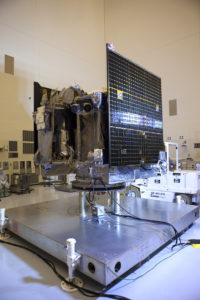
Built by Lockheed Martin Space Systems in Denver, Colorado, the spacecraft measures 10.33 by 8 feet and will be powered in space by two solar panels generating 1,226 watts to 3,000 watts, depending on the distance from the sun. With both of its arrays deployed, the spacecraft extends to 20.25 feet long. Learn more about …
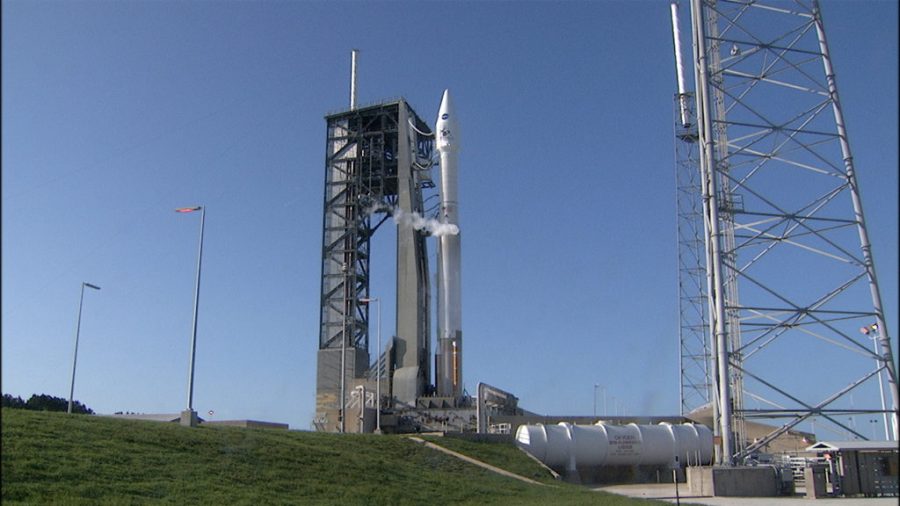
Countdown clocks just passed the T-1 hour mark and activities are proceeding smoothly. Tanking operations continue, and in case you missed it, Launch Weather Officer Clay Flinn has upgraded the forecast to reflect a 90 percent chance of "go" weather at the 7:05 p.m. liftoff time. Image from NASA TV
