


















NASA’s Psyche Mission to Fly by Mars for Gravity Assist
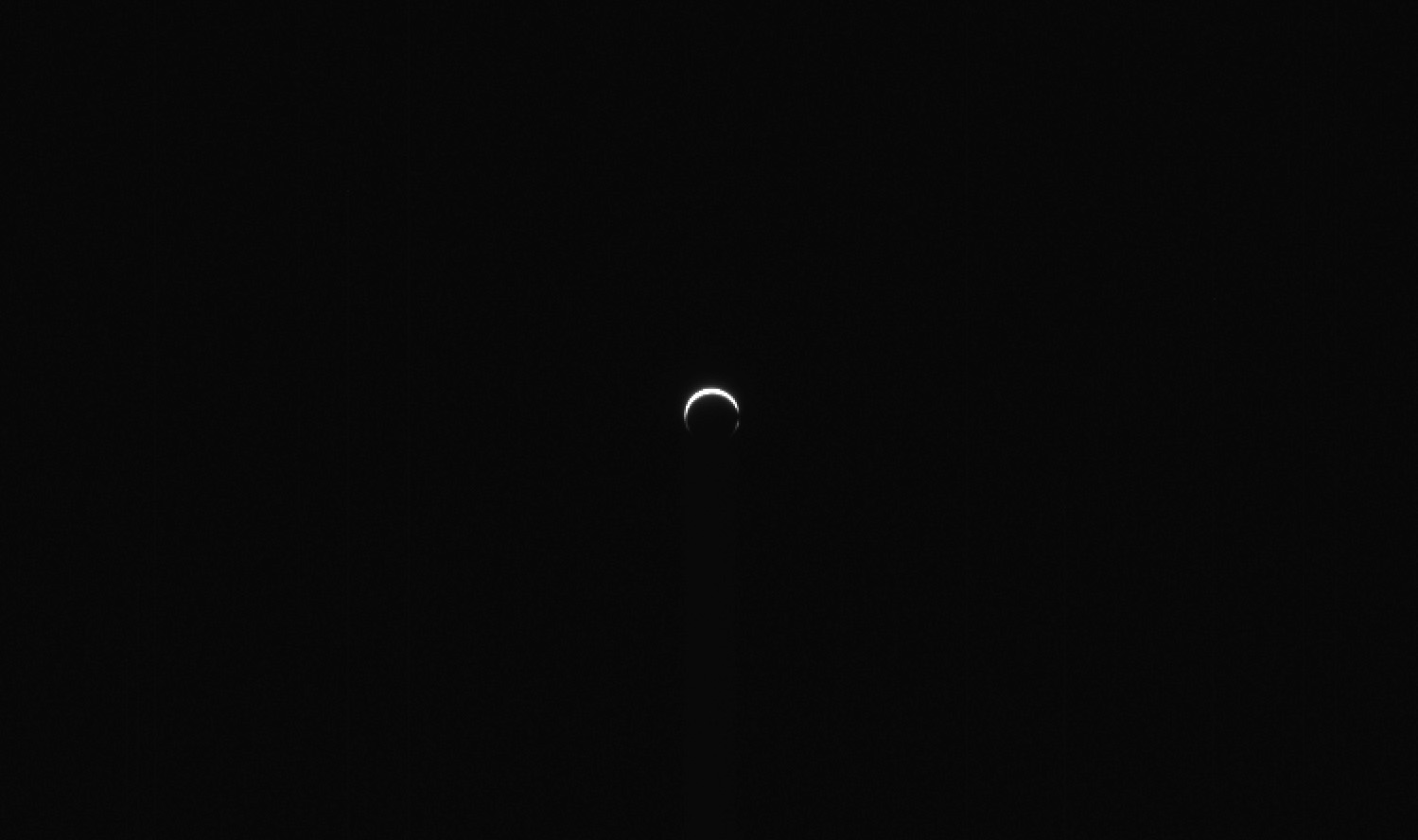
NASA’s Psyche spacecraft will get a boost from Mars on Friday, May 15, passing just 2,800 miles (4,500 kilometers) from the planet’s surface at some 12,333 mph (19,848 kph). The spacecraft will harness the planet’s gravitational pull to speed up and adjust its trajectory toward the metal-rich asteroid Psyche, one of the more unusual objects in our solar system.
Launched on Oct. 13, 2023, the Psyche spacecraft relies on a solar-electric propulsion system and the inert gas xenon for propellant, gradually gaining speed over the course of its long journey. Psyche’s mission planners are using the Mars flyby to save propellant, letting the planet’s gravity do some of the work instead of the propulsion system alone. But gravity assists like these also offer opportunities for missions to practice and to calibrate their science instruments.
Psyche’s operations team plans to use the spacecraft’s multispectral imager to capture thousands of observations of Mars. The images will provide valuable data and help the team hone techniques they will need when the spacecraft approaches and begins orbiting the asteroid Psyche in late 2029.
Observations from the spacecraft are already coming in from the imager. Beginning on May 7, the first unprocessed, or “raw,” images of a starfield, including a tiny Mars, appeared on the mission’s website. Mission specialists will process views of the encounter, balancing for brightness and contrast, and they expect to develop a time-lapse of the flyby in the coming weeks.
To prepare for the Mars encounter, the operations team conducted a trajectory correction maneuver on Feb. 23, firing the spacecraft’s thrusters for 12 hours to increase speed and refine its approach to the planet.
“We are now exactly on target for the flyby, and we’ve programmed the flight computer with everything that the spacecraft will do throughout May,” said Sarah Bairstow, Psyche’s mission planning lead at NASA’s Jet Propulsion Laboratory in Southern California, which manages the mission. “This is our first opportunity in flight to calibrate Psyche’s imager with something bigger than a few pixels, and we’ll also make observations with the mission’s other science instruments.”
Credit: NASA/JPL-Caltech/ASU/True Story Films
What Psyche will see
Mars won’t initially look like the illuminated reddish disk seen in so many photos of the planet. “We are approaching Mars at a very high phase angle, which means we are catching up with the planet from its night side with only a sliver of sunlight creating a thin crescent,” said Jim Bell, the Psyche imager instrument lead at Arizona State University in Tempe. “The thin crescent on approach and the nearly ‘full Mars’ view after we fly past create opportunities for the imaging team for both great calibration observations as well as just plain beautiful photos.”
It’s possible that Mars may possess a faint dusty ring, or torus — the result of micrometeorites striking the surfaces of the planet’s two moons, Phobos and Deimos, and ejecting dust particles into space. The Sun’s alignment with Psyche and Mars may cause dusty material to scatter sunlight, making it visible in the processed observations.
The imager will also capture “satellite search” observations of the space surrounding the planet — a practice run for when the team will be searching for any moonlets around the asteroid Psyche. There could be an opportunity to learn more about Mars as well. The spacecraft’s magnetometer will likely detect the planet’s magnetic field redirecting charged particles from the Sun, and the gamma-ray and neutron spectrometer will monitor how the flux of cosmic rays (highly energetic subatomic particles from interstellar space) changes during the flyby.
“Ultimately, though, the only reason for this flyby is to get a little help from Mars to speed us up and tilt our trajectory in the direction of the asteroid Psyche,” said Lindy Elkins-Tanton, principal investigator for Psyche at the University of California, Berkeley. “But if all our instruments are powered up, and we can do important testing and calibration of the science instruments, that would be the icing on the cake.”

Tracking Psyche
To confirm that the flyby was a success, the mission team will be monitoring the radio frequency signals traveling to and from Psyche through NASA’s Deep Space Network (DSN). Any change in spacecraft speed will be recorded in the Doppler shift of the signals from the spacecraft as it passes Mars, so its new speed and trajectory will be quickly known as Psyche departs Mars and continues its journey to the main asteroid belt.
Several Mars missions — NASA’s Mars Reconnaissance Orbiter, Mars Odyssey orbiter, and Curiosity and Perseverance rovers, along with ESA’s (European Space Agency) Mars Express and ExoMars Trace Gas Orbiter — will also provide complementary surface and atmospheric imaging observations as well as navigation data during the flyby. Comparing Psyche’s images and other data to measurements from these missions will help the team calibrate their instruments, and synchronized radio communications with the DSN will help the planning for future spacecraft approaching Mars.