




























APOD
Astronomy Picture of the Day
Discover the cosmos! Each day a different image or photograph of our fascinating universe is featured, along with a brief explanation written by a professional astronomer.
Ultra-Fast Pulsar
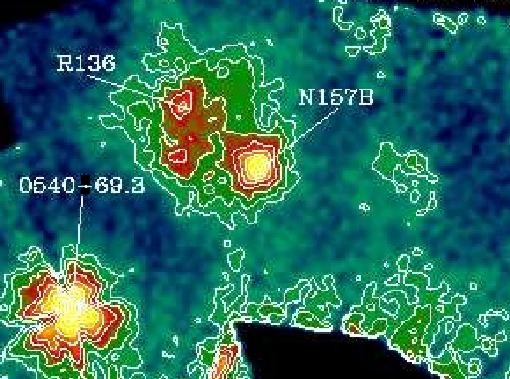
Explanation: Pulsars are rotating neutron stars , born in the violent crucibles of supernova explosions . Like cosmic lighthouses , beams of radiation from surface hotspots sweep past our viewpoint creating pulses which reveal the rotation rates of these incredibly dense stellar corpses . The most famous pulsar of all is found in the nearby supernova remnant, the Crab Nebula . The Crab's young pulsar is fast. Rotating at 33 times a second, its radiation energizes the surrounding gaseous stellar debris . But using archival observations from orbiting X-ray telescopes , astronomers have recently identified another “Crab-like” pulsar that is even faster. Located in the Large Magellanic Cloud (LMC) , X-ray pulses from this newly discovered pulsar, in the supernova remnant N157B , indicate an even faster rotation rate - 62 times a second - making it the fastest known pulsar associated with a supernova remnant . This contoured, false color X-ray image of a portion of the LMC shows the location of N157B along with the core of the nearby hot star cluster R136 , and the site of another Crab-like pulsar in SNR 0540-69.3 (rotating a mere 20 times a second). The image is about 1,500 light-years across.
| Date | February 11, 1998 |
|---|---|
| Credit | Credit: E. V. Gotthelf (LHEA, GSFC) Q. D. Wang (Northwestern Univ.), ASCA |
| Authors & editors: | Robert Nemiroff (MTU) & Jerry Bonnell (UMCP) |
| A service of: |
ASD at NASA / GSFC, NASA Science Activation & Michigan Tech. U. |