




















APOD
Astronomy Picture of the Day
Discover the cosmos! Each day a different image or photograph of our fascinating universe is featured, along with a brief explanation written by a professional astronomer.
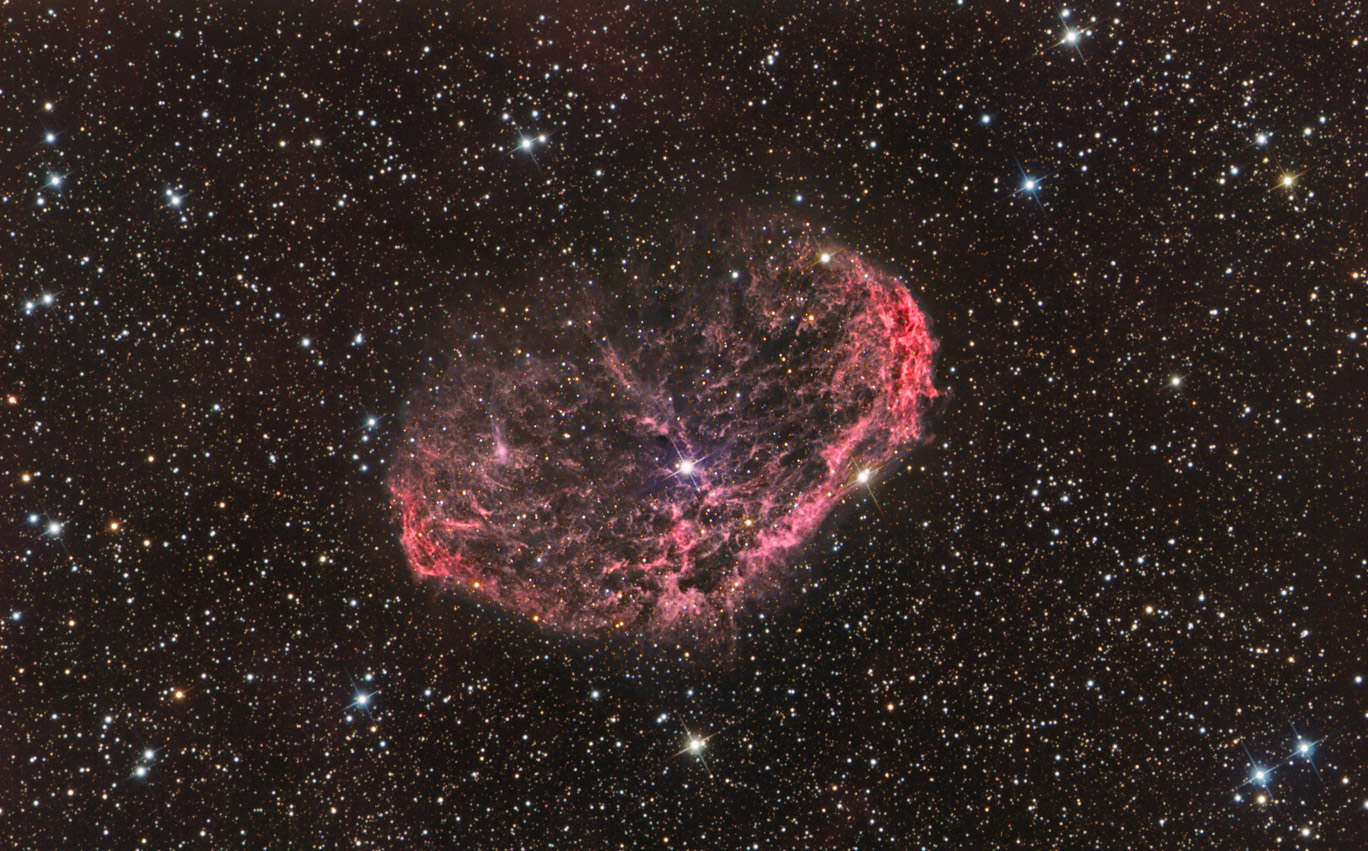
NGC 6888: The Crescent Nebula
Explanation: What caused the Crescent Nebula? Looking like an emerging space cocoon , the Crescent Nebula, visible in the center of the above image , was created by the brightest star in its center. A leading progenitor hypothesis has the Crescent Nebula beginning to form about 250,000 years ago. At that time, the massive central star had evolved to become a Wolf-Rayet star (WR 136), shedding its outer envelope in a strong stellar wind , ejecting the equivalent of our Sun's mass every 10,000 years. This wind impacted surrounding gas left over from a previous phase , compacting it into a series of complex shells , and lighting it up. The Crescent Nebula , also known as NGC 6888, lies about 4,700 light-years away in the constellation of Cygnus . Star WR 136 will probably undergo a supernova explosion sometime in the next million years.
| Date | November 11, 2007 |
|---|---|
| Credit | Credit & Copyright: Franck Bugnet |
| Authors & editors: | Robert Nemiroff (MTU) & Jerry Bonnell (UMCP) |
| A service of: |
ASD at NASA / GSFC, NASA Science Activation & Michigan Tech. U. |