




























APOD
Astronomy Picture of the Day
Discover the cosmos! Each day a different image or photograph of our fascinating universe is featured, along with a brief explanation written by a professional astronomer.
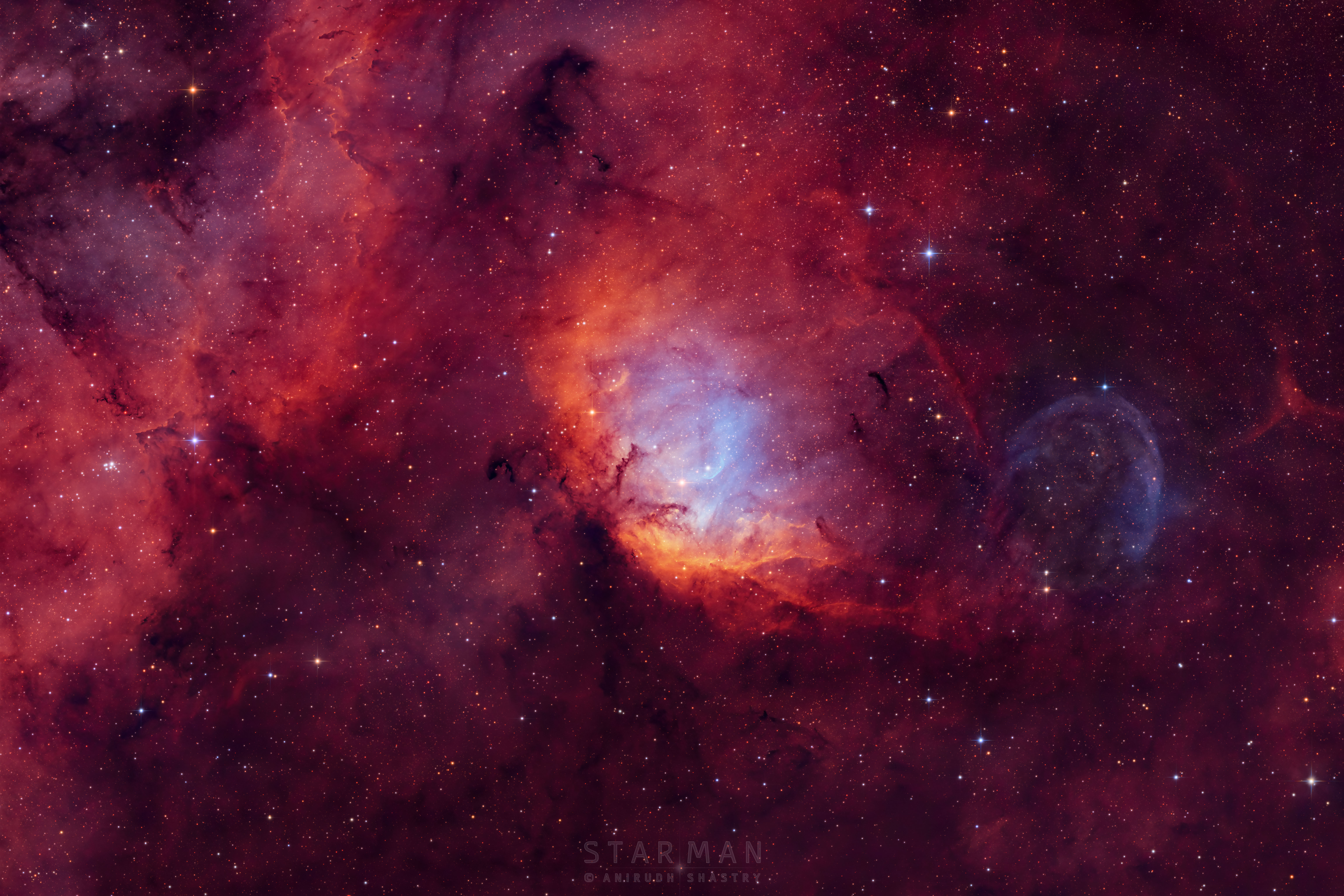
Tulip Nebula and Black Hole Cygnus X-1
Explanation: When can you see a black hole, a tulip, and a swan all at once? At night -- if the timing is right, and if your telescope is pointed in the right direction . The complex and beautiful Tulip Nebula blossoms about 8,000 light-years away toward the constellation of Cygnus the Swan. Ultraviolet radiation from young energetic stars at the edge of the Cygnus OB3 association , including O star HDE 227018, ionizes the atoms and powers the emission from the Tulip Nebula. Stewart Sharpless cataloged this nearly 70 light-years across reddish glowing cloud of interstellar gas and dust in 1959 , as Sh2-101 . Also in the featured field of view is the black hole Cygnus X-1 , which is also a microquasar because it is one of strongest X-ray sources in planet Earth's sky. Blasted by powerful jets from a lurking black hole , its fainter bluish curved shock front is only faintly visible beyond the cosmic Tulip's petals, near the right side of the frame.
Back to School? Learn Science with NASA
| Date | August 28, 2024 |
|---|---|
| Credit | Image Credit & Copyright: Anirudh Shastry |
| Authors & editors: | Robert Nemiroff (MTU) & Jerry Bonnell (UMCP) |
| A service of: |
ASD at NASA / GSFC, NASA Science Activation & Michigan Tech. U. |