






















APOD
Astronomy Picture of the Day
Discover the cosmos! Each day a different image or photograph of our fascinating universe is featured, along with a brief explanation written by a professional astronomer.
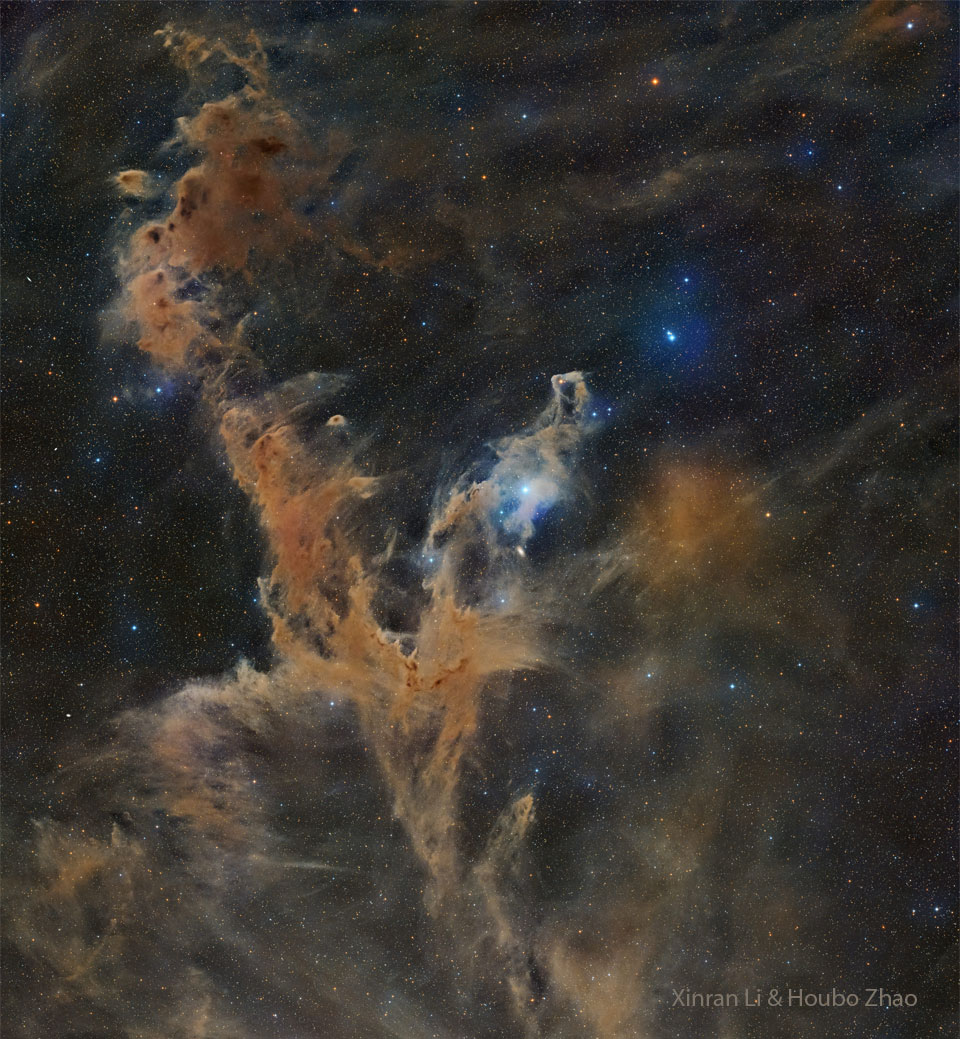

Chamaeleon Dark Nebulas
Explanation: Sometimes the dark dust of interstellar space has an angular elegance. Such is the case toward the far-south constellation of Chamaeleon . Normally too faint to see , dark dust is best known for blocking visible light from stars and galaxies behind it. In this 11.4-hour exposure , however, the dust is seen mostly in light of its own, with its strong red and near- infrared colors creating a brown hue. Contrastingly blue, a bright star Beta Chamaeleontis is visible on the upper right of the V, with the dust that surrounds it preferentially reflecting blue light from its primarily blue-white color. All of the pictured stars and dust occur in our own Milky Way Galaxy with one notable exception : a white spot just below Beta Chamaeleontis is the galaxy IC 3104 , which lies far in the distance. Interstellar dust is mostly created in the cool atmospheres of giant stars and dispersed into space by stellar light, stellar winds , and stellar explosions such as supernovas .
| Date | November 19, 2025 |
|---|---|
| Credit | Image Credit & Copyright: Xinran Li & Houbo Zhao |
| Authors & editors: | Robert Nemiroff (MTU) & Jerry Bonnell (UMCP) |
| A service of: |
ASD at NASA / GSFC, NASA Science Activation & Michigan Tech. U. |