











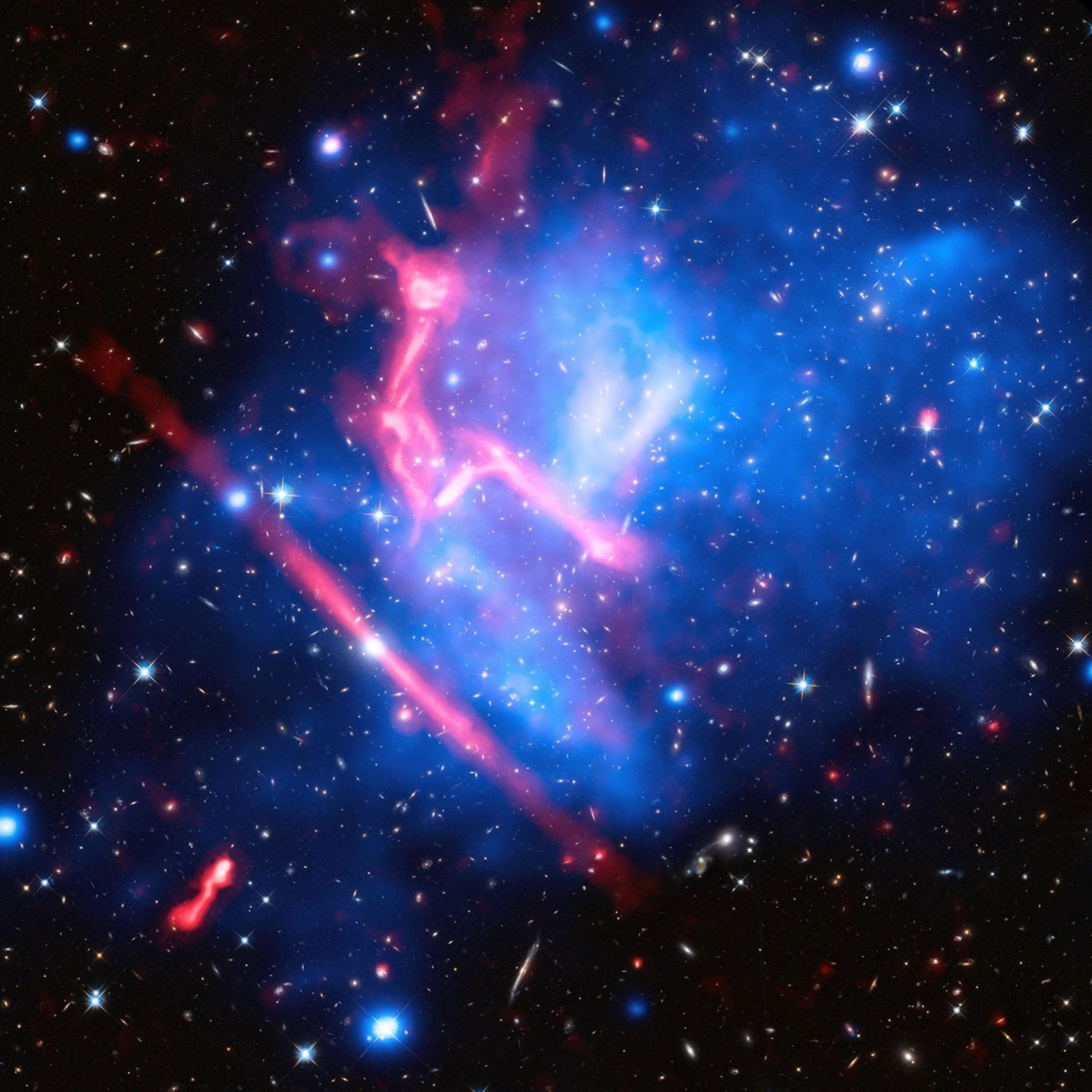
Galaxy Cluster MACS J0717.5+3745 in Multiple Wavelengths
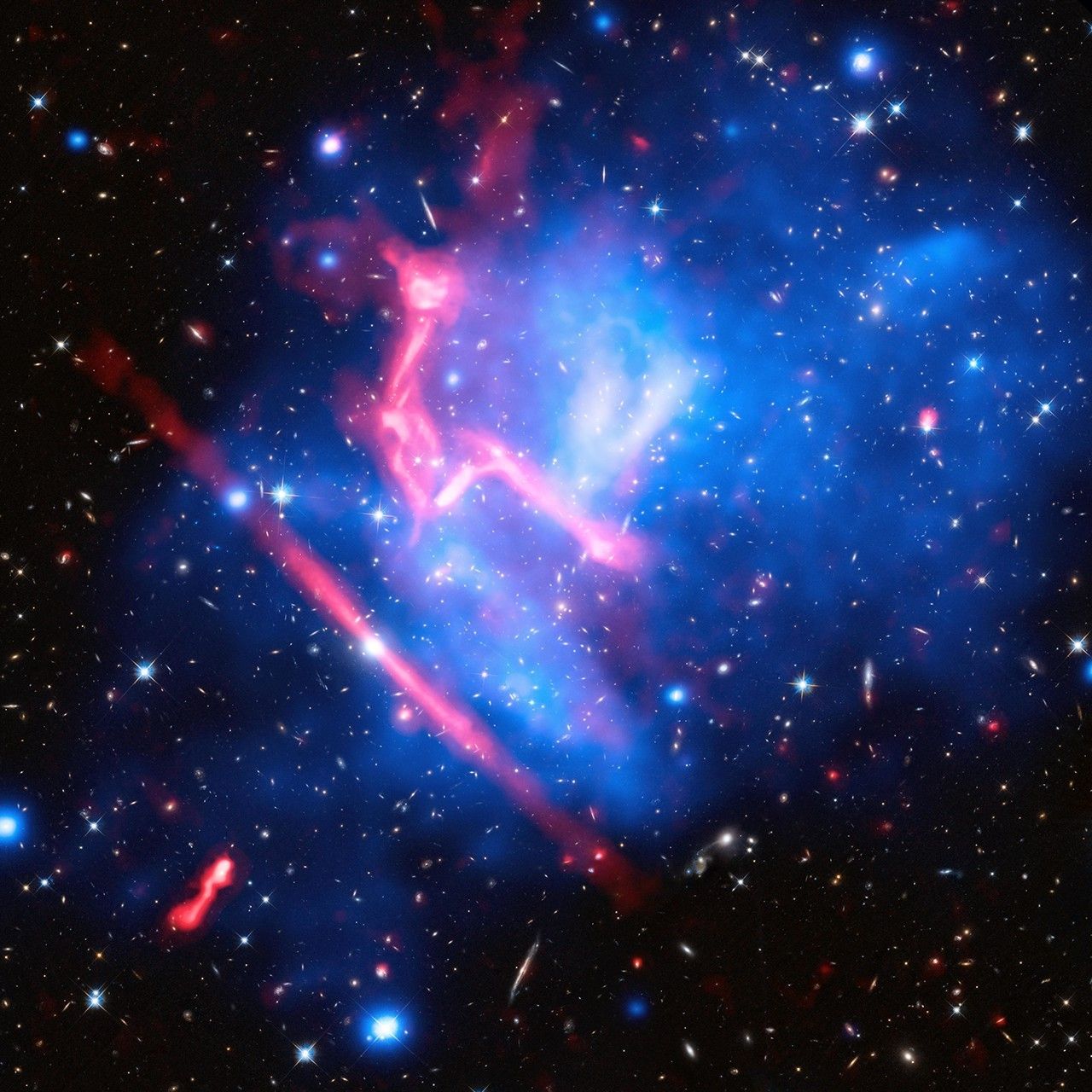
Galaxy clusters are enormous collections of hundreds or even thousands of galaxies and vast reservoirs of hot gas embedded in massive clouds of dark matter, invisible material that does not emit or absorb light but can be detected through its gravitational effects. MACS J0717.5+3745, one of the most complex and distorted galaxy clusters known, is the site of a collision between four clusters. It is located about 5.4 billion light-years away from Earth. This image of MACS J0717 contain data from two other telescopes in addition to the Hubble Space Telescope: NASA's Chandra X-ray Observatory (diffuse emission in blue), Hubble Space Telescope (red, green, and blue), and the National Science Foundation's Karl G. Jansky Very Large Array (diffuse emission in pink). Where the X-ray and radio emission overlap, the image appears purple.
Image Credit: NASA, ESA, CXC, NRAO/AUI/NSF, STScI, R. van Weeren (Harvard-Smithsonian Center for Astrophysics), and G. Ogrean (Stanford University); Acknowledgment: NASA, ESA, J. Lotz (STScI), and the HFF team
- X
https://science.nasa.gov/image-detail/amf-8ea83a70-8ffa-48b0-9664-3dea6e7cadbf/
Image CreditNASA, ESA, CXC, NRAO/AUI/NSF, STScI, R. van Weeren (Harvard-Smithsonian Center for Astrophysics), and G. Ogrean (Stanford University); Acknowledgment: NASA, ESA, J. Lotz (STScI), and the HFF team
Size3600x3600px