















Ghost Head Nebula
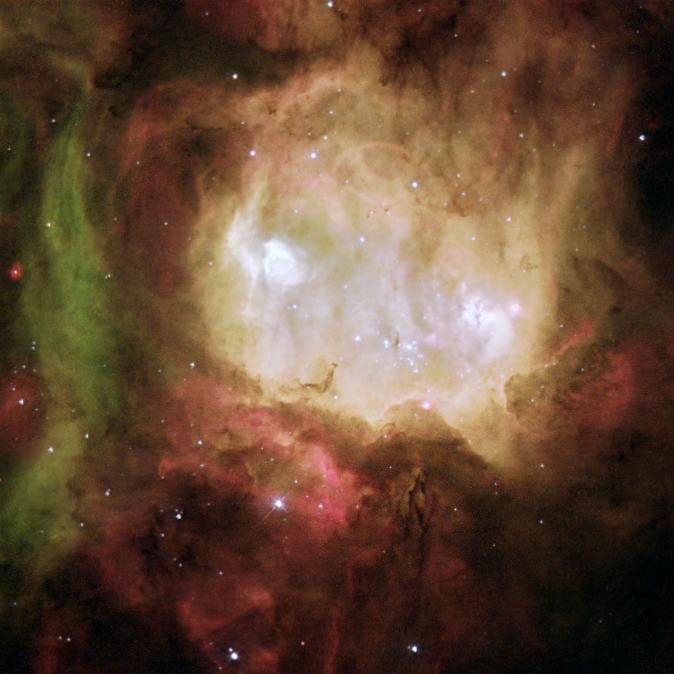
This image from NASA's Hubble Space Telescope reveals a vibrant nebula far from Earth. Its colors, produced by the light emitted by oxygen and hydrogen, help astronomers investigate the star-forming processes in nebulae such as NGC 2080. Nicknamed the Ghost Head Nebula, NGC 2080 is part of a chain of star-forming regions south of the 30 Doradus nebula in the Large Magellanic Cloud that have attracted special attention. These regions have been studied in detail with Hubble and have long been identified as unique star-forming sites. 30 Doradus is the largest star-forming complex in the whole Local Group of galaxies. The light from the nebula captured in this image is emitted by two elements, hydrogen and oxygen. The red and the blue light are from regions of hydrogen gas heated by nearby stars. The green light on the left comes from glowing oxygen, energized by a powerful stellar wind (a stream of high-speed particles) coming from a massive star just outside the image. The white region in the center is a combination of all three emissions and indicates a core of hot, massive stars in this star-formation region. The intense emission from these stars has carved a bowl-shaped cavity in the surrounding gas.
Image Credit: NASA, ESA & Mohammad Heydari-Malayeri (Observatoire de Paris, France)
- X
https://science.nasa.gov/image-detail/amf-bbb156e6-f571-4209-960f-8c213c30289d/
Image CreditNASA, ESA & Mohammad Heydari-Malayeri (Observatoire de Paris, France)
Size674x674px