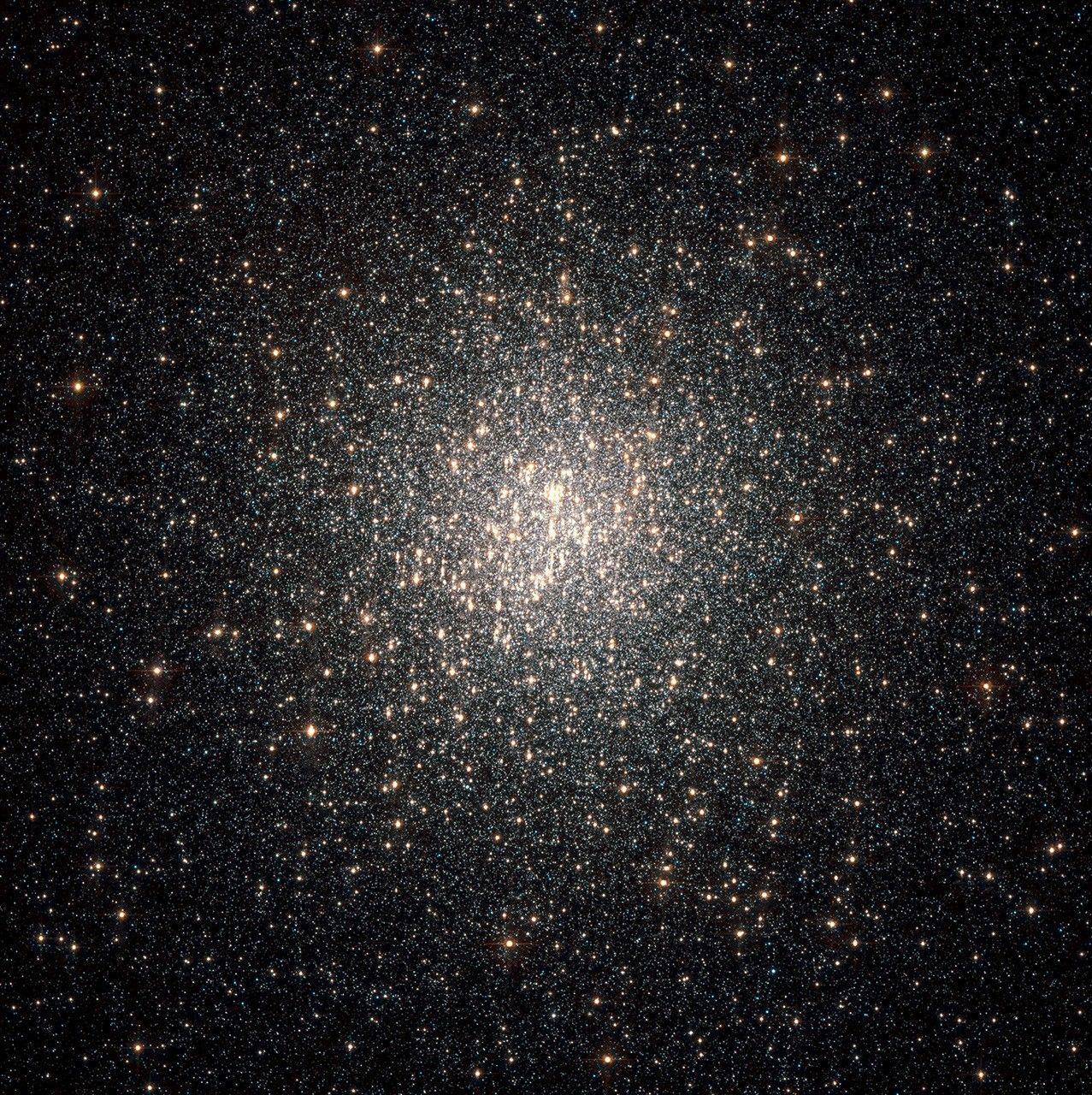

















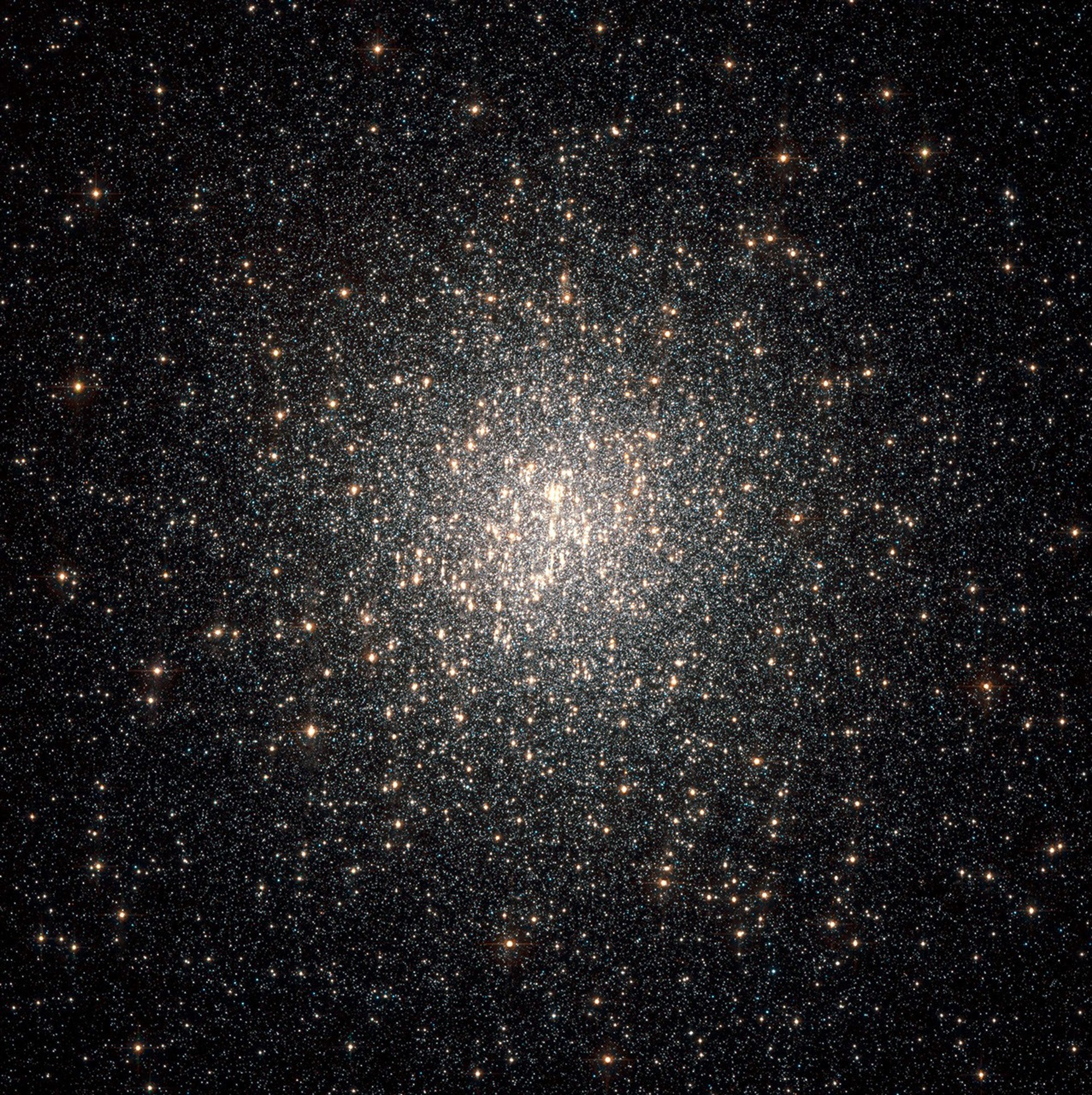
Globular Cluster NGC 2808
This Hubble Space Telescope image of a dense swarm of stars shows the central region of the globular cluster NGC 2808. Astronomers were surprised to identify three generations of cluster stars within NGC 2808. The discovery is far different from the standard picture of a globular cluster. For decades, astronomers thought that cluster stars formed at the same time, in the same place, and from the same material, and have co-evolved for billions of years. Globular clusters are the homesteaders of our Milky Way Galaxy, born during our galaxy's formation. They are compact swarms of typically hundreds of thousands of stars held together by gravity. All the stars in NGC 2808 were born very early in the life of the 12.5-billion-year-old massive cluster. Of the about 150 known globular clusters in our Milky Way Galaxy, NGC 2808 is one of the most massive, containing more than 1 million stars.
Image Credit: NASA, ESA, A. Sarajedini (University of Florida) and G. Piotto (University of Padua [Padova]);
- X
https://science.nasa.gov/image-detail/amf-cdd95cc3-ec5a-4d22-b091-1f7d40259cc6/
Image CreditNASA, ESA, A. Sarajedini (University of Florida) and G. Piotto (University of Padua [Padova]);
Size3856x3864px