









IRIS
Interface Region Imaging Spectrograph
IRIS: Studying the Energy Flow that Powers the Solar Atmosphere
IRIS (Interface Region Imaging Spectrograph) teases out the rules governing the lowest layers of the solar atmosphere — historically some of the hardest to untangle.
Video credit: NASA's Goddard Space Flight Center
Overview
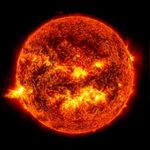
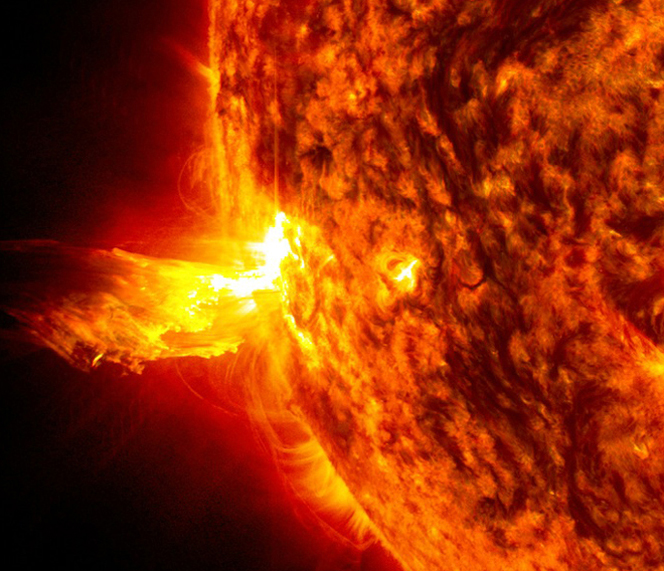
NASA's Interface Region Imaging Spectrograph (IRIS) is an Earth-orbiting observatory designed to study the Sun's lower atmosphere, specifically the poorly understood "interface region," which includes the chromosphere and transition region.
The central mystery the IRIS mission addresses is why the Sun's outer atmosphere, the corona, is so much hotter than its surface. Temperatures rapidly climb from thousands of degrees at the solar surface (which is 5,500º C or 9,900º F) to millions of degrees in the corona, sometimes reaching tens of millions of degrees during solar flares. This intense heating process begins in the lower-lying chromosphere and transition region, which are cooler than the corona but still part of this dramatic temperature gradient.
The primary goal of the IRIS mission is to investigate this phenomenon by studying how solar material moves, accumulates energy, and heats up as it traverses the interface region that lies between the solar surface and the corona. To achieve this, the mission gathers unique data: light spectra and images of the chromosphere and transition region. This vital data not only helps explain the heating of the solar atmosphere but also contributes to a better understanding of solar storms, enabling more accurate predictions by observing the hottest gases generated during solar explosions like flares and nanojets.
The IRIS mission was launched in 2013 as part of NASA’s Small Explorer Mission program, a commitment to relatively small, specialized, and cost-effective spacecraft. It joins NASA’s fleet of heliophysics missions studying a vast interconnected system from the space surrounding Earth and other planets to the farthest limits of the Sun’s constantly flowing stream of solar wind.
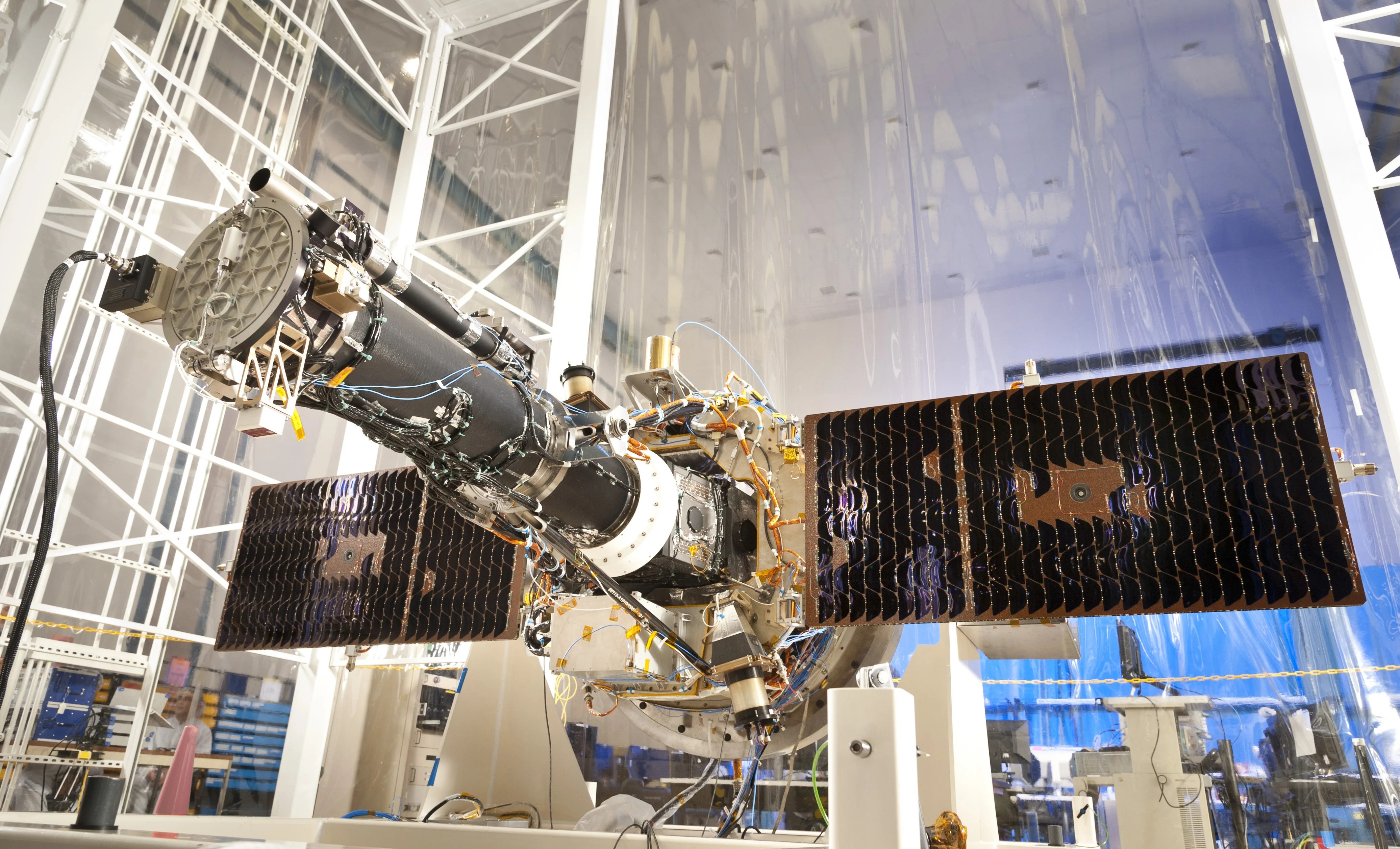
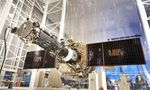
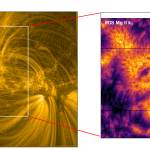
The observatory itself is roughly 2.1 meters (7 feet) long, with solar panels roughly 3.7 meters (12 feet) across, meaning the entire spacecraft could fit into a large living room. The IRIS spacecraft carries a single 20-centimeter (8-inch) ultraviolet (UV) telescope, along with instruments designed to analyze the spectrum of light and to take images. The spacecraft includes high-resolution instruments that allow scientists to distinguish features as small as 150 miles across within the solar atmosphere. The IRIS mission can only image about one percent of the Sun’s surface at one time, so scientists use IRIS to target specific regions on the Sun. The UV spectrum is the key to studying the motion of particles in the interface region, which in turn reveals how the region heats up — and which processes are heating it up.
To help analyze observations of the solar atmosphere from IRIS, researchers use sophisticated three-dimensional supercomputer models of the solar atmosphere, providing important information about how this mysterious part of the Sun’s atmosphere works.
All the IRIS data is publicly available and can be accessed at the IRIS Data Archive at Lockheed Martin Solar & Astrophysics Lab.
Science Goals and Objectives
- Which types of non-thermal energy dominate in the chromosphere and beyond?
- How does the chromosphere regulate mass and energy supply to the corona and heliosphere?
- How do magnetic flux and matter rise through the lower atmosphere, and what role does flux emergence play in flares and mass ejections?
Stats
| Nation | United States of America (USA) |
| Location | Earth Orbit |
| Spacecraft | Explorer XCIV |
| Spacecraft Mass | 200 kilograms (440 pounds) |
| Mission Design, Assembly, Integration, and Operations | Lockheed Martin Solar & Astrophysics Laboratory |
| Mission Management | NASA / Goddard Space Flight Center |
| Launch Vehicle | Pegasus-XL |
| Launch Date and Time | 28 June 2013, 02:27:46 UTC |
| Launch Site | Vandenberg Air Force Base, California |
| Prime Mission Length | Two years (now in extended mission) |
| Scientific Instruments | Multi-channel Imaging SpectrographUltraviolet Telescope |