
















OMG Stories

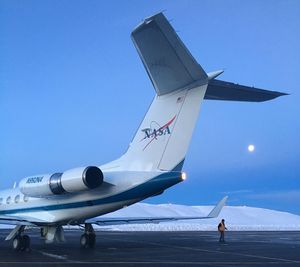
NASA's Gulfstream III was one of several research aircraft that OMG used during the mission's six-year field campaign. Airports in Greenland, Iceland, and Norway served as bases for research flights.
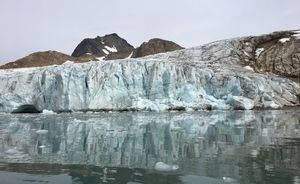
NASA's Oceans Melting Greenland airborne mission found that Greenland's glaciers that empty into the ocean, like Apusiaajik Glacier shown here, are at greater risk of rapid ice loss than previously understood.
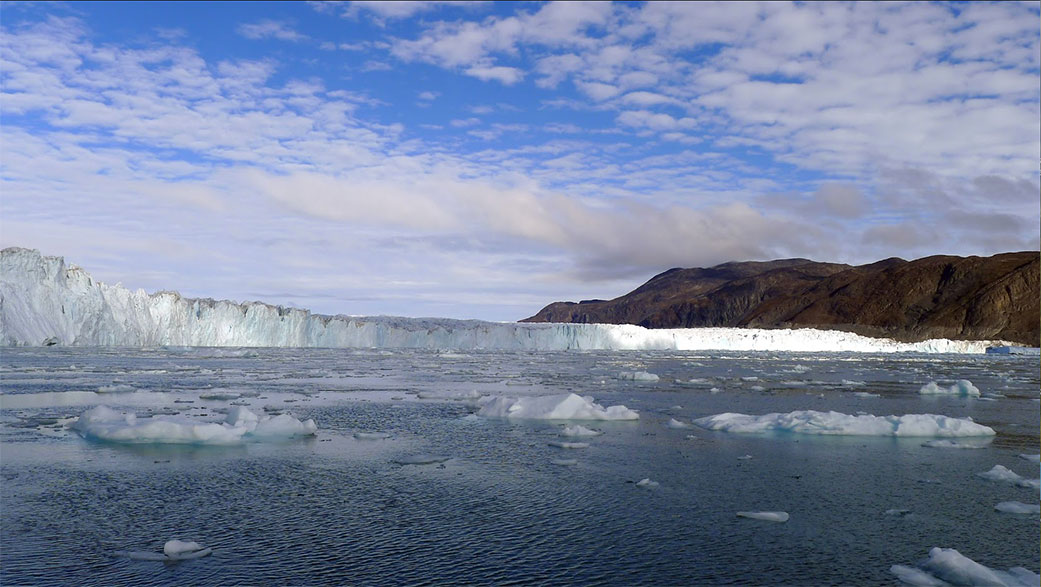
The pioneering campaign drops probes from a plane into the sea to track how seawater is melting glaciers and lend insight into the future of sea level rise. This week, NASA’s airborne Oceans Melting Greenland (OMG) mission begins its final…
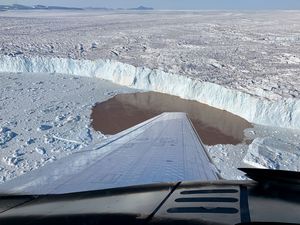
To measure water depth and salinity, the OMG project dropped probes by plane into fjords along Greenland's coast. Shown here is one such fjord in which a glacier is undercut by warming water.
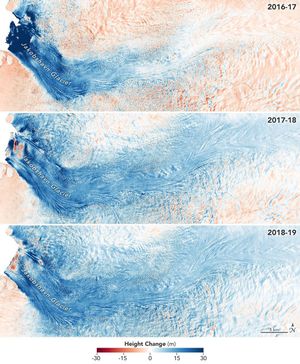
These images from NASA's Ocean's Melting Greenland (OMG) mission, show the mass Greenland's Jakobshavn Glacier has gained from 2016-17, 2017-18 and 2018-19.

Kulusuk Island is breathtakingly beautiful — a spectacular mountain backdrop, quaint village, turquoise icebergs, even adorable sled-dog puppies. But Oceans Melting Greenland Project Manager Steve Dinardo didn’t choose it as a base because of the scenery. “We came here to…

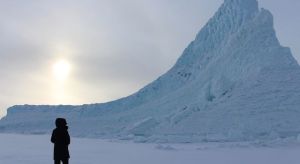
“Incredibly majestic.” After years of intensive research on Greenland’s glaciers, Josh Willis is standing next to one for the first time in his life. Apusiaajik isn’t one of Greenland’s giants — in fact, its name means “little glacier.” But its…
With a new research plane and a new base to improve its chances of outsmarting hurricanes, NASA's OMG campaign takes to the sky this week.
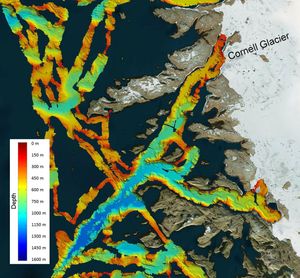
This image shows a region of the sea floor off the coast of northwest Greenland mapped as part of NASA's Oceans Melting Greenland (OMG) mission. The data shown here will be used to understand the pathways by which warm water…

NASA's Oceans Melting Greenland program will study how the oceans are eating away at Greenland's ice sheet and help scientists predict sea level rise.
Stories Archive
Greenland's ice shelves hold back sea level rise. There are just 5 left.
November 7, 2023
The vast floating ice platforms of northern Greenland, unrivaled features of the northern hemisphere that keep our seas lower by holding back many trillion tons of ice...
Source: The Washington Post
NASA Greenland Mission Completes Six Years of Mapping Unknown Terrain
January 26, 2022
To learn how ocean water is melting glaciers, NASA’s Oceans Melting Greenland mission extensively surveyed the coastline of the world’s largest island...
Source: NASA JPL
View from the top: The polar ice caps in Greenland melting faster than you think
November 18, 2021
According to NASA, Greenland's melting glaciers currently contribute more freshwater to sea level rise than any other source does...
Source: ABC7
The Greenland Connection
September 21, 2021
So many things in Greenland are gigantic. Greenland is five times the size of California, and roughly 80 percent is covered with ice. Greenland’s ice sheet is a mile deep on average, but near the center of the country it rises 10,000 feet into the sky...
Source: The Post and Courier
Tipping The Icebergs: What Losing The Greenland Ice Sheet Means For The Planet
August 30, 2021
Scientists studying one of the world's biggest ice sheets made a shocking observation this month that underscores how much Earth’s climate has changed...
Source: WBUR
NASA scientists spot troubling, extreme melting in Greenland from a plane
August 26, 2021
NASA scientist Josh Willis flew over Greenland this week, and gazed at a sprawling polar world of melted ice and dark pools of water...
Source: Mashable
NASA’s Oceans Melting Greenland Mission Leaves for Its Last Field Trip
August 4, 2021
By dropping probes from a plane into the ocean, the pioneering campaign tracks how seawater is melting glaciers to give insight into the future of sea level rise...
Source: NASA JPL
Freakish ice cube shows the scale of Earth's vanishing ice
January 26, 2021
On Earth, the amount of ice lost each year is equal to a monstrous, over six-mile-high ice cube looming over New York City...
Source: Mashable
Undercutting Sverdrup Glacier
January 26, 2021
Sverdrup Glacier in northwest Greenland is pretty average. It is a textbook example of the many coastal glaciers around the island that flow into deep fjords. But Sverdrup also represents a large class of Greenland glaciers that are undergoing rapid retreat in response to warm ocean water...
Source: NASA Earth Observatory
Warming Seas Are Accelerating Greenland’s Glacier Retreat
January 25, 2021
Scientists with NASA’s Oceans Melting Greenland mission are probing deep below the island’s warming coastal waters to help us better predict the rising seas of the future...
Source: NASA JPL
Why a Growing Greenland Glacier Doesn’t Mean Good News for Global Warming
October 21, 2019
In March, a NASA-led research team announced that Jakobshavn Isbrae, Greenland’s fastest-flowing and thinning glacier over the past two decades, is now flowing more slowly, thickening and advancing toward the ocean instead of retreating farther inland...
Source: NASA Climate
Greenland’s melting ice may affect everyone’s future
October 15, 2019
A thousand feet above the glistening, iceberg-dotted water of the ocean off of East Greenland, oceanographer Josh Willis braces for balance, his feet spread wide on the metal floor of a specially-outfitted airplane. He grips a wide grey cylinder, hovering it over a 6-inch-wide bottomless tube...
Source: National Geographic
Climate In Crisis: Al Roker studies Greenland’s melting glaciers
September 16, 2019
For an NBC News series exploring the global environment, Al Roker traveled to Greenland for an eye-opening look at its record melt and heat wave. More than 400 billion tons of water have come off the ice sheet and into the ocean, an event that scientists warn could happen again.
Source: TODAY
Climate Meltdown: Greenland’s ice sheet melting at ‘alarming rate’ say NASA scientists
September 10, 2019
NASA scientists in Greenland are trying to understand the alarmingly rapid rate the ice sheet there is melting. In the first of our special series from Greenland, 5 News correspondent Julian Druker and cameraman Rui Costa visited the Danish territory to see the affects of climate change first hand.
Source: YouTube
High above Greenland glaciers, NASA looks into melting ocean ice
August 26, 2019
Skimming low over the gleaming white glaciers on Greenland's coast in a modified 1940s plane, three NASA scientists, led by an Elvis-impersonating oceanographer, waited to drop a probe into the water beneath them...
Source: The Jakarta Post
High above Greenland glaciers, NASA looks into melting ocean ice
August 25, 2019
For four summers, a group of NASA scientists has visited Greenland and flown dozens of missions surveying temperatures in the Arctic and how quickly gladiers are retreatng. Data that Oceans Melting Greenland - OMG - hope will improve predictions about sea level rise.
Source: YouTube
Warm waters are ‘supercharging’ Greenland’s glacier melt, scientists say
August 24, 2019
In July, Greenland’s ice sheet lost more than 197 billion tons of ice – the equivalent to around 80 million Olympic swimming pools. We traveled to the remote eastern side of Greenland aboard a special aircraft with NASA scientists, who say there is enough ice in Greenland to raise sea levels by about 25 feet, which would be “devastating to coastlines around the planet.”
Source: CNN
NASA tracking Greenland’s melting ice
August 20, 2019
This is a slightly different edit of the video from the CBS story below for the CBS Evening News.
Source: CBS News
NASA program “OMG” trying to find out how fast Greenland’s ice is melting
August 19, 2019
Greenland’s ice sheet is melting six times faster than in the 1980s. This month, it lost 11 billion tons of surface ice in one day, enough to fill more than four million Olympic-sized swimming pools...
Source: CBS News
At the bottom of a glacier in Greenland, climate scientists find troubling signs
August 19, 2019
On one of the hottest days this summer, locals in the tiny village of Kulusuk, Greenland heard what sounded like an explosion. It turned out to be a soccer field’s worth of ice breaking off a glacier more than five miles away...
Source: CNN
NASA scientists fly over Greenland to track melting ice
August 15, 2019
The fields of rippling ice 500 feet below the NASA plane give way to the blue-green of water dotted with irregular chunks of bleached-white ice, some the size of battleships, some as tall as 15-story buildings...
Source: AP News
NASA Heads To Greenland Just In Time For The Latest Heatwave
August 1, 2019
NASA oceanographer and climate scientist Josh Willis and his team are set to arrive in Greenland on August 9 just one week after a scorching heatwave. They’ll collect data on ocean temperature and salinity, which will help them determine how much the ice melts when the water warms, what the current melt rate is, and how much that melt rate is increasing...
Source: Forbes
Major Greenland Glacier Is Growing
June 19, 2019
Jakobshavn Glacier in western Greenland is notorious for being the world’s fastest-moving glacier. It is also one of the most active, discharging a tremendous amount of ice from the Greenland Ice Sheet into Ilulissat Icefjord and adjacent Disko Bay—with implications for sea level rise. The image above, acquired on June 6, 2019, by the Operational Land Imager (OLI) on Landsat 8, shows a natural-color view of the glacier...
Source: NASA Earth Observatory
Greenland Glaciers In Deep Water
May 20, 2019
We know more about other planets than we know about the bottom of the ocean here on our own. One of the least explored areas left on this planet is the sea floor that lies under glaciers surrounding Greenland and Antarctica...
Source: Forbes
Cold Water Currently Slowing Fastest Greenland Glacier
March 25, 2019
NASA research shows that Jakobshavn Glacier, which has been Greenland’s fastest-flowing and fastest-thinning glacier for the last 20 years, has made an unexpected about-face. Jakobshavn is now flowing more slowly, thickening, and advancing toward the ocean instead of retreating farther inland. The glacier is still adding to global sea level rise - it continues to lose more ice to the ocean than it gains from snow accumulation - but at a slower rate...
Source: NASA JPL
NASA’s Greenland Mission Still Surprises in Year Four
March 14, 2019
Only seven months after NASA’s Oceans Melting Greenland (OMG) mission wrapped its last field campaign on the world’s largest island, an OMG crew is back in Greenland to collect more data. With two or three field projects a year since 2016, no wonder OMG has made the most comprehensive measurements yet of how ocean water lapping at the undersides of Greenland’s melting glaciers affects them. All that data has answered a lot of existing questions - and it’s raised plenty of new ones...
Source: NASA JPL
NASA Explorers: Glacial Pace
November 15, 2018
NASA Explorers study Earth’s glaciers and ice sheets more than almost any other part of the cryosphere. As they melt and change, glaciers and ice sheets dramatically affect sea level rise and the climate system as a whole, creating an urgency to understand and forecast their behavior...
Source: YouTube
The Biggest Threat to Greenland’s Glaciers Lies Deeper in the Ocean Than Expected
October 10, 2018
This summer, a chunk of ice the size of lower Manhattan broke off of a glacier in Eastern Greenland. It contained 10 billion tons of ice, making the video of the event an insanely shareable capsule of climate change dread. But for NASA scientists, the spectacle created by these massive calving events is really just the final step in a far more worrisome — and less visible — process...
Source: VICE News
Finding Open Water in Greenland’s Icy Seas
October 1, 2018
“Three, two, one ... drop!” Researchers in NASA’s Oceans Melting Greenland campaign heard that phrase 239 times this fall. Each time, it triggered a team member to release a scientific probe from an airplane into the seawater along the coast of Greenland. The probes are part of a five-year effort to improve our understanding of the ocean’s role in Greenland’s rapid ice loss...
Source: NASA JPL
NASA’s OMG: Where the Water Meets the Ice
October 1, 2018
Join JPL scientist Josh Willis as he and the NASA Oceans Melting Greenland (OMG) team work to understand the role that ocean water plays in melting Greenland’s glaciers. From the sky and the sea, NASA’s OMG mission gathers data on glaciers and water temperature all around Greenland as they try to get a better picture of global sea level rise.
Source: YouTube
The Hunt for Better Climate Science
September 19, 2018
NASA scientists are mapping the loss of ice in Greenland, part of a cutting-edge effort to understand how warming oceans melt ice sheets — a key factor in improving uncertain forecasts for sea-level rise...
Source: Reuters
“We Came Here to Work”: OMG in the Field
September 6, 2018
Kulusuk Island is breathtakingly beautiful — a spectacular mountain backdrop, quaint village, turquoise icebergs, even adorable sled-dog puppies. But Oceans Melting Greenland Project Manager Steve Dinardo didn’t choose it as a base because of the scenery. “We came here to work,” he says...
Source: NASA Blogs
A Majestic Glacier on OMG’s Return to Greenland
August 30, 2018
After years of intensive research on Greenland’s glaciers, Josh Willis is standing next to one for the first time in his life. Apusiaajik isn’t one of Greenland’s giants — in fact, its name means “little glacier.” But its marbled blue-and-white wall of ice is tall, long and, as Willis says, majestic...
Source: NASA Blogs
NASA Gets Up Close with Greenland’s Melting Ice
August 20, 2018
With a new research plane and a new base to improve its chances of outsmarting Atlantic hurricanes, NASA’s Oceans Melting Greenland campaign takes to the sky this week for its third year of gathering data on how the ocean around Greenland is melting its glaciers...
Source: NASA JPL
OMG, the Water’s Warm! NASA Study Solves Glacier Puzzle
June 21, 2018
A new NASA study explains why the Tracy and Heilprin glaciers, which flow side by side into Inglefield Gulf in northwest Greenland, are melting at radically different rates. Using ocean data from NASA’s Oceans Melting Greenland (OMG) campaign...
Source: NASA JPL
Decline of Two Glaciers in Northwest Greenland
April 8, 2018
Greenland’s coastline is anything but smooth. It is punctuated by rocky outcrops and ice-choked fjords, the outlets through which ice from the interior drains into the sea. The myriad “marine-terminating outlet glaciers” along the coast of Prudhoe Land in northwest Greenland may not be the country’s largest, but they are retreating fast...
Source: NASA Earth Observatory
New Greenland Maps Show More Glaciers at Risk
November 1, 2017
New maps of Greenland’s coastal seafloor and bedrock beneath its massive ice sheet show that two to four times as many coastal glaciers are at risk of accelerated melting as previously thought...
Source: NASA JPL
Scientists mapping Greenland have produced some surprising – and worrying – results
October 4, 2017
Greenland, the world’s largest island and home to its second largest ice sheet, is a land of ragged cliffs, breathtaking fjords and unimaginable amounts of water on either side of the freezing point. It has also, until now, been something of a mystery...
Source: The Washington Post
Narwhals Are Helping NASA Understand Melting Ice and Rising Seas
August 24, 2017
Greenland’s ice cap holds beneath it 10 percent of the earth’s freshwater, enough to raise global sea levels by 20 feet. While there’s no doubt it is melting, scientists have little certainty about exactly what’s happening inside this 10,000-year-old ice roughly three times the size of Texas. Last winter was the warmest on record in the Arctic, and as Greenland heats up, understanding this glaciate has become essential to navigating our future...
Source: Bloomberg
OMG Mission: Greenland’s Ice Melting Faster Than Previously Thought
June 28, 2017
Thanks to rising temperatures, glaciers in Greenland are melting faster than scientists previously thought — and a new NASA video shows how researchers are tracking the magnitude of the changes (in feet per day)...
Source: Live Science
Greenland’s Thinning Ice
June 8, 2017
With temperatures around the world climbing, melt waters from the continental ice sheets of Greenland and Antarctica are raising sea levels. Those ice sheets are melting from both above and below. Much of the ice lost from ice sheets comes from a process called calving where ice erodes, breaks off, and flows rapidly into the ocean. A large volume of ice is also lost from ice sheets melting on their surfaces...
Source: NASA Science
Sun and sky, snow and ice - Reflections at the top of the world
June 5, 2017
It was 11:30 in the morning and GLISTIN-A instrument engineer Ron Muellerschoen and I were in northern Greenland at the Thule Air Base pier looking over the frozen Wolstenholme Bay. We’d been talking about the time Ron was wearing shorts here during the summer, but today it was the typical -22 Fahrenheit (-30 Celsius.) And even though over the past week we’d somehow gotten used to the cold and I was wearing a big parka, my legs were starting to get cold after walking for an hour. So we decided to head back...
Source: NASA Climate
Jump into a sea of new data from NASA’s Oceans Melting Greenland
May 11, 2017
“Get to work,” Josh Willis, NASA’s Oceans Melting Greenland (OMG) principal investigator, said during a two-and-a-half-hour debriefing. “Get to work.” It was as though he’d been ringing one of those big ol’ dinner gongs...
Source: NASA Sea Level
NASA took on an unprecedented study of Greenland’s melting. Now, the data are coming in
February 10, 2017
In 2015, in a moment of science communication genius, NASA created a mission called “OMG.” The acronym basically ensured that a new scientific mission — measuring how quickly the Oceans are Melting Greenland — would get maximum press attention...
Source: The Washington Post
NASA, UCI Reveal New Details of Greenland Ice Loss
February 9, 2017
Less than a year after the first research flight kicked off NASA’s Oceans Melting Greenland campaign last March, data from the new program are providing a dramatic increase in knowledge of how Greenland’s ice sheet is melting from below. Two new research papers in the journal Oceanography use OMG observations to document how meltwater and ocean currents are interacting along Greenland’s west coast and to improve seafloor maps used to predict future melting and subsequent sea level rise...
Source: NASA
Glaciers on the edge
February 1, 2017
“This year we’re gonna bring it!” Oceans Melting Greenland (OMG) Principal Investigator Josh Willis told me excitedly. “It’s the beginning of year two of this five-year airborne mission, which means that by comparing data from the first and second years, we’ll be able to observe changes in Greenland’s glaciers and coastal ocean water for the first time.” Glaciers around Greenland’s jagged coastline have been melting into the ocean and causing increased sea level rise, so measuring the amount of ice mass loss will help us understand the impact of these changes, Willis said. “Will we see 5 feet of sea level rise this century ... or more?”...
Source: NASA Climate
NASA Releases New, Detailed Greenland Glacier Data
December 21, 2016
NASA’s Oceans Melting Greenland (OMG) mission has released preliminary data on the heights of Greenland coastal glaciers from its first airborne campaign in March 2016. The new data show the dramatic increase in coverage that the mission provides to scientists and other interested users. Finalized data on glacier surface heights, accurate within three feet (one meter) or less vertically, will be available by Feb. 1, 2017...
Source: NASA JPL
Science Torpedoes Reveal How Greenland Is Melting From Below
October 19, 2016
If the climate keeps warming the way it has, Greenland may finally live up to its name (which was probably bestowed on it by some colorblind viking). The island’s glacier-crusted surface is melting, and a lot of this is from balmier atmospheric temperatures. But as the saying goes, that’s just the tip of the iceberg. The oceans are becoming more tepid as well, and that warmer water is causing the glaciers to thaw from below...
Source: Wired
Making lemonade out of climate change - Science unveils the sheer beauty of Planet Earth
October 17, 2016
You might expect that being a science writer primarily focused on climate change and climate science could put me in a bad mood. You can see this if you read the comments on many of my blogs, on our NASA Climate Change Facebook page and on my TEDx video. Many commenters think I should express more alarm about our changing climate...
Source: NASA Climate
NASA Launches “Operation OMG” After 10 Ft. Sea Level Rise Predicted in Next 50 Yrs.
August 16, 2016
Falling in line with an alarming new paper spearheaded by climate-science guru Dr. James Hansen, the National Aeronautics and Space Administration (NASA) has launched its own urgent five-year study — a project that will “stress-test” Hansen’s new, and downright dire predictions...
Source: enviroNews
Greenland on the edge - Where ice meets water at the bottom of the sea
August 2, 2016
A person can look at a thing over and over again before finally seeing it for the first time. That’s how I felt standing in front of an Arctic map at the University of Washington in Seattle. I gazed at the northwest coastline of Greenland, north of Baffin Bay, up where the Canadian Queen Elizabeth Islands come close to Greenland...
Source: NASA Climate
A sea slug changed my life
June 20, 2016
At 8 p.m. after a long day of work in the Houston humidity, Derek Rutavic, manager of the NASA Gulfstream-III that will head back to Greenland this fall, and I were in the back of the plane singing One Direction’s “Drag Me Down” over the high frequency radio system. It was stifling hot, getting dark and we were tired and hungry...
Source: NASA Climate
OMG: How fast are oceans melting Greenland?
June 16, 2016
We know more about the moon and other planets than we do some places on our home planet. Remote parts of the world ocean remain uncharted, especially in the polar regions, especially under areas that are seasonally covered with ice and especially near jagged coastlines that are difficult to access by boat. Yet, as global warming forces glaciers in places like Greenland to melt into the ocean, causing increased sea level rise, understanding these remote places has become more and more important...
Source: NASA Sea Level
New Maps Chart Greenland Glaciers’ Melting Risk
April 21, 2016
Many large glaciers in Greenland are at greater risk of melting from below than previously thought, according to new maps of the seafloor around Greenland created by an international research team. Like other recent research findings, the maps highlight the critical importance of studying the seascape under Greenland’s coastal waters to better understand and predict global sea level rise...
Source: NASA JPL
OMG: Is the Ocean Melting the Ice?
April 5, 2016
At 1.7 million square kilometers (660,000 square miles), the Greenland ice sheet is three times the size of Texas. On average, the ice is about 1.6 kilometers (1 mile) deep and contains enough water to raise global sea levels about 6 meters (20 feet) if it were all to melt...
Source: NASA Earth Observatory
Earth Expeditions: Episode 1 - Oceans Melting Greenland, KORUS...
April 4, 2016
Our first episode of the NASA TV Earth Expeditions program follows the Oceans Melting Greenland team as they prep for their deployment and then fly over the melting glaciers of Greenland. Then we do some man on the street interviews, preview our next expedition, KORUS-AQ, which will study air quality in South Korea, and learn about NASA’s DC-8 flying laboratory...
Source: NASA Earth Facebook
Sorrow and excitement - Watching global warming in real-time from a NASA plane
March 30, 2016
“When I looked down at the rivers of ice running into the ocean, it was shocking to think about the effects of rising sea levels as far away as California or Antarctica,” said Principle Investigator Josh Willis, two days after returning from his first trip to observe this pristine part of our planet as it melts into the sea and goes bye-bye...
Source: NASA Climate
NASA’s OMG Mission Maps Sea Floor Depth off Greenland’s Coast
March 29, 2016
This image shows a region of the sea floor off the coast of northwest Greenland mapped as part of NASA’s Oceans Melting Greenland (OMG) mission. This five-year Earth Ventures Suborbital mission will test the connection between ocean warming and ice loss in Greenland. The data shown here will be used to understand the pathways by which warm water can reach glacier edges...
Source: NASA
Into the Final Turn: From Cold to Colder
March 28, 2016
On Monday morning, the Oceans Melting Greenland (OMG) team left the chill of Keflavik (32 degrees Fahrenheit but with a relentless, stinging wind) for the more ruthless cold of -8 degrees Fahrenheit in Thule, Greenland...
Source: NASA Blogs
Step 1: Minor in Theater. Step 2: Devise Science Experiment.
March 28, 2016
Here’s the second part of our Q&A with Oceans Melting Greenland (OMG) principal investigator Josh Willis, an oceanographer at NASA’s Jet Propulsion Laboratory in Pasadena, California, specializing in sea level rise. Josh is also a graduate of the improv program at Second City Hollywood Conservatory in Los Angeles. Here he describes how exercising his sense of humor improves his science...
Source: NASA Blogs
Glaciers by Sight, Glaciers by Radar
March 27, 2016
The Oceans Melting Greenland (OMG) team is flying NASA’s G-III at about 40,000 feet. On a clear day, this altitude also provides a stunning perspective of one of the world’s two great ice sheets (the other is Antarctica). The flight Saturday, March 26, over the northeast coastline was one of those clear days...
Source: NASA Blogs
Halfway Around Greenland – So Far
March 25, 2016
Oceans Melting Greenland (OMG) will pave the way for improved estimates of sea level rise by investigating the extent to which the oceans are melting Greenland’s ice. OMG will observe changing water temperatures and glaciers that reach the ocean around all of Greenland from 2015 to 2020...
Source: NASA Blogs
Goodbye Astronomy, Hello Greenland Glaciers
March 24, 2016
The seven-person Oceans Melting Greenland (OMG) team arrived in Keflavik earlier this week to make its first round of research flights over Greenland’s eastern coast. The team is flying NASA’s GLISTIN-A radar to measure the thickness of glaciers that flow to the ocean...
Source: NASA Blogs
Greenland is melting and it’s time to pay attention
March 16, 2016
Yes, yes, Greenland is melting. You already knew that...probably. And the giant flux of fresh water pouring out of the second largest ice sheet on the planet isn’t slowing down anytime soon. Greenland’s ice melt is actually accelerating...
Source: NASA Climate
In Greenland, Another Major Glacier Comes Undone
November 12, 2015
It’s big. It’s cold. And it’s melting into the world’s ocean. It’s Zachariae Isstrom, the latest in a string of Greenland glaciers to undergo rapid change in our warming world. A new NASA-funded study published today in the journal Science finds that Zachariae Isstrom broke loose from a glaciologically stable position in 2012 and entered a phase of accelerated retreat. The consequences will be felt for decades to come...
Source: NASA JPL
You’re gonna lose it when you hear about Oceans Melting Greenland
September 28, 2015
This morning when I told someone I’d interviewed NASA oceanographer Josh Willis for this blog, they replied, “Isn’t Josh Willis a climatologist?” “Aha!” I said. “That’s a problem. Not knowing that Earth’s ocean is responsible for controlling the climate is major. Oceanographers are climatologists.”...
Source: NASA Climate
Why NASA's so worried that Greenland’s melting could speed up
August 29, 2015
Antarctica contains vastly more ice than Greenland. However, Greenland is subjected to the rapidly warming temperatures of the Arctic. The result is that for now at least — and as you can see above — it is losing ice mass considerably faster than Antarctica is, to the tune of several hundred gigatons a year...
Source: The Washington Post
NASA: Sea Level Rise is Going to get Much Worse
August 28, 2015
Eleven of the fifteen largest cities in the world are located on the coast. The tenuous barrier between land and sea was a boon for humanity in the past, providing access to ports around the globe, building lifelines of trade between countries, and raising triumphs of steel and concrete high into the air. Now, sea levels are also on the rise, putting millions of people who live in those cities in harm’s way...
Source: Popular Science
Oceans Will Rise Much More Than Predicted, NASA Says
August 27, 2015
Year by year, millimeter by millimeter, the seas are rising. Fed by melting glaciers and ice sheets, and swollen by thermal expansion of water as the planet warms, the world’s oceans now on average are about eight inches higher than a century ago. And this sea change is only getting started...
Source: National Geographic
How to Understand What your Teenage Space Agency is Saying
August 27, 2015
OMG NASA, SRSLY? The National Aeronautics and Space Administration (aka, NASA) has fittingly named their latest mission OMG, or Oceans Melting Greenland. It’s a funny name for a very serious project...
Source: Popular Science
NASA’s OMG Mission Maps Greenland’s Coastline
August 26, 2015
This summer, a refitted fishing boat is mapping the seafloor around Greenland as the first step in a six-year research program to document the loss of ice from the world’s largest island. NASA’s Oceans Melting Greenland (OMG) field campaign is gathering data...
Source: NASA JPL
NASA launches operation ‘OMG’
August 12, 2015
Late last month, an alarming new study concluded that the glaciers of Greenland and Antarctica will melt ten times faster than previous estimates, raising ocean levels 10 feet in as little as a half century. But is it accurate? NASA has launched an urgent, five-year, $30 million study that will help scientists find out...
Source: MSNBC
NASA launches mission to Greenland
July 28, 2015
When the retired fishing trawler MV Cape Race sets off along Greenland’s west coast this week, it will start hauling in a scientific catch that promises to improve projections of how the ice-covered island will fare in a warming world. The ship’s cruise is the initial phase of a six-year air and sea campaign to probe interactions between Greenland’s glaciers and the deep, narrow fjords where they come to an end...
Source: Nature
NASA Airborne Campaigns Tackle Climate Questions
November 25, 2014
Five new NASA airborne field campaigns, including one managed by NASA’s Jet Propulsion Laboratory, Pasadena, California, will take to the skies starting in 2015 to investigate how long-range air pollution, warming ocean waters and fires in Africa affect our climate...
Source: NASA JPL