













Harmonized Landsat and Sentinel-2 PI Christopher Neigh shares milestones and a vision for the future
In 2025, the Harmonized Landsat and Sentinel-2 (HLS) program established itself as a cornerstone for global medium-resolution optical Earth observation and became one of NASA’s most downloaded products. The seamless, analysis-ready dataset is free for anyone to use and download on NASA Earthdata: HLSL30v2.0 and HLSS30v2.0. HLS version 2.0 (Ju et al., 2025), released in July, represents a major advancement in algorithm sophistication and dataset completeness. The improved surface reflectance dataset now extends globally back to 2013 (excluding Antarctica) and integrates observations from Landsat 8/9 and Sentinel-2A/B/C satellites, achieving an unprecedented median revisit interval of less than 1.6 days. This high frequency of observations transforms our ability to monitor Earth's changing surface.
June saw the first in-person HLS meeting between NASA headquarters, the Satellite Needs Working Group (SNWG), and representatives from NASA’s Goddard Space Flight Center and Marshall Space Flight Center, representing enhanced coordination and strategic alignment. The HLS project also serves as a critical steppingstone for advancing collaboration between NASA and the European Space Agency (ESA).
HLS's frequent revisit is one of its key values to data users. Zhou et al. (2025) evaluated the cloud-free coverage of HLS V2.0 in 2022 and found that HLS data provided observations every 1.6 days at the global scale and 2.2 days in data-scarce tropical regions. This temporal resolution addresses one of the most persistent challenges in optical remote sensing: obtaining cloud-free observations for time-sensitive applications.
HLS Impacts
Already, scientists are putting HLS to use for practical and scientific applications. Zhou et al. (2025) evaluated the global consistency, reliability, and uncertainty of the newly-released suite of nine HLS vegetation indices. This assessment provides the scientific community with confidence in using HLS-derived vegetation indices for agriculture, forestry, ecosystem monitoring, and more.
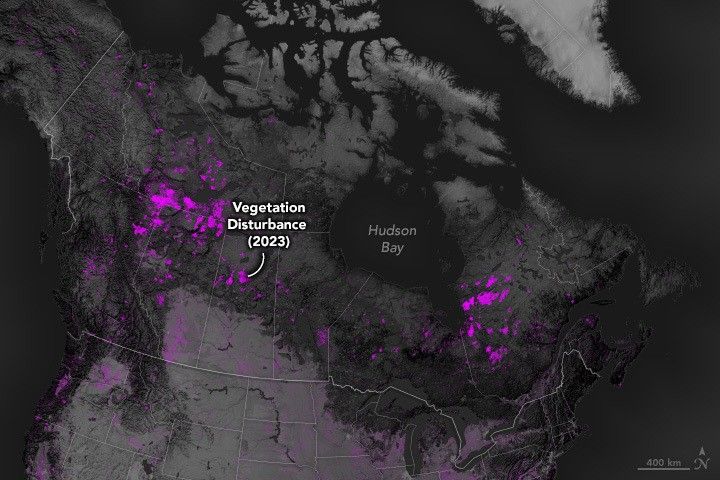
Pickens et al. (2025) unveiled a global land change monitoring system, DIST-ALERT, based on HLS data. DIST-ALERT highlights HLS's transformative impact on environmental monitoring, identifying new land change dynamics that are impossible to track with Landsat or Sentinel observations alone.
Vision for the Future
The HLS program continues to evolve to deliver high-quality, reliable data to its expanding user base. Shi et al. (2026, under review in Remote Sensing of Environment) developed Fmask version 5.0, employing a hybrid approach combining physical rules, machine learning, and deep learning for cloud masking. When released, this next-generation cloud detection algorithm will improve the accuracy and consistency of cloud/cloud-shadow screening—a critical component for maximizing usable observations in the HLS time series.
Looking forward, the HLS vision encompasses:
- Enhanced Algorithms: Integrating Fmask v5.0 and refining harmonization algorithms to further reduce inter-sensor differences and improve accuracy across diverse conditions.
- Expanded Product Suite: Developing products that leverage HLS's unique temporal resolution.
- Meeting User Needs: Strengthening partnerships with operational agencies and downstream users to ensure HLS products effectively support applications including agriculture, water resources, disaster response, and climate adaptation.
- Continuity and Sustainability: Planning for long-term data continuity as Landsat Next and future Sentinel missions come online, ensuring seamless transition and multi-decadal consistency.
- Community Engagement: Expanding training, documentation, and outreach to maximize HLS adoption across the global user community, particularly in regions where frequent, free, analysis-ready data can transform environmental monitoring capabilities.
The HLS program exemplifies successful international collaboration in Earth observation, delivering on the promise of harmonized, frequent, global-scale monitoring. As we build on the foundation of HLS v2.0, the program is positioned to enable breakthrough science and operational applications that were previously impossible with individual satellite missions alone.