













Moon Maps for International Observe the Moon Night
Each year, we provide custom maps of the Moon with information about lunar locations that will be especially well-positioned for viewing on International Observe the Moon Night. Each map includes sections dedicated to lunar landforms, lunar maria (seas of basalt), and human landing sites. Many of the best views will occur along the terminator (the line between the day and night side of the Moon).
To find suggestions for observing the Moon every day of the year, check out our Moon Viewing Tips and visit our Daily Moon Guide.
2026 Moon Maps
These maps depict the Moon as it will appear from the Northern or Southern Hemisphere on International Observe the Moon Night, September 19, 2026.
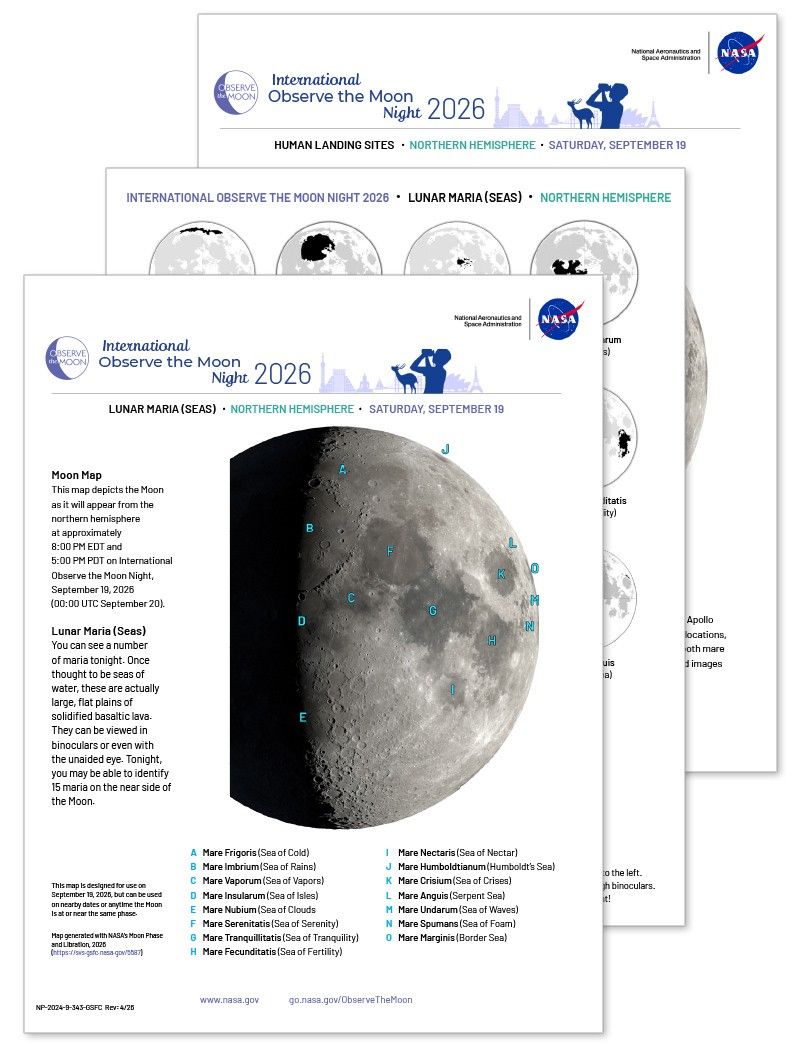
Lunar Maria (Seas)
On International Observe the Moon Night 2026, observers have the opportunity to identify 15 maria on the near side of the Moon. Once thought to be seas of water, these are actually large, flat plains of solidified basaltic lava. They can be viewed in binoculars or even with the unaided eye.
Human Landing Sites
Between July 1969 and December 1972, a total of 12 astronauts landed on the surface of the Moon for six of the Apollo missions. Apollo missions 11, 12, 14, 15, 16, and 17 each landed in different locations on the lunar surface. These locations, each fascinating for their own particular reasons, sampled a wide range of lunar geology and terrain, from smooth mare plains to rugged ancient highlands. Four of the landing sites are visible on International Observe the Moon Night 2026.
Telescopic Treats
Some of the more interesting lunar landforms that have favorable lighting for viewing on International Observe the Moon Night 2026 are identified in our Moon Maps.
More Resources
10 Ways to Observe the Moon From Anywhere
There are so many ways to observe the Moon! Here are a few ideas to get you started, no matter where you are.
Rain or Shine Moon Resources
Hands-on activities, digital interactives, tactile models, videos, animations, and more.
International Observe the Moon Night Event Materials
Everything you need to prepare for your International Observe the Moon Night event.
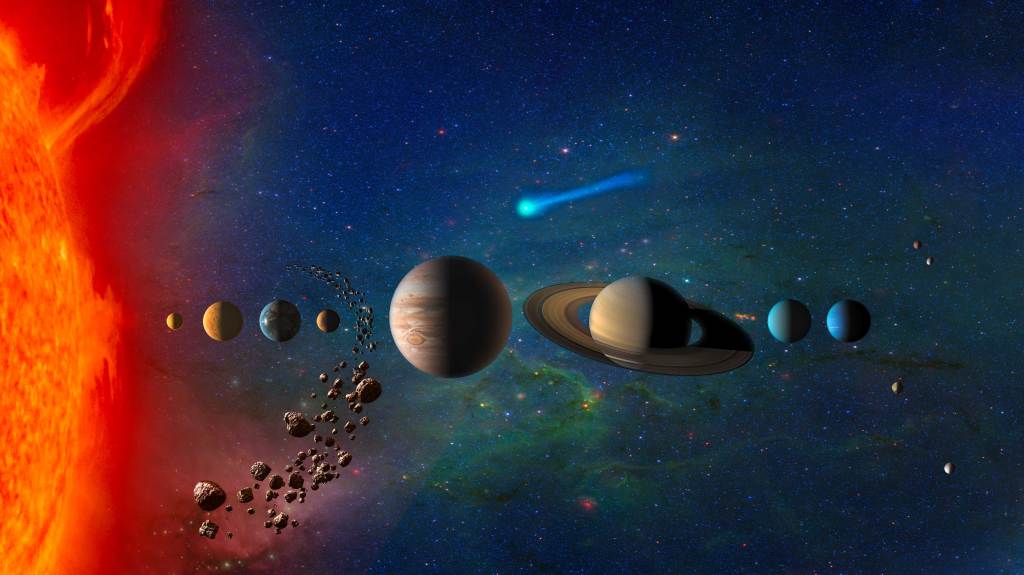
Solar System Resource Packages
For educators, students, and anyone interested in learning more about our solar system.