






















Description
Map Projected Browse Image
Click on the image for larger version
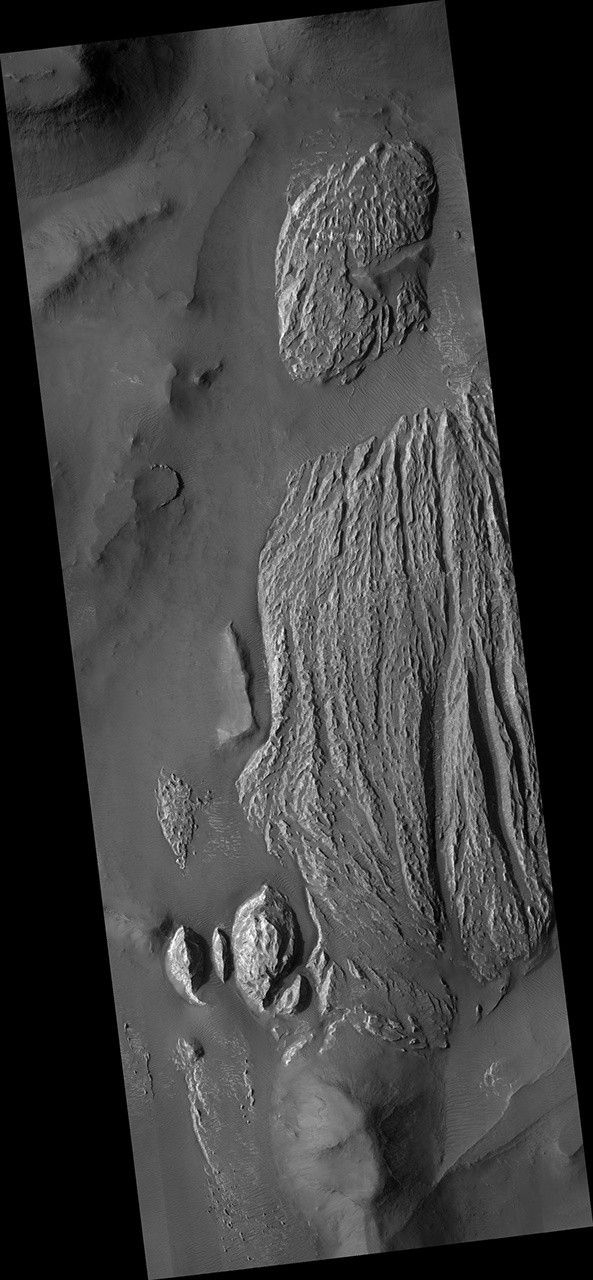
The objective of this observation is to examine a light-toned deposit in a region of what is called "chaotic terrain" at the base of the Valles Marineris canyon system.
The deposit displays a rough surface, in contrast to the smoothness of the surrounding area. Some parts of the surface appear as if they were eroded by a fluid flowing north and south, or perhaps sculpted by the wind. This area is also visible in a Context Camera image (P04_002747_1736). This deposit may be related to interior layered deposits in the Valles Marineris where it's been suggested to have formed in an ancient lake.
This caption is based on the original science rationale.
HiRISE is one of six instruments on NASA's Mars Reconnaissance Orbiter. The University of Arizona, Tucson, operates HiRISE, which was built by Ball Aerospace & Technologies Corp., Boulder, Colorado. NASA's Jet Propulsion Laboratory, a division of the California Institute of Technology in Pasadena, manages the Mars Reconnaissance Orbiter Project for NASA's Science Mission Directorate, Washington.