









Description
Map Projected Browse Image
Click on the image for larger version
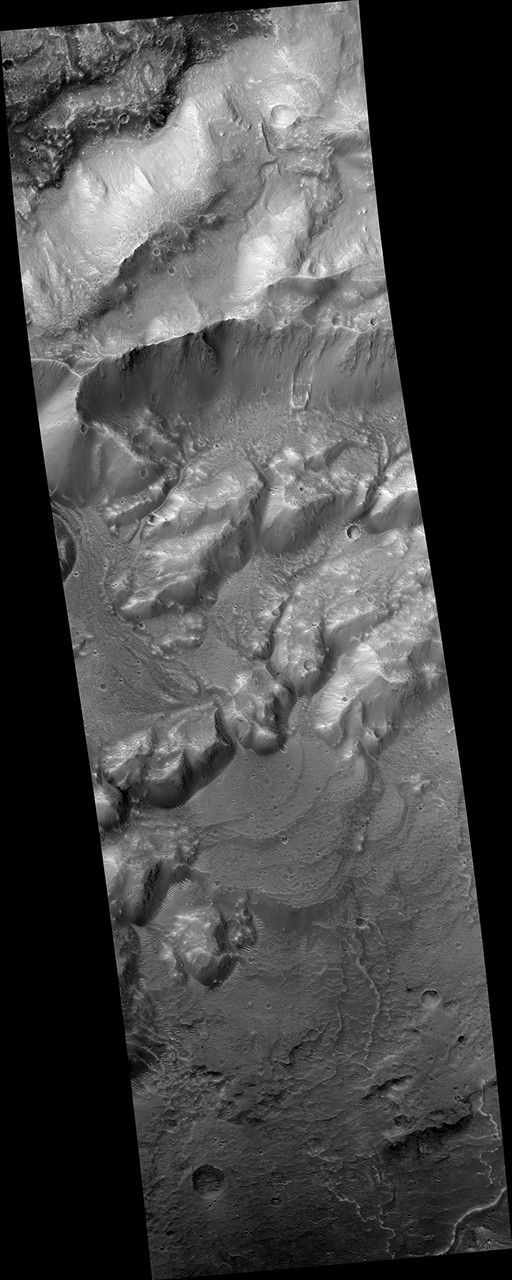
This image shows the northern rim of a crater in Deuteronilus. At the northern end, we see the crater rim and ridges inside and below that rim. A channel set is entering from the west and passing through a notch in a ridge. Topographically below that notch, overlapping lobes spread over the crater floor.
Fan-shaped lobes likes these are also in the desert southwest of the United States, and are called "alluvial fans." They are caused when streams that carry sediment in a confined channel open up onto a plain or wide area, and deposit their sediment just outside of the channel mouth.
This is a stereo pair with ESP_028274_2160.
The University of Arizona, Tucson, operates HiRISE, which was built by Ball Aerospace & Technologies Corp., Boulder, Colo. NASA's Jet Propulsion Laboratory, a division of the California Institute of Technology in Pasadena, manages the Mars Reconnaissance Orbiter Project for NASA's Science Mission Directorate, Washington.