



















Description
Map Projected Browse Image
Click on image for larger version
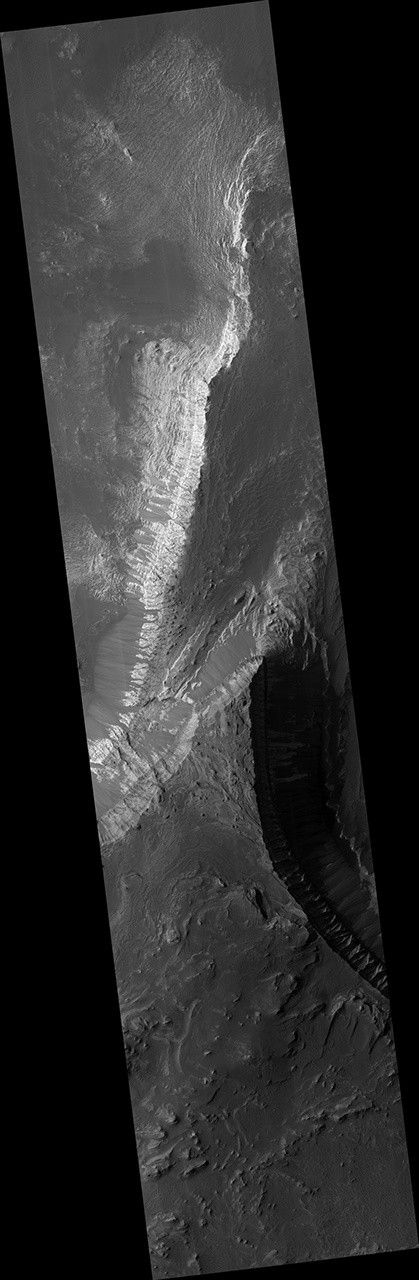
Massive deposits of sediments rich in hydrated sulfates are found in central Valles Marineris. Such deposits on Earth are soft and easily eroded, and that appears to be true on Mars as well.
There are large gullies and sediment fans along the steepest slopes. Elsewhere on Mars, such slopes are actively eroding in before-and-after HiRISE images, so this would be a good location to observe again in a future year. Linear gaps in data coverage on the bright sun-facing slopes are locations where the image data is saturated.
The map is projected here at a scale of 50 centimeters (19.7 inches) per pixel. (The original image scale is 52.6 centimeters [20.7 inches] per pixel [with 2 x 2 binning]; objects on the order of 158 centimeters [62.2 inches] across are resolved.) North is up.
The University of Arizona, in Tucson, operates HiRISE, which was built by Ball Aerospace & Technologies Corp., in Boulder, Colorado. NASA's Jet Propulsion Laboratory, a division of Caltech in Pasadena, California, manages the Mars Reconnaissance Orbiter Project for NASA's Science Mission Directorate, Washington.