




















Description
Map Projected Browse Image
Click on image for larger version
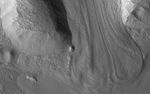
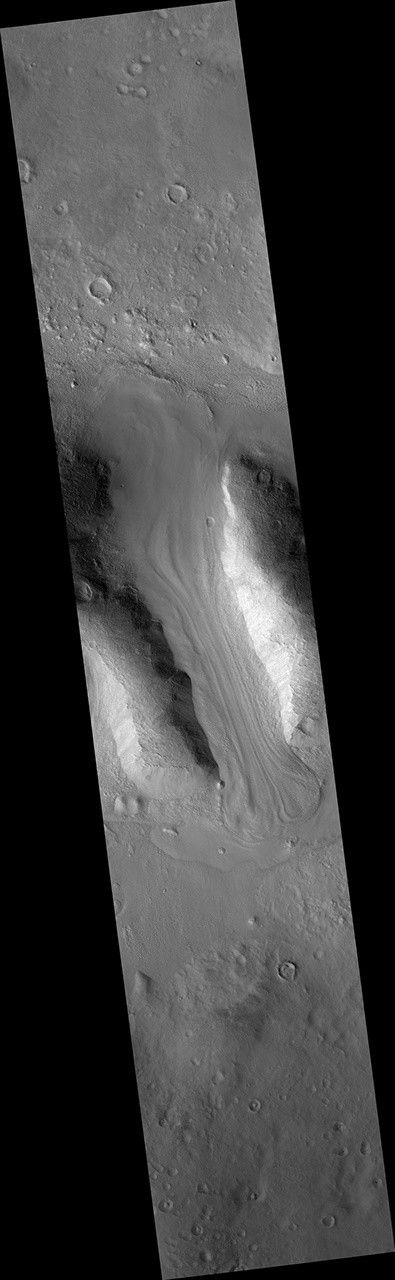
There are many locations in the mid-latitudes of Mars that look like material has flowed. This image shows an example flowing downhill between two ridges. Comparing these to what we see on the Earth and to other information we have about Mars leads scientists to believe that these are glaciers.
Glacier-like features like this indicate that ice accumulated here in the past, which does not happen in today's climate. It's somewhat of a mystery why these features have flowed so much when they are so thin, the ice is so cold, and Martian gravity is so low. They probably move much more slowly than typical glaciers on Earth, but Mars has plenty of time on its hands so they end up looking very similar to the valley glaciers we see on our own planet.
The map is projected here at a scale of 50 centimeters (19.7 inches) per pixel. (The original image scale is 59.8 centimeters [23.5 inches] per pixel [with 2 x 2 binning]; objects on the order of 179 centimeters [70.5 inches] across are resolved.) North is up.
The University of Arizona, in Tucson, operates HiRISE, which was built by Ball Aerospace & Technologies Corp., in Boulder, Colorado. NASA's Jet Propulsion Laboratory, a division of Caltech in Pasadena, California, manages the Mars Reconnaissance Orbiter Project for NASA's Science Mission Directorate, Washington.