











Description
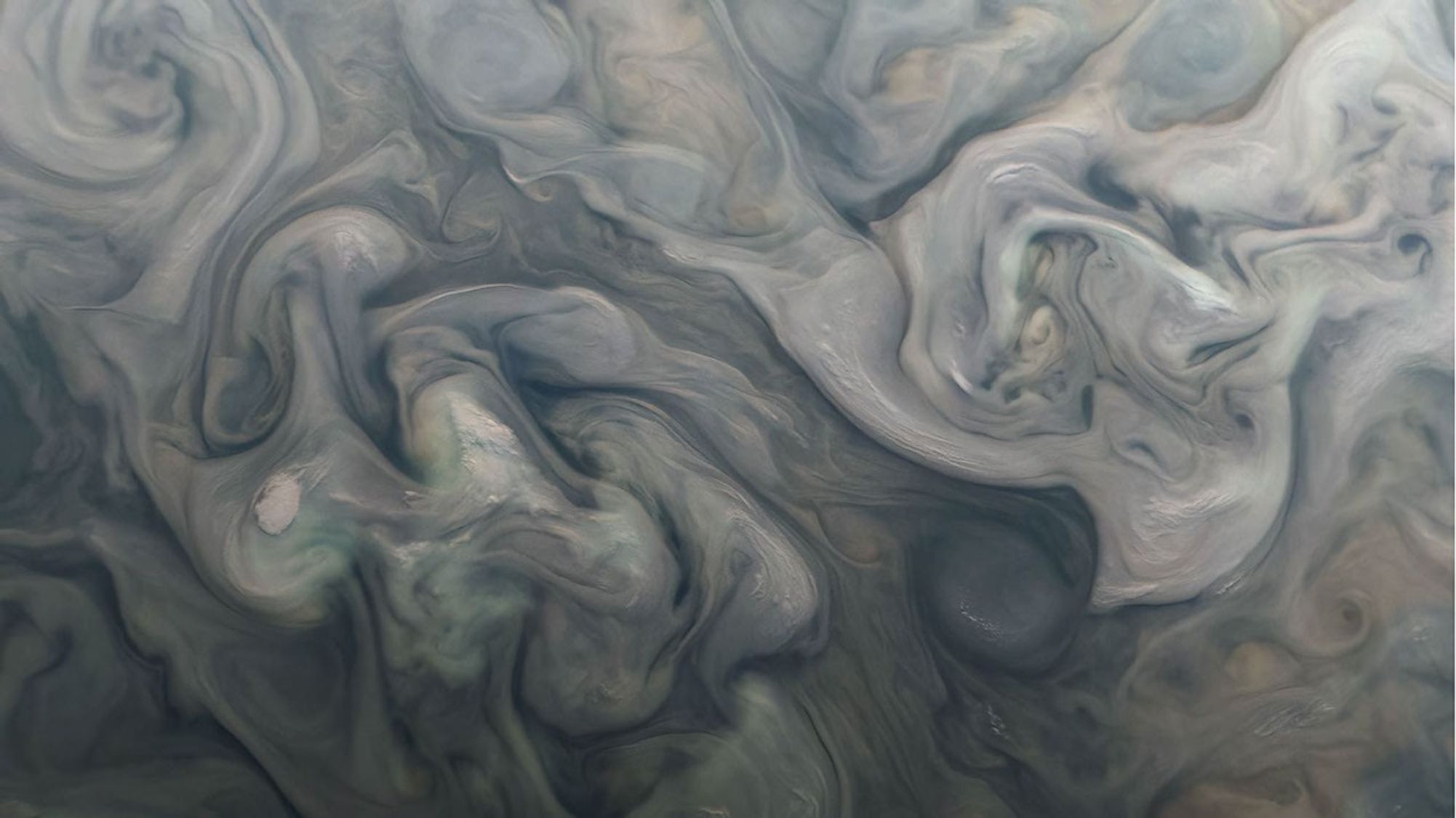
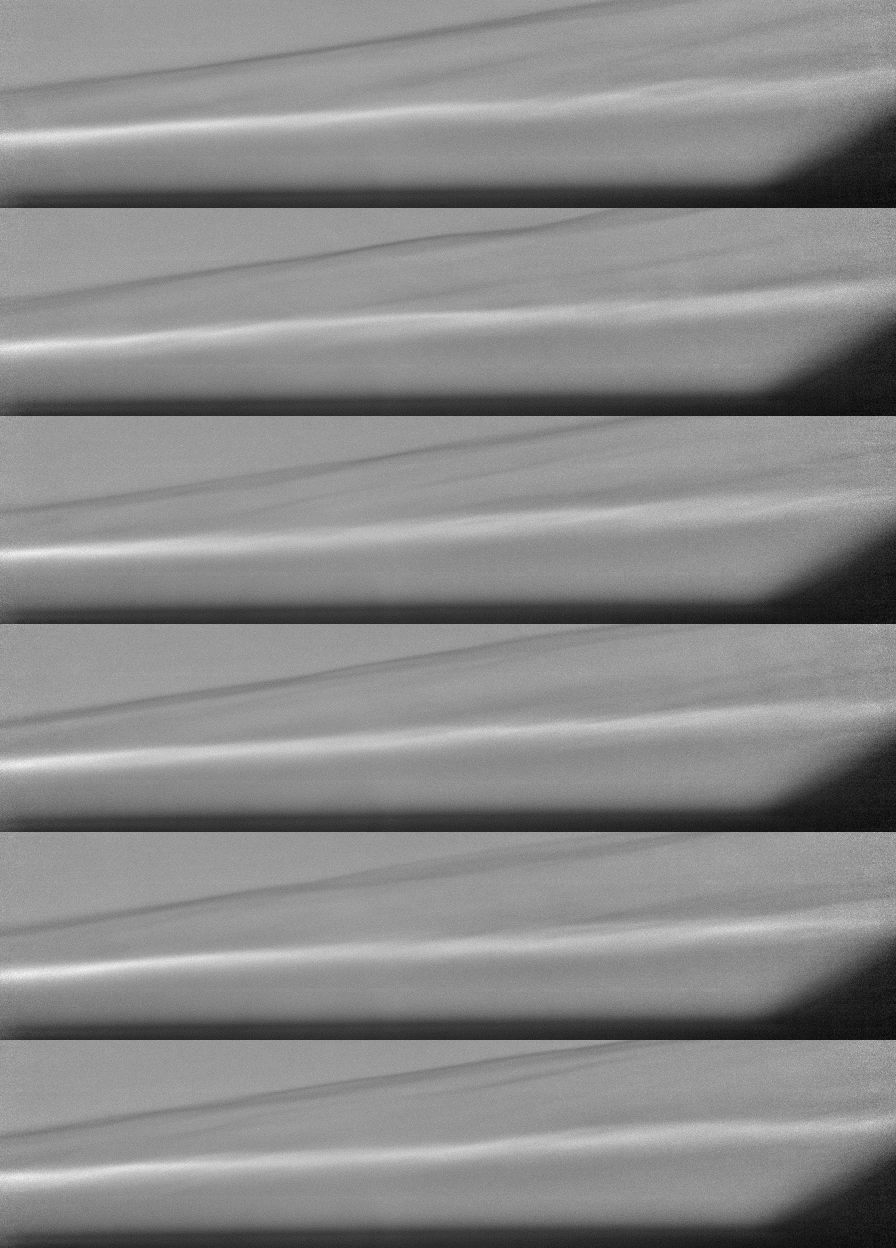
Two frame "movie" of a pair of vortices in Jupiter's southern hemisphere. The two frames are separated by ten hours. The right oval is rotating counterclockwise, like other anticyclonic bright vortices in Jupiter's atmosphere. The left vortex is a cyclonic (clockwise) vortex. The differences between them (their brightness, their symmetry, and their behavior) are clues to how Jupiter's atmosphere works. The frames span about fifteen degrees in latitude and longitude and are centered at 141 degrees west longitude and 36 degrees south planetocentric latitude. Both vortices are about 3500 kilometers in diameter in the north-south direction.
The images were taken in near infrared light at 756 nanometers and show clouds that are at a pressure level of about 1 bar in Jupiter's atmosphere. North is at the top. The smallest resolved features are tens of kilometers in size. These images were taken on May 7, 1997, at a range of 1.5 million kilometers by the Solid State Imaging system on NASA's Galileo spacecraft.
The Jet Propulsion Laboratory, Pasadena, CA manages the Galileo mission for NASA's Office of Space Science, Washington, DC. JPL is an operating division of California Institute of Technology (Caltech).
This image and other images and data received from Galileo are posted on the World Wide Web, on the Galileo mission home page at URL http://galileo.jpl.nasa.gov. Background information and educational context for the images can be found at http://www.jpl.nasa.gov/galileo/sepo.