






















Description
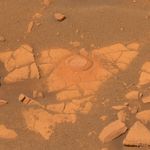
NASA's Mars Exploration Rover Opportunity recently stopped to analyze an exposure of rock near "Beagle Crater," on a target nicknamed "Baltra." Nearly 100 sols, or Martian days, had passed since Opportunity had last analyzed one of the now-familiar rock exposures seen on the Plains of Meridiani. The rover ground a 3-millimeter-deep (0.12-inch-deep) hole in the rock using the rock abrasion tool on sol 893 (July 29, 2006) while stationed about 25 meters (82 feet) from the southwest rim of Beagle Crater.
Scientists wanted to analyze the outcrop one more time before driving the rover onto the ring of smooth material surrounding "Victoria Crater." Opportunity's analysis showed the rock to be very similar in its elemental composition to other exposures encountered during the rover's southward trek across Meridiani Planum.
Opportunity acquired the image data shown here shortly after noon on Mars on sol 896 (Aug. 1, 2006) with the panoramic camera (Pancam), after backing up 1 meter (3.3 feet) from Baltra to assure that the target was in sunlight. This is an approximately true-color Pancam image, generated from mathematical combinations of calibrated left-eye images using filters ranging from 432-nanometer to 753-nanometer wavelengths.