




















Description
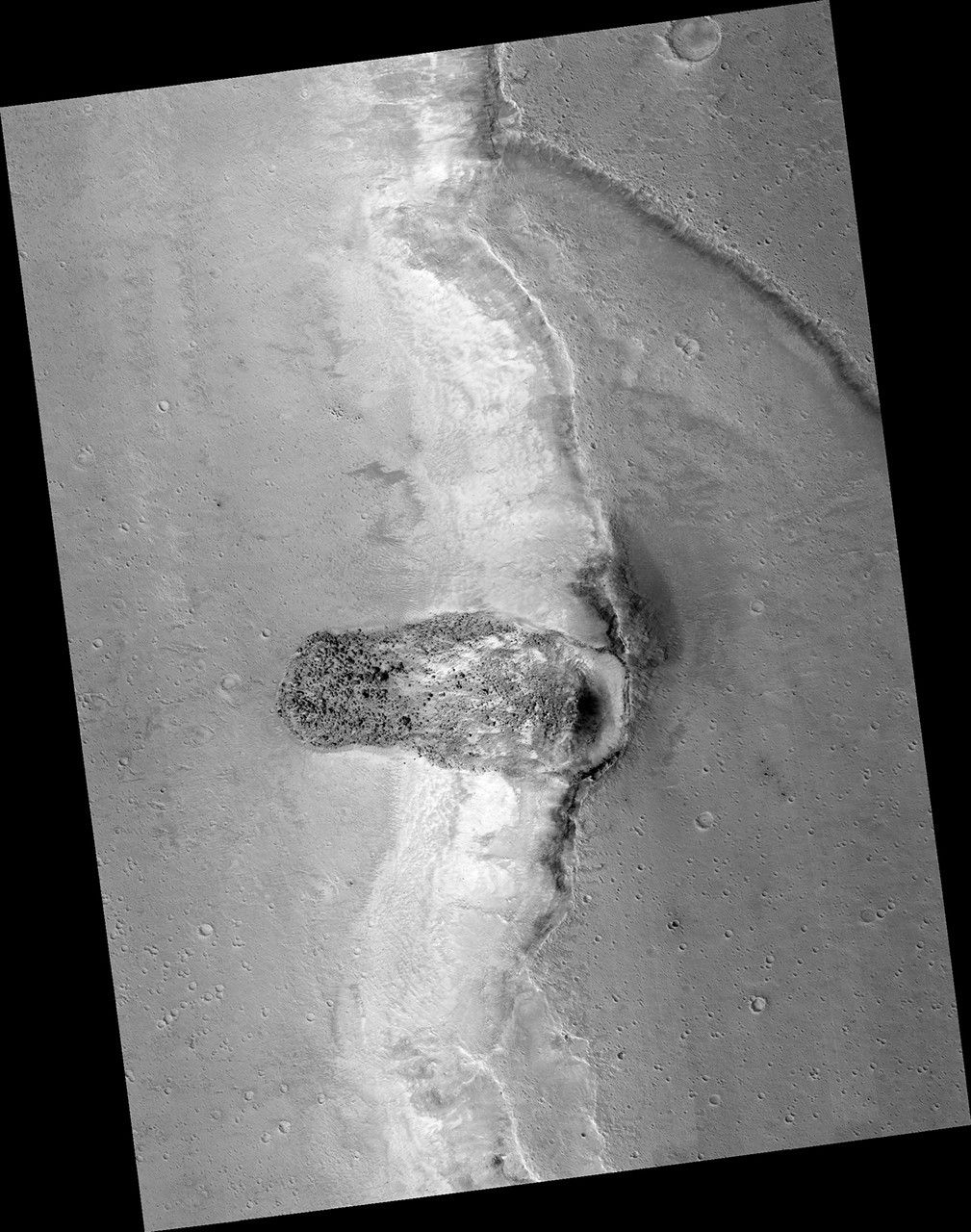
Map Projected Browse Image
Click on the image for larger version
This image NASA's Mars Reconnaissance Orbiter (MRO) finally completes a stereo pair with another observation acquired in 2007. It shows a fresh (well-preserved) landslide scarp and rocky deposit off the edge of a streamlined mesa in Simud Valles, a giant outflow channel carved by ancient floods.
The stereo images can be used to measure the topography, which in turn constrains models for the strength of the mesa's bedrock. Do look at the stereo anaglyph.
This is a stereo pair with PSP_005701_1920.
The map is projected here at a scale of 25 centimeters (9.8 inches) per pixel. [The original image scale is 31.5 centimeters (12.4 inches) per pixel (with 1 x 1 binning); objects on the order of 94 centimeters (37 inches) across are resolved.] North is up.
The University of Arizona, Tucson, operates HiRISE, which was built by Ball Aerospace & Technologies Corp., Boulder, Colo. NASA's Jet Propulsion Laboratory, a division of Caltech in Pasadena, California, manages the Mars Reconnaissance Orbiter Project for NASA's Science Mission Directorate, Washington.