






















Description
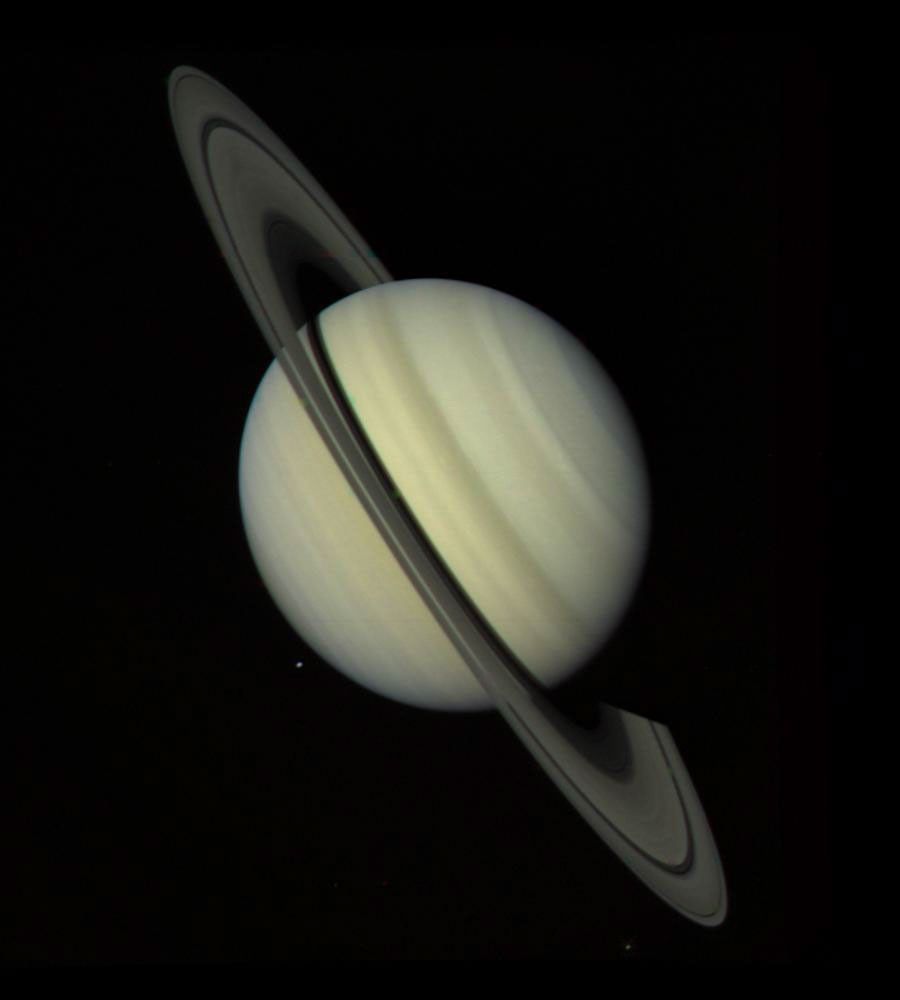
NASA's Voyager 1 took this photograph of Saturn on Oct. 18, 1980,34 million kilometers (21.1 million miles) from the planet. The photograph was taken on the last day that Saturn and its rings could be captured within a single narrow-angle camera frame as the spacecraft closed in on the planet for its nearest approach on Nov. 12. Dione, one of Saturn's inner satellites, appears as three color spots just below the planet's south pole. An abundance of previously unseen detail is apparent in the rings. For example, a gap in the dark, innermost ring, called the C-ring or crepe ring, is clearly shown. Material is seen within the relatively wide Cassini Division, separating the middle, B-ring from the outermost ring, the A-ring. The Encke Division is shown near the outer edge of the A-ring. The detail in the rings' shadows cast on the planet is of particular interest: the broad, dark band near the equator is the shadow of the B-ring; the thinner, brighter line is just to the south of the shadow of the less dense A-ring. The Voyager Project is managed for NASA by the Jet Propulsion Laboratory, Pasadena, Calif.