

















A NASA-sponsored team has developed electronics that can operate reliably in the harsh radiation and temperature conditions found on distant planetary bodies like Europa, an ocean world orbiting Jupiter. Not only could this new technology enable autonomous sensors and robotic exploration of distant ocean worlds, it could also support NASA’s goal to establish human outposts on the Moon and Mars by enabling electronic systems to function in those cold regions with reduced heating requirements.

Numerous bodies in our solar system are believed to contain water in the form of ice, vapor, or liquid on or below the surface. These ocean worlds include planetary moons like Jupiter’s Europa and Ganymede, and Satern’s Enceladus and Titan; the dwarf planet Pluto; and even comets and Uranus. The liquid water beneath ice crusts on ocean worlds can offer insights about the origins of our solar system and provide clues that could enable us to discover life elsewhere in the universe.
Unfortunately, exploring these locations is challenging. Ocean world environments are very harsh, with high radiation levels (5 Mrad of ionizing radiation, which is 50 times more than is lethal to humans) and extremely low temperatures (-180°C). Missions to explore these destinations require electronics for sensing, control, and communications that can function under such unforgiving conditions. It would be particularly advantageous if these electronic systems could operate not only on the surfaces of these worlds, but also underwater or in bores drilled through ice caps. In addition, such systems will need to meet very low size, weight, power, and cost (SWaP-C) requirements to enable their accommodation in missions traveling to such distant locations. NASA is sponsoring a promising effort to develop the electronics infrastructure needed to explore distant ocean worlds.
A team at Georgia Tech in Atlanta led by Professor John D. Cressler and assisted by personnel at NASA’s Jet Propulsion Laboratory in Southern California and the University of Tennessee-Knoxville is working to develop and demonstrate robust silicon-germanium (SiGe) electronics that can survive both the intense radiation and low temperatures found on ocean worlds. Previous missions to the Moon and Mars have necessarily enclosed their electronic systems in protective “warm boxes” to shield them from radiation exposure and maintain Earth-like temperatures to ensure robust operation, but this approach for ocean worlds is not viable due to the severe SWaP-C constraints imposed.
For ocean world missions, the envisioned electronics should be commercially available; flexible, supporting various application needs like communications, instrumentation, and control; highly integrated, supporting digital, analog, and radio frequency (RF) functions in a small form factor; and low-cost. These electronic systems should also provide order-of-magnitude improved SWaP-C advantages without requiring a power-hungry, heavy, and bulky protective warm box. The Georgia Tech-led team has demonstrated that silicon-germanium (SiGe) technology can satisfy these needs, achieving robust operation down to -180ºC, with simultaneous radiation exposure as high as 5 Mrad. However, this SiGe technology requires additional development before it becomes commercially available.
Transistors are the fundamental building blocks of electronics, enabling useful functionalities such as on/off switching and amplification. The ability of SiGe transistors to operate reliably and with higher speeds at extremely cold temperatures is a direct consequence of the internal physics of the device. SiGe transistors incorporate a nanoscale SiGe alloy, which acts to accelerate electrons moving through the transistor as it switches on and off, and this effect is amplified as the temperature drops, yielding faster operation when cold. Furthermore, since the transistor’s physical structure incorporates the SiGe alloy, the portions of the transistor that are typically made from radiation-soft oxides (materials that experience significant degradation when exposed to radiation) are dramatically minimized, improving overall radiation tolerance of the device. The result is a win-win for operating SiGe transistors at cold temperatures in a high-radiation environment, as is found on ocean worlds and in other extremely cold environments in the solar system.

Cressler’s team developed ocean-worlds-ready transistor models for electronic circuit design and used them to create and test analog and RF electronic SiGe building blocks that would not require containment in a warm-box to operate on ocean worlds, thus reducing the system’s size, weight and power requirements. They used a component library (analog, digital, and RF circuit building blocks) to create an integrated circuit (IC) prototype as proof-of-concept, validating it to a Technology Readiness Level (TRL) of 5/6 (i.e., validation and demonstration on Earth in an environment that simulates the conditions on an ocean world as closely as possible).
A major milestone for the project was the conception, design, and demonstration of a power-efficient X-band (8-12 GHz) SiGe RF communications link that is less than 10 mm2 in size (see the above image on the lower right) and operates flawlessly, while pumping modulated RF data at -180ºC and being simultaneously exposed to 5 Mrad of radiation. Design and test of a system with these unique capabilities had never been accomplished before. This type of SiGe RF communications link could enable ocean worlds missions by serving as an electronic data interface to distributed sensor networks, a lander, an orbiter, or ice cap boring machinery and submersibles.
Outputs of this project include design files for the SiGe component library and an associated electronic design ecosystem (transistor models, test results, documentation, best practices for design and testing, etc.). These products are available for NASA reuse and can be directly infused into future NASA missions. These new SiGe elements could support a wide variety of electronic needs for ocean world missions and other missions that need to function in cold temperatures, including communications systems, sensors, instruments, control systems, etc., each of which could operate without protection in an autonomous fashion.
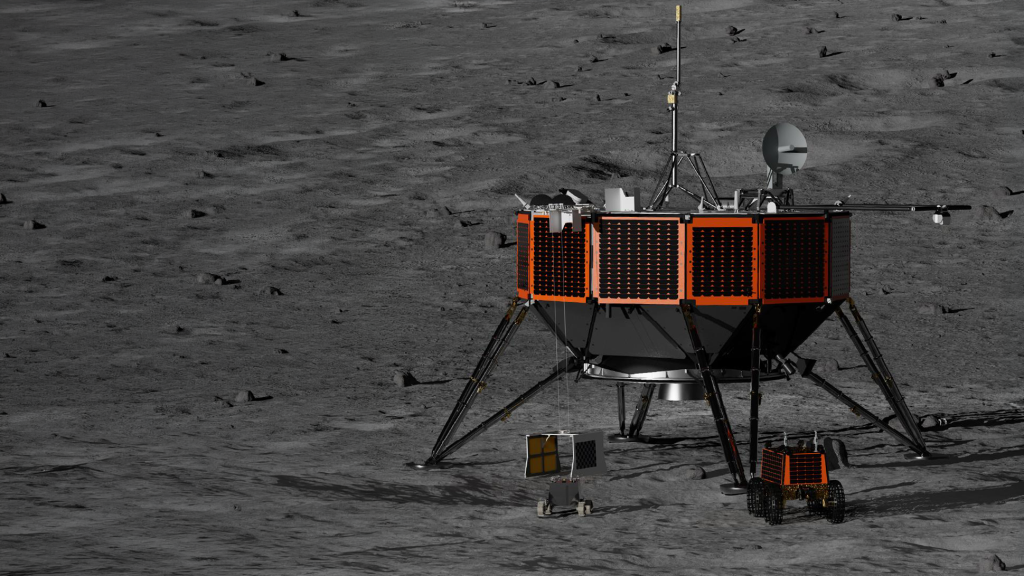
Given that ocean worlds represent the worst-case environmental conditions found in the solar system in terms of the combination of radiation and cold temperatures, SiGe components developed during this project also have direct and immediate applicability for use on the Moon, on Mars, and even in Earth orbit. For instance, to enable lunar exploration and eventual human settlement, SiGe electronics could operate autonomously on the lunar surface (which features modest radiation exposure, but very cold temperatures), boosting infrastructure and exploration capabilities. For example, SiGe radar sensors and communications links could operate unprotected on the boom of a lunar rover during nighttime traverses near the equator and with reduced heating requirements when operating in the permanently shadowed craters of the Moon, thereby enhancing mission capabilities.
For additional details, see the entry for this project on NASA TechPort.
Project Lead(s): John D. Cressler (Georgia Tech)
Sponsoring Organization(s): NASA Planetary Science Division’s COLDTech program.