





















Description
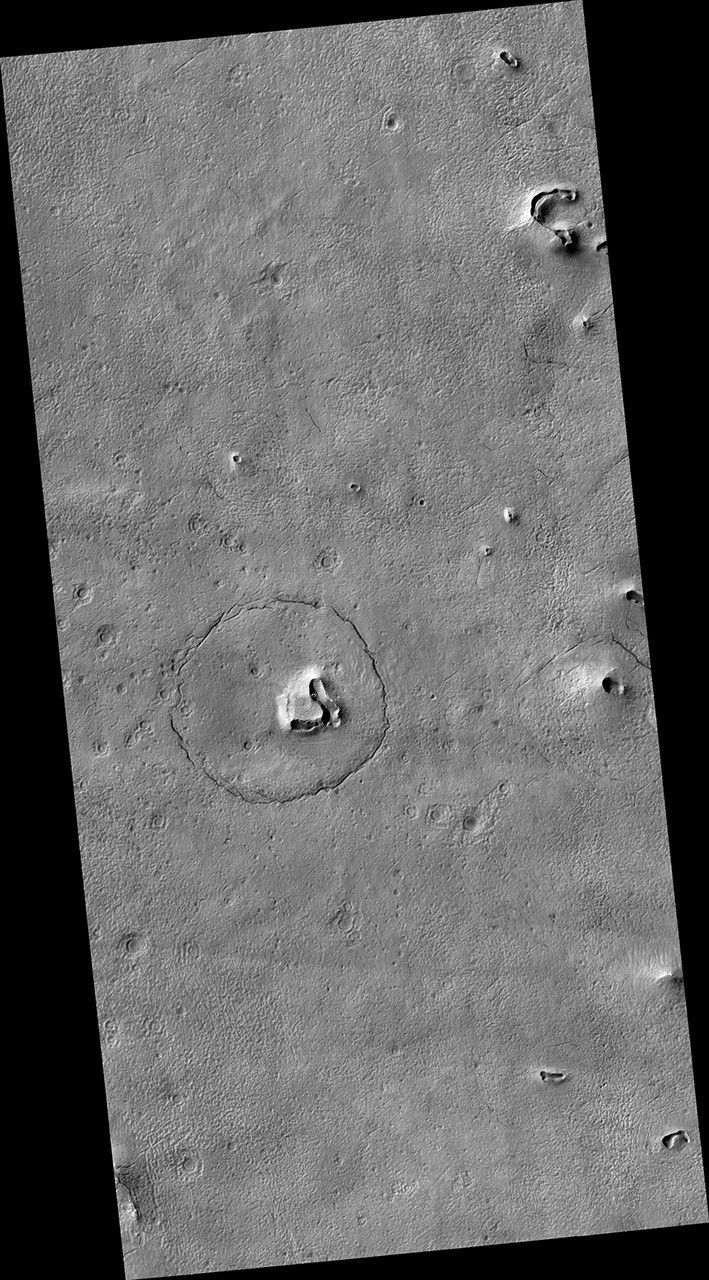
Map Projected Browse Image
Click on image for larger version
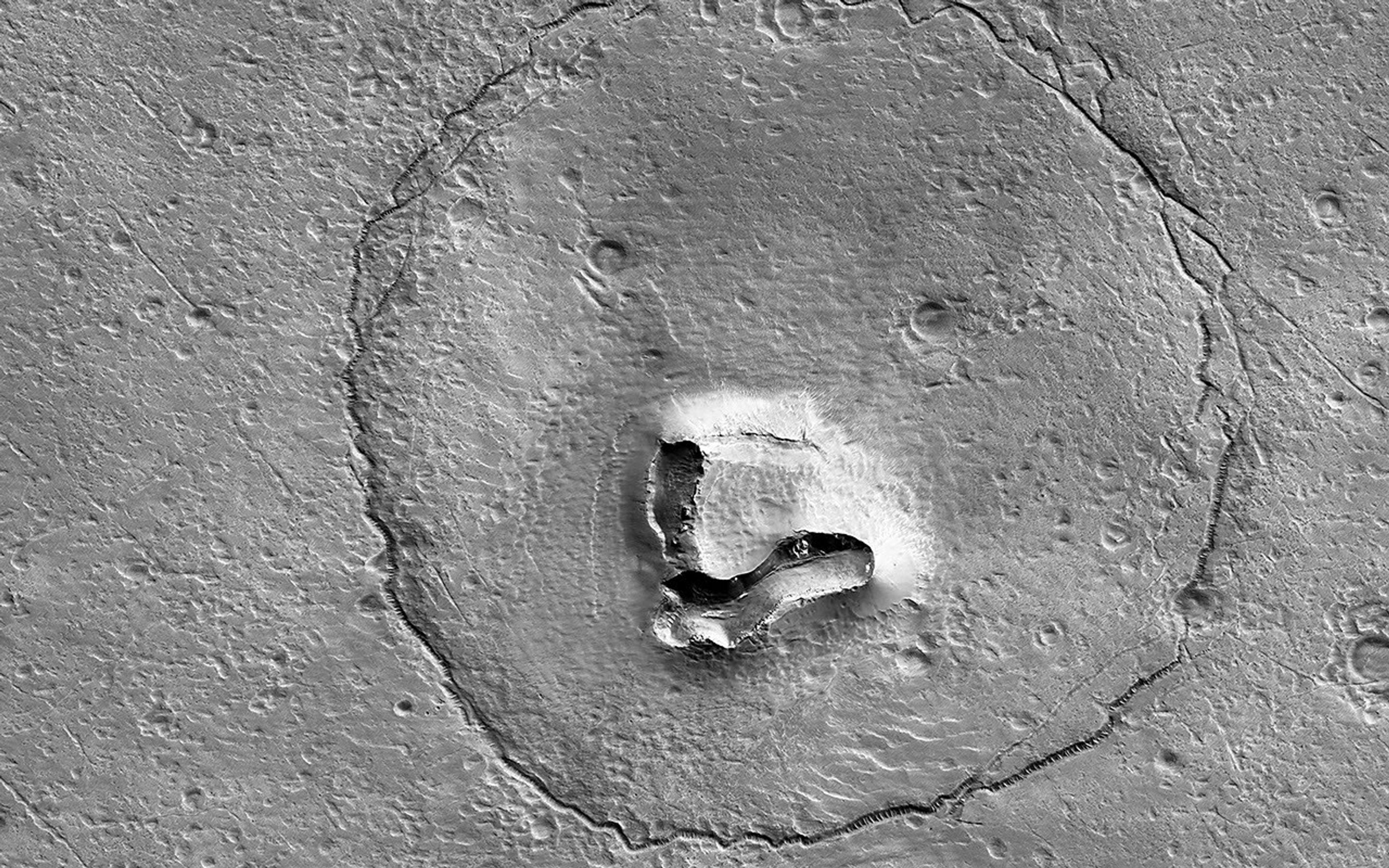
This feature looks a bit like a bear's face. What is it really?
There's a hill with a V-shaped collapse structure (the nose), two craters (the eyes), and a circular fracture pattern (the head). The circular fracture pattern might be due to the settling of a deposit over a buried impact crater. Maybe the nose is a volcanic or mud vent and the deposit could be lava or mud flows?
Maybe just grin and bear it. (Check out the stereo anaglyph!)
The map is projected here at a scale of 25 centimeters (9.8 inches) per pixel. (The original image scale is 26.0 centimeters [10.2 inches] per pixel [with 1 x 1 binning]; objects on the order of 78 centimeters [30.7 inches] across are resolved.) North is up.
This is a stereo pair with ESP_076347_1380.
The University of Arizona, in Tucson, operates HiRISE, which was built by Ball Aerospace & Technologies Corp., in Boulder, Colorado. NASA's Jet Propulsion Laboratory, a division of Caltech in Pasadena, California, manages the Mars Reconnaissance Orbiter Project for NASA's Science Mission Directorate, Washington.