



















Physics of the Cosmos
The Fornax Initiative
A NASA Astrophysics Science Platform
About Fornax
Bringing Together Data, Compute, and Software So That Astronomers Can Focus on Science
NASA Astrophysics is developing the Fornax Initiative in collaboration with the NASA Astrophysics Archives and GSFC’s Astrophysics Projects Division (ApPD).
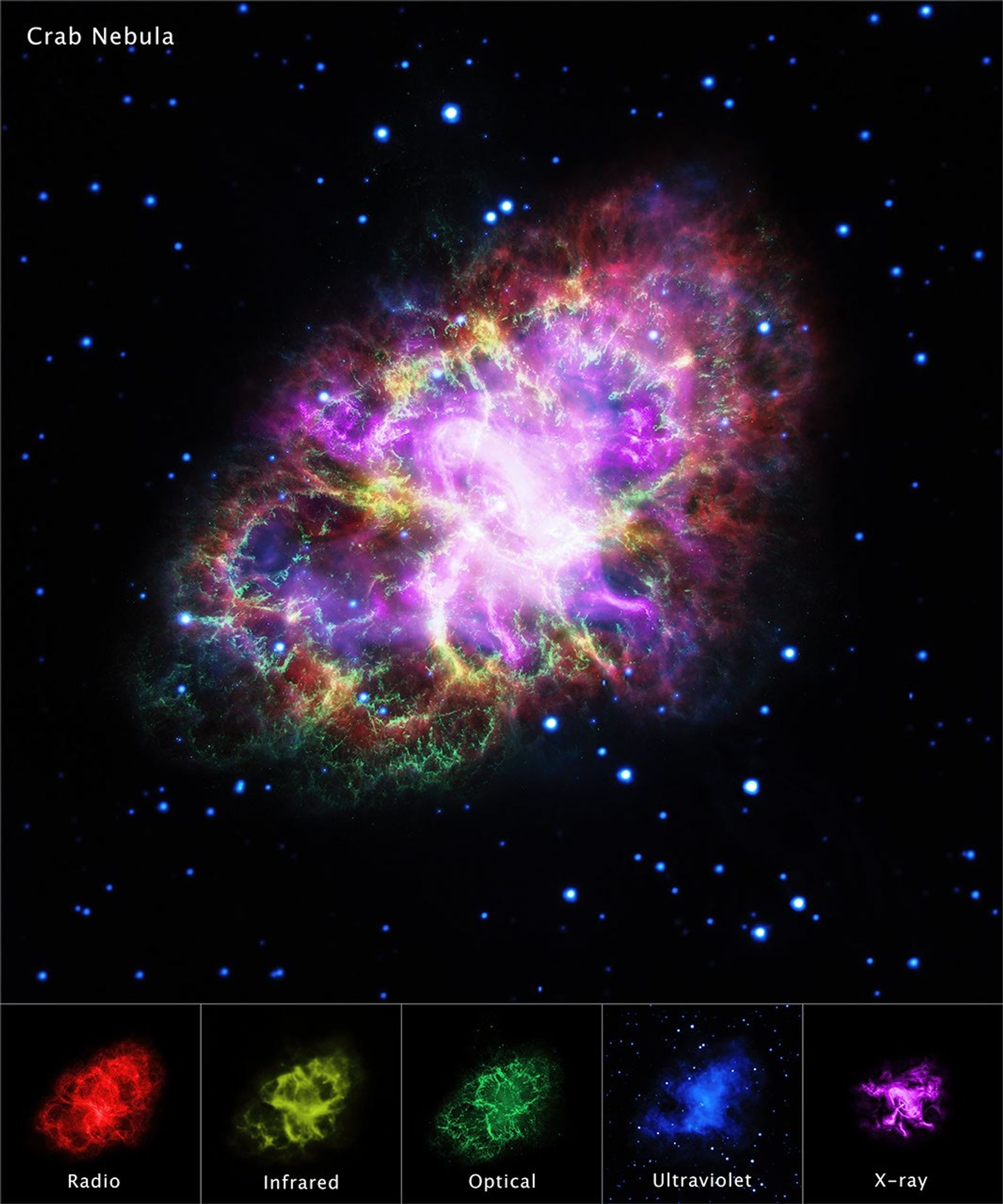
Fornax Welcomes Beta Users
NASA’s Fornax Initiative is now accepting beta users on its Science Console, a JupyterLab environment in the cloud for computing next to NASA astrophysics archival data. Cloud data in the HEASARC, IRSA, and MAST archives can be used directly in the Fornax Science Console, including Euclid, SPHEREx, JWST, Fermi, and others. Users can also import their own datasets, with some size restrictions.
The Fornax Science Console can be accessed with a Web browser and contains pre-installed data analysis software plus Jupyter tutorial notebooks for common analysis tasks. Beta users get an account with cloud resource “credits” that can be used for compute, storage, etc. There is no charge to users.
In this beta phase, we are admitting people doing research in astrophysics. We are looking for you to inform us about what resources and features the community needs, so if you require anything, please do not hesitate to ask the helpdesk. We can add credits if you have a scientific use case that requires more than our initial estimate, for example. If there is something you need and cannot see how to do, again, please ask. We may know a solution, and if we do not, your input can be added to the list of improvements under development.
For further information see:
- Fornax Quick Start Guide - to get an account and get started
- Fornax User Documentation - detailed info about Fornax and the Fornax Science Console
- Fornax JupyterHub Notebooks - notebooks that run in the Science Console or standalone
- Fornax Community Forum - ask questions, connect with other users, find support
What Is Fornax?
NASA's Astrophysics missions generate vast and complex datasets offering immense scientific potential. The vital role of NASA's Astrophysics archives in mission success is evident, as they have demonstrated that user-focused, technologically-rich data systems are key science multipliers. As the Astronomy 2020 Decadal Review emphasized, in the coming decade, frontier science will be done with multi-wavelength and multi-messenger analysis across large, complex data sets, which will only increasing the challenges of accessing big data, maintaining software, and obtaining sufficient computing resources.
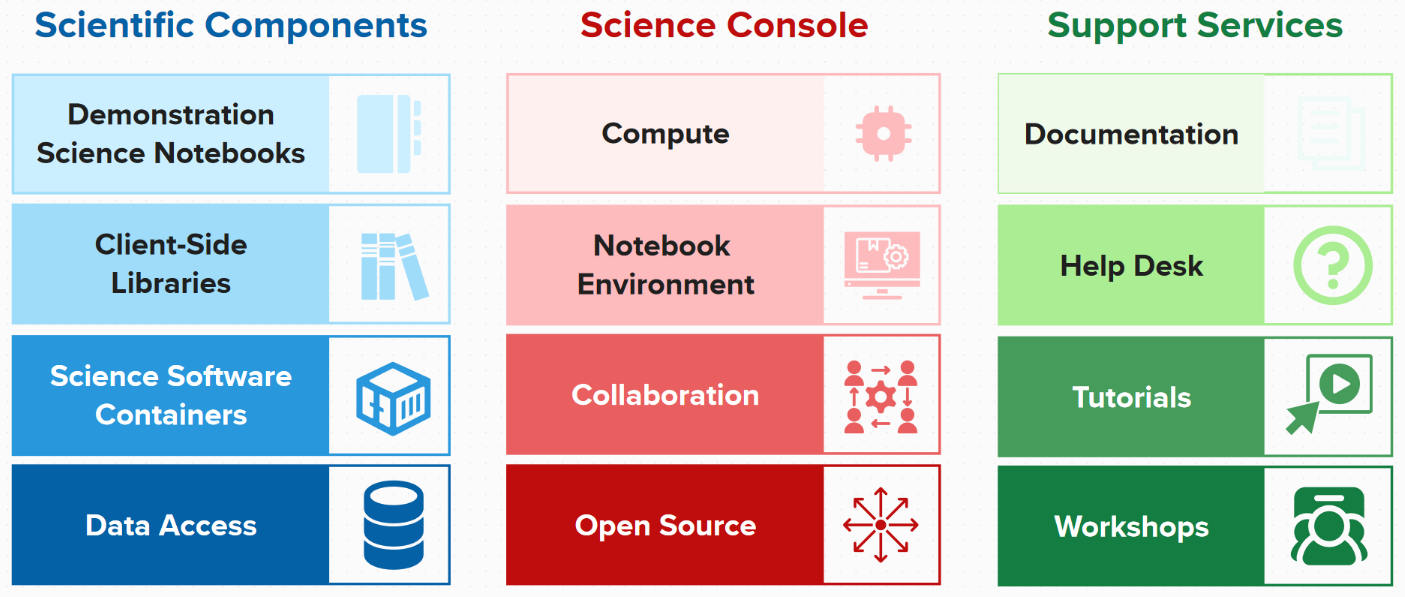
Fornax Scientific Components, the astrophysics-specific elements required to enable science in the cloud, including Python notebooks that demonstrate access to cloud-hosted NASA mission data, curated astrophysics software environments, and cloud-native services to support common astronomy workflows.
Fornax Science Console, a web-based application that users log into for access to cloud computing, data storage, and interactive data analysis in JupyterLab.
Science Support Systems, a program of engagement with the astronomical community, including a Helpdesk and training opportunities.
Our goal is to support the science needs of a wide range of users, from those who are learning Python and would simply benefit from having access to a maintained Python environment for common astrophysics software to those who wish to perform complicated analyses that require significant cloud computing. For use cases that require more computing than can be provided by NASA through Fornax, we will build the system such that scientists can use the Fornax Scientific Components and the Fornax Science Console with their own cloud computing resources. This commitment to including all users is at the heart of how Fornax will realize the promise of the cloud in supporting Open Science.
Fornax Science Console
- Console Login (sign up for a beta account here)
- Documentation and Notebooks
- Community Forum
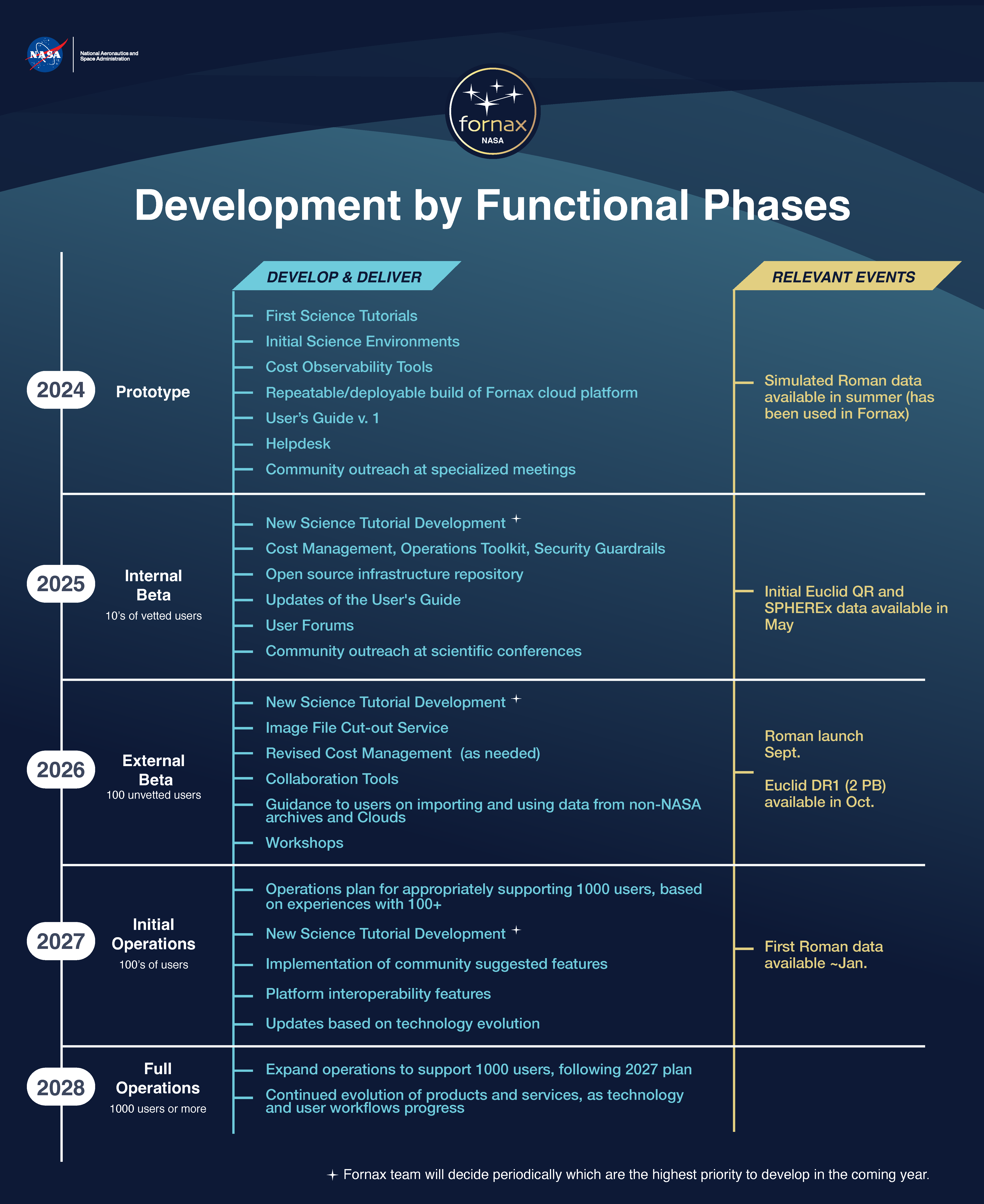
The Fornax Timeline
The Fornax Team
News & Events
Meetings, conferences, seminars, workshops, and other news and events for The Fornax Initiative

The Fornax Initiative is seeking researchers to participate in a virtual User Panel and provide feedback on NASA’s multi-mission, multi-archive cloud-based infrastructure for astrophysics research.

Fornax Initiative at the 248th AAS Meeting. 14-18 June 2026.

NASA’s Fornax Initiative is now accepting beta users on our Science Console, a JupyterLab environment in the cloud for computing next to NASA astrophysics archival data.
Fornax Science Highlights
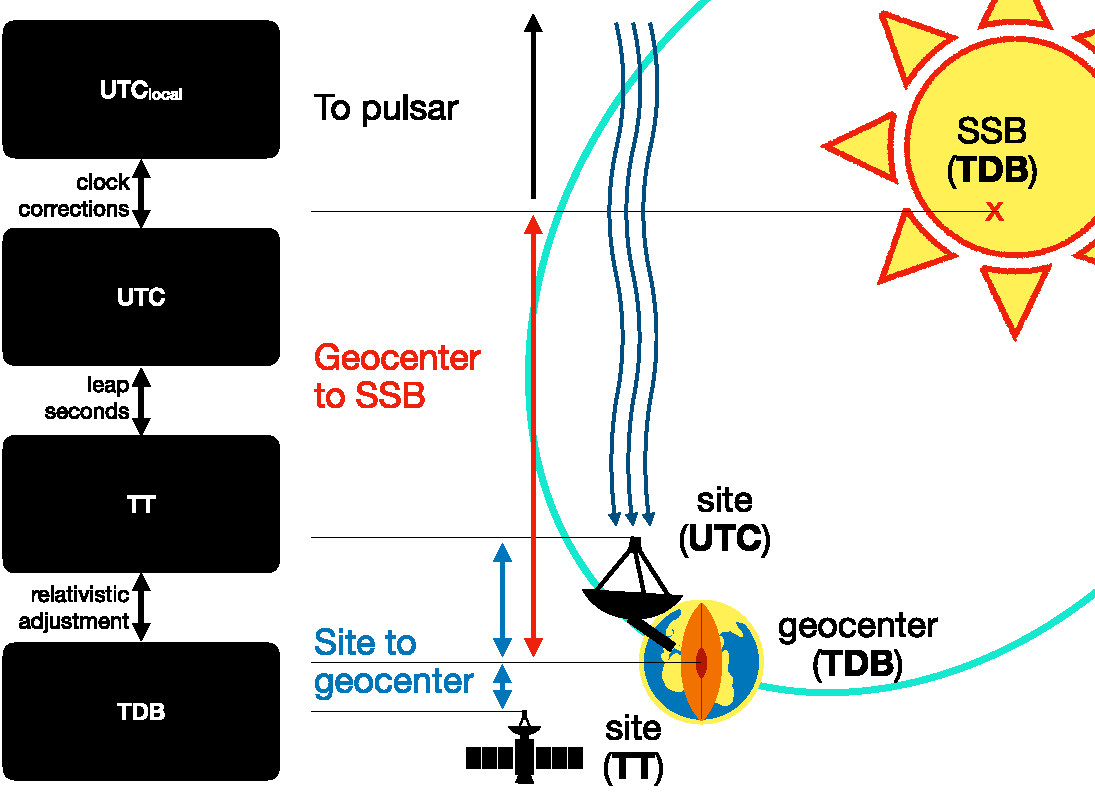
A Simple, Flexible Method for Timing Cross-Calibration of Space Missions
Open source method for cross-calibration of the microsecond timing accuracy of 15 different missions using thirty years of Crab Pulsar data.
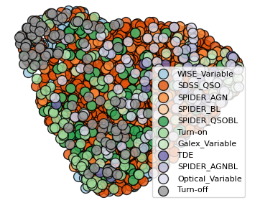
Reducing the Dimensions of Active Galactic Nuclei Lightcurve Manifolds
Using machine learning to characterize the multi-wavelength time-domain behavior of a sample of AGN.
News Straight to Your Inbox
Subscribe to your community email news list
We will never share your email address.