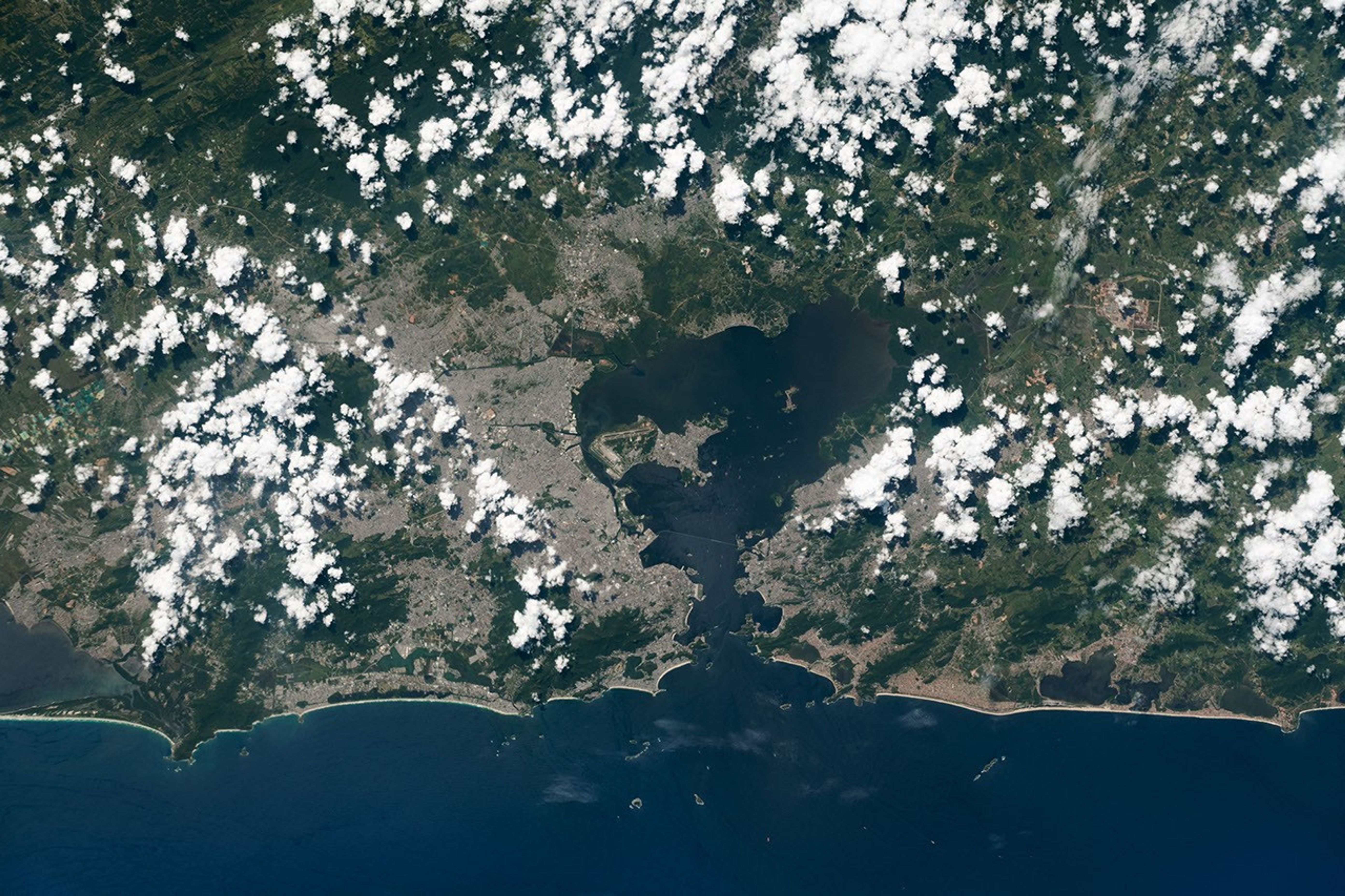












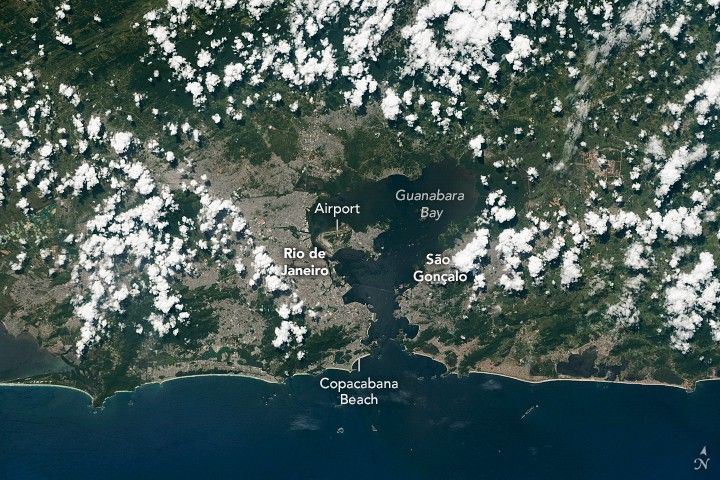
Popcorn clouds dot the landscape over the Brazilian cities of Rio de Janeiro and São Gonçalo in this photograph taken by an astronaut looking down from the International Space Station (ISS). Rio de Janeiro is home to more than 6.5 million people.
Clouds had formed over rural areas and densely populated cities but are noticeably absent above Guanabara Bay, the coastal lagoons, and the ocean due to the mechanisms of cloud formation. Heat from the Sun warms the land surfaces in the area, which then warms the air directly above it. That warm air, and all of its cloud-making water vapor, then rises and condenses into clouds.
Bodies of water, on the other hand, do not change temperature as rapidly; the water remains cooler even during full Sun exposure. The water does not heat up enough to significantly warm the air above it, preventing air from rising to make clouds. This, and many additional climate processes, can be traced to the different average heat capacity of water and land.
The cloudless window over Guanabara Bay allows for a view of its largest island, Governador Island. A sharp boundary separates the telltale shapes of the runways of Rio de Janeiro-Galeão International Airportâs and the densely populated eastern half of the island. The famed beaches of the area, such as Copacabana, line the Atlantic shore.
References & Resources
Astronaut photograph ISS062-E-113274 was acquired on March 25, 2020, with a Nikon D5 digital camera using a 140 millimeter lens and is provided by the ISS Crew Earth Observations Facility and the Earth Science and Remote Sensing Unit, Johnson Space Center. The image was taken by a member of the Expedition 62 crew. The image has been cropped and enhanced to improve contrast, and lens artifacts have been removed. The International Space Station Program supports the laboratory as part of the ISS National Lab to help astronauts take pictures of Earth that will be of the greatest value to scientists and the public, and to make those images freely available on the Internet. Additional images taken by astronauts and cosmonauts can be viewed at the NASA/JSC Gateway to Astronaut Photography of Earth. Caption by Alex Stoken, Jacobs, JETS Contract at NASA-JSC.