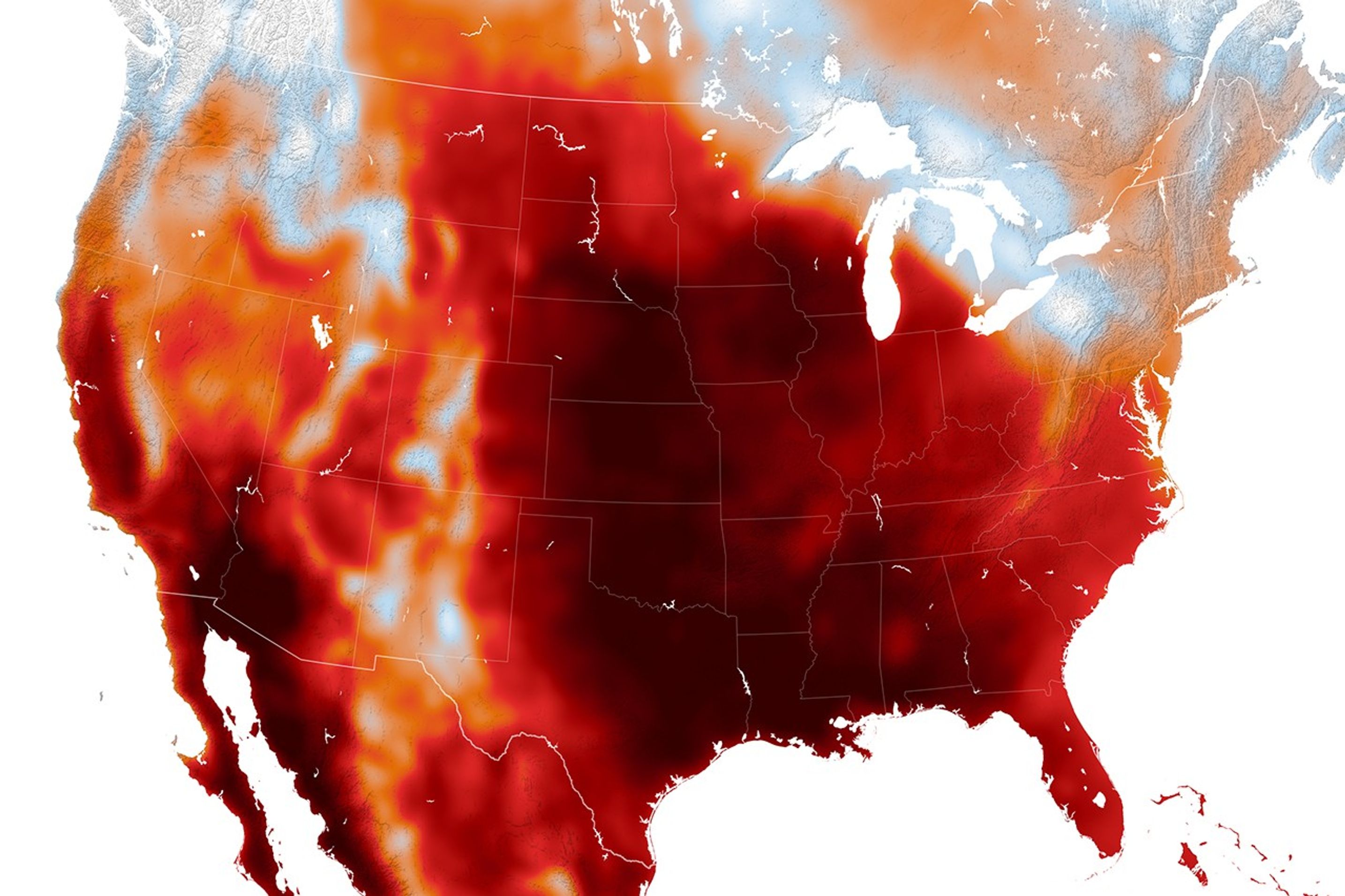




























High heat and humidity blanketed many states in the U.S. South, Midwest, and Great Plains in late August of 2023, when a large area of high pressure and warm air, often referred to as a heat dome, parked over the interior United States.
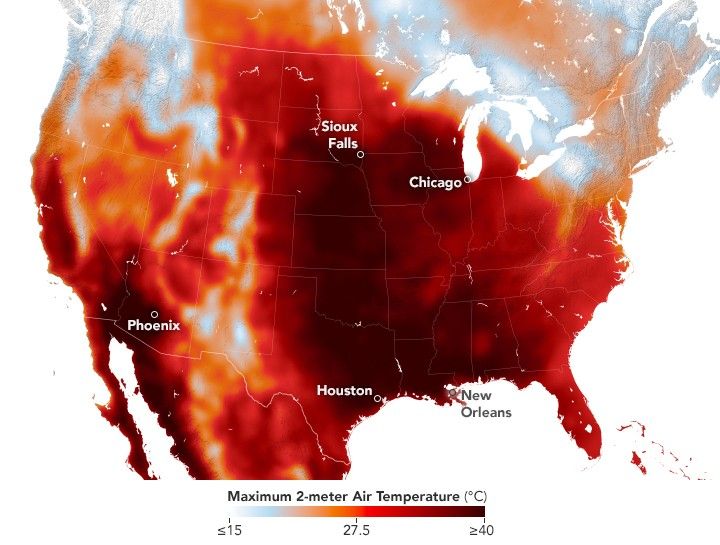
The map above shows air temperatures modeled at 2 meters (6.5 feet) above the ground at about 3 p.m. Central Time on August 23, 2023. It was produced by combining satellite observations with temperatures predicted by a version of the Goddard Earth Observing System (GEOS) model, which uses mathematical equations to represent physical processes in the atmosphere. The darkest reds indicate areas where temperatures exceeded 104°F (40°C).
Many areas across the middle of the country sweltered under record or near-record heat in this stretch of weather. New Orleans, Louisiana, tied its previous record high, set in August 1980. The temperature topped out at 102°F (39°C) on August 23 at the Louis Armstrong New Orleans International Airport. Houston, Texas, nearly tied its record of consecutive days over 100°F (38°C), while Sioux Falls, South Dakota, tied their hottest daily low temperature of 81°F (27°C).
High humidity, owing to moisture drawn from the Gulf of Mexico, contributed to the extreme nature of the heat wave. Chicago, Illinois, experienced a heat index of 116°F (47°C) on August 23, which ties its second highest on record. The higher the heat index, which indicates how hot it feels when accounting for both temperature and relative humidity, the harder it is for the human body to cool itself. Commuter trains in the city had to run slower due to heat-related stress on the tracks. More than 100 million people may have been exposed to dangerous heat and humidity for multiple days, according to one analysis by The Washington Post.
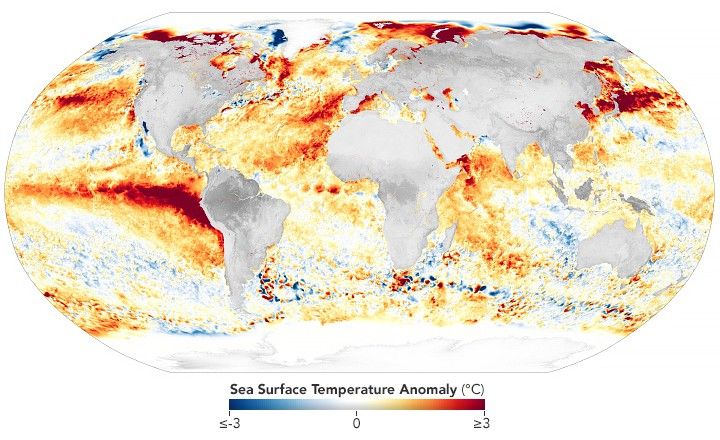
The heat dome in the United States is but one of several bouts of hot weather occurring around the world. Another stretch of extreme heat is gripping southern Europe, while scores of new temperature records are being set in Japan. Even winter weather in the Southern Hemisphere is unusually warm.
Stateside, a cold front could bring relief to much of the Midwest by August 26, according to the National Weather Service’s Weather Prediction Center. However, the southern plains and Gulf Coast may experience several more days of excessive heat.
References & Resources
- NASA Climate (2022, March 9) Too Hot to Handle: How Climate Change May Make Some Places Too Hot to Live. Accessed August 25, 2023.
- NBC News (2023, August 23) Dangerous heat for over 93 million in Midwest and South. Accessed August 25, 2023.
- NWS Weather Prediction Center (2023, August 25) Short Range Forecast Discussion. Accessed August 25, 2023.
- The Washington Post (2023, August 24) Heat records are being smashed in multiple parts of the globe. Accessed August 25, 2023.
- The Washington Post (2023, August 25) Where extreme heat will pose the biggest threat: Look up your city. Accessed August 25, 2023.
- The Weather Channel (2023, August 25) Relief From Triple-Digit, Record Heat Is Ahead For Plains, Midwest And Parts Of The South. Accessed August 25, 2023.
NASA Earth Observatory image by Lauren Dauphin, using GEOS-5 data from the Global Modeling and Assimilation Office at NASA GSFC. Story by Lindsey Doermann .