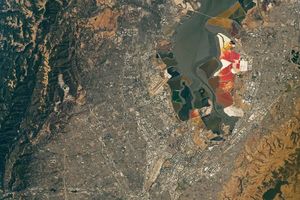













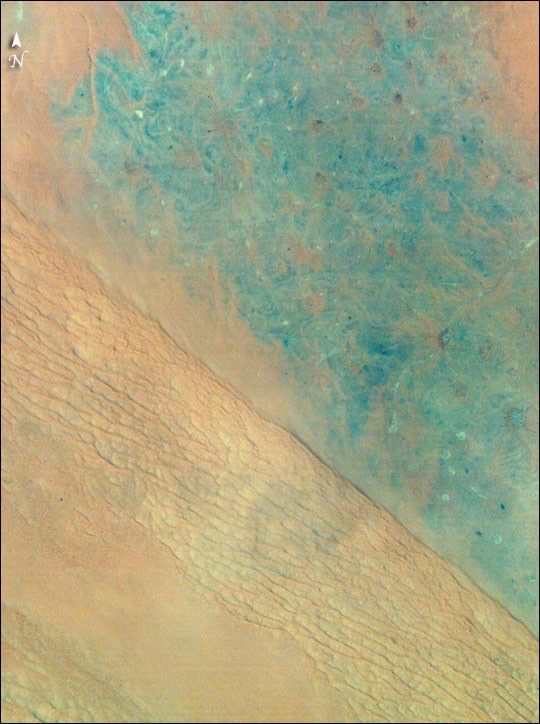
Driven by northwesterly winds, sands from northwest Saudi Arabia have accumulated in the center of the country as great rivers of dunes (cordons) that extend for hundreds of kilometers. About 320 kilometers northwest of Riyadh, the steep, almost cliff-like margin of the Ad Dahna cordon casts a shadow (right center; diagonally across the scene). Two types of dune surface appear: the tracery of numerous linear dunes (center) and a featureless sand sheet (lower left). Dark, older rocks (30-65 million years old—top right) underlie the sand sea and crop out northeast of the cordon. Convergent dry river beds appear top right.
Astronauts have obtained thousands of detailed images of the world’s remote deserts, helping scientists better understand local geomorphological features in a regional context.
References & Resources
Astronaut photograph ISS005-E-9293 was acquired March 13, 2003, with a Nikon D1 digital camera with an 800 mm lens and is provided by the Earth Observations Laboratory, Johnson Space Center. The International Space Station Program supports the laboratory to help astronauts take pictures of Earth that will be of the greatest value to scientists and the public, and to make those images freely available on the Internet. Additional images taken by astronauts and cosmonauts can be viewed at the NASA/JSC Gateway to Astronaut Photography of Earth .