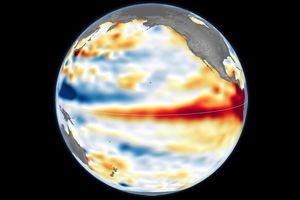

























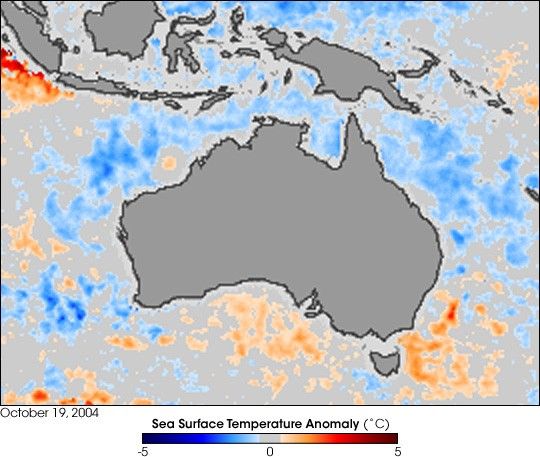
Recent satellite measurements of sea surface temperature all around Australia’s northern coastline reveal that the ocean is colder than average. These waters are situated near the center of the area known as the “Indo-Pacific Warm Pool.” While these are typically some of the warmest ocean waters on Earth, measurements acquired on October 19, 2004, by the Advanced Microwave Scanning Radiometer for EOS (AMSR-E), aboard NASA’s Aqua satellite, show that the region is anomalously cool.
Should this cool sea surface temperature anomaly linger for many days or even weeks, it will suppress normal atmospheric convection (upward movement of warm, moist air) which generates thunderstorms and large cloud systems—the predominant source of rain in this part of the world. If that proves to be the case, scientists warn that Australia and Indonesia could experience drought conditions as summertime approaches in the Southern Hemisphere. Moreover, parts of Australia and Indonesia could be in for another severe wildfire season.
The false-color image above represents sea surface temperature anomaly. The image is produced by comparing recent AMSR-E data to the 30-year average. Areas colored blue show cooler-than-average conditions, red indicates warmer than average, and light gray represents little or no change. Dark gray areas are land masses.
References & Resources
NASA image created by Jesse Allen, Earth Observatory Team, using AMSR-E data obtained from Remote Sensing Systems .