


























Any debate or discussion about climate change starts from the basic fact that Earth’s temperature depends on the balance between how much solar energy the Earth absorbs and how much it radiates back into space. Scientists at NASA’s Goddard Institute for Space Studies (GISS) have completed a study of the Earth’s energy balance using a combination of global climate models, ground-based measurements, and satellite observations, and they have some important news. Not only is Earth absorbing about 0.85 Watts of energy per square meter more than it is radiating back to space, but a sizable chunk of that excess energy is “hiding” in Earth’s oceans, its full effect on the climate system still unrealized.
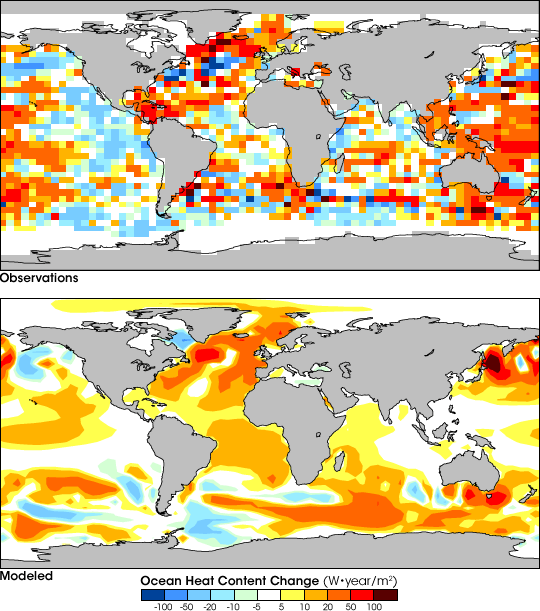
These maps show observed (top) and modeled (below) energy imbalances in the top 750 meters (2,461 feet) of the world’s oceans from 1993-2003. Areas where there was an energy surplus are shown in shades of yellow to red, while areas where there was an energy deficit are in shades of green to purple.
Ten years of observations show that Earth’s oceans absorbed an average of 6.02 excess watt-years of energy per square meter (a watt-year is the total amount of energy supplied by 1 watt of power for a year.) Model simulations are in close agreement: an average of five “runs” of the GISS climate model to simulate evolution of the climate since 1880 predicts that by 2003, the imbalance would be about 5.98 watt-years per square meter.
According to the scientists,
The present planetary energy imbalance is large by standards of Earth’s history. For example, an imbalance of 1 Watt per square meter maintained for the last 10,000 years is sufficient to melt ice equivalent to 1 kilometer of sea level (if there were that much ice), or raise the temperature of the ocean above the thermocline [the boundary layer between the warm, surface waters and the deep ocean] by more than 100° C.

Earth’s average global temperatures have not increased enough since 1880 to account for the total energy imbalance. Although some of the excess heat has gone to melt snow and ice and to warm the land surface, much of the energy imbalance that has accumulated since 1880 has been stored in the ocean and has not made its presence felt. Instead, the scientists say that in addition to the 0.6-0.7 degree Celsius warming that has happened over the past century or so, an additional 0.6-degree-Celsius increase in average global temperatures remains “in the pipeline,” even if greenhouse gas concentrations and other climate-warming influences immediately stopped increasing.
The “lag time” between when the oceans absorb excess energy and when that excess produces observable changes in global temperature can be a two-edged sword. In their introduction to their research paper, published today in the scientific journal Science, the authors wrote,
This delay provides an opportunity to reduce the magnitude of anthropogenic climate change before it is fully realized, if appropriate action is taken. On the other hand, if we wait for more overwhelming empirical evidence of climate change, the inertia implies that still greater climate change will be in store, which may be difficult or impossible to avoid.
References & Resources
NASA image courtesy Jim Hansen et. al., Goddard Institute for Space Studies