














The Italian island of Sardinia is strewn with allusions to the past, from hints of ancient civilizations—real and fantastical—to natural treasures originating in bygone eras. Thousands of stone fortresses built by Bronze Age societies stand as architectural wonders, even if their purposes are not fully understood. Lending to the air of mystery, evidence of a natural disaster about 3,000 years ago has led to speculation that modern-day Sardinia overlies the “lost city of Atlantis,” the mythical land consumed by the sea.
What is known, however, is that the island’s foundation contains rocks dating back to the Paleozoic Era, some 500 million years ago. Plate tectonics began separating Sardinia and Corsica, its island neighbor to the north, from mainland Europe around 20 million years ago. Its ensuing isolation enabled it to become a biodiversity hotspot containing dozens of species found nowhere else on the planet.
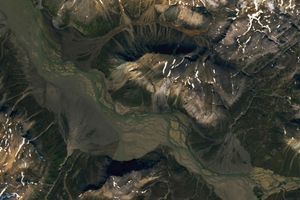
The VIIRS (Visible Infrared Imaging Radiometer Suite) on the Suomi NPP satellite captured this clear image of Sardinia, the second-largest island in the Mediterranean, in November 2024. At approximately 24,000 square kilometers (9,300 square miles) in area, it is about the size of the U.S. state of New Hampshire.
Different shades of green help differentiate the island’s varied topography. Rugged, forested mountain ranges are interrupted by low-lying plains. The highest point, at 1,834 meters (6,017 feet) above sea level, is the summit of the ultra-prominent Punta La Marmora.

One oblate patch of dark green near the center of Sardinia could be considered an island in the ecological sense. The Planu sa Giara (also called Giara di Gesturi) is a basalt plateau containing unique plant and animal life, most notably the small wild Giara horses. About 20 nuraghes, likely built in the 2nd millennium BCE, dot this plateau. These fortress-like stone structures with circular towers are just a few of the thousands that still stand on the island. One of the best examples, at the Su Nuraxi di Barumini archaeological site near the base of the plateau, is designated a UNESCO World Heritage Site.
Today, the island is home to about 1.6 million people—and nearly double that many sheep. Approximately 10,000 active farms produce a significant portion of the European Union’s sheep milk, most of which is used to make cheeses such as pecorino. Cork oaks, the source of another distinctively Sardinian product, grow in the island’s forests. Generations of workers have harvested the trees’ spongy bark to craft wine stoppers and other items.
References & Resources
- Artnet (2024, November 10) Who Were the Mysterious Builders of This Ancient Stone Megalith in Sardinia? Accessed April 9, 2025.
- Carmignani, L., et al. (2015) The geological map of Sardinia (Italy) at 1:250,000 scale. Journal of Maps, 12(5), 826–835.
- Fois, M., et al. (2022) The Endemic Vascular Flora of Sardinia: A Dynamic Checklist with an Overview of Biogeography and Conservation Status. Plants, 11(5), 601.
- The Guardian (2015, August 15) Was Sardinia home to the mythical civilisation of Atlantis? Accessed April 9, 2025.
- UNESCO World Heritage Convention (1997) Su Nuraxi di Barumini. Accessed April 9, 2025.
NASA Earth Observatory image by Wanmei Liang , using VIIRS data from NASA EOSDIS LANCE , GIBS/Worldview , and the Suomi National Polar-orbiting Partnership . Photo of Su Nuraxi di Barumini by Rens Kokke. Story by Lindsey Doermann .