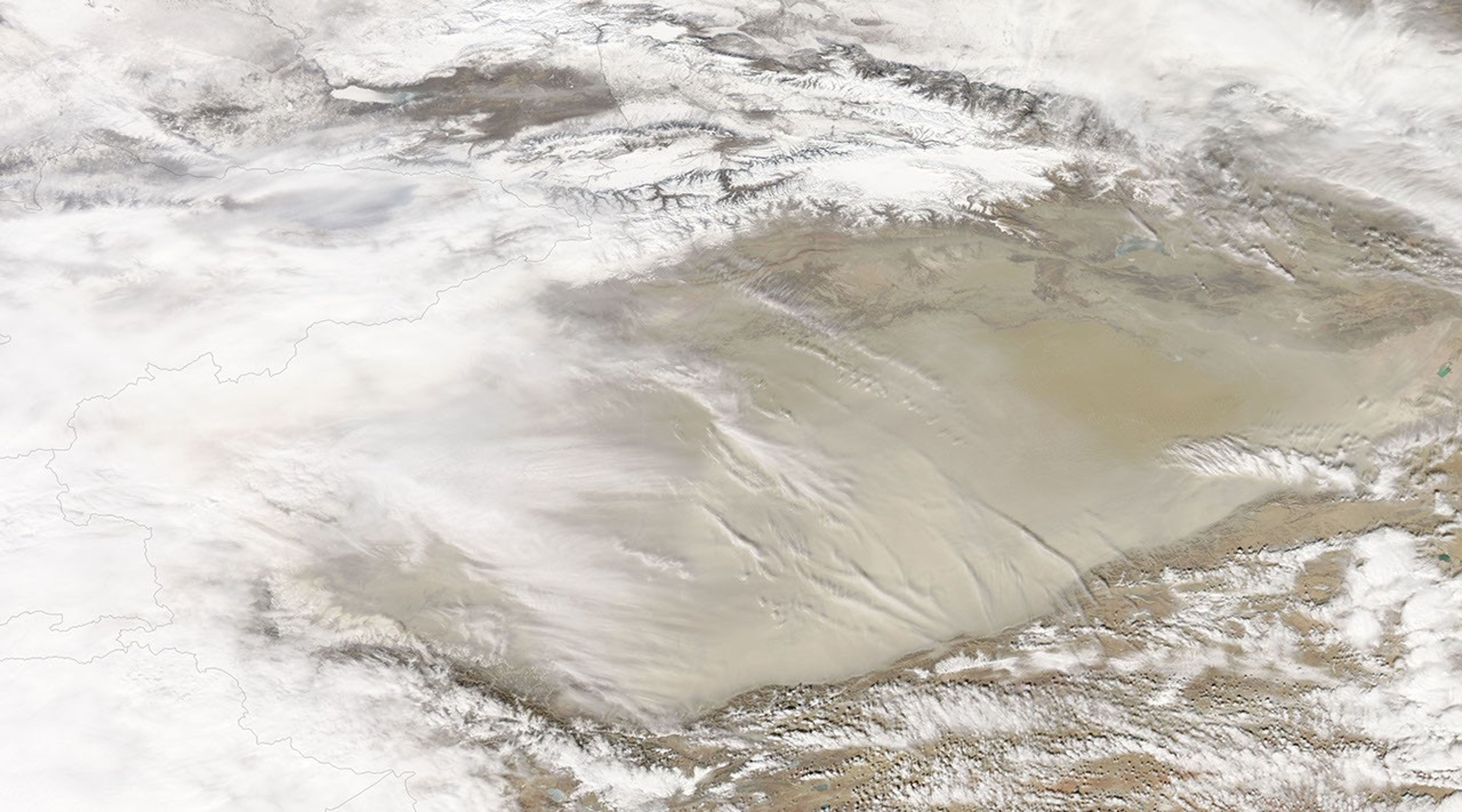






















Dust continued stirring in the Taklimakan Desert in early March 2011. The Moderate Resolution Imaging Spectroradiometer (MODIS) on NASA’s Aqua satellite captured this natural-color image on March 2, 2011.
Along the southern rim of the Tarim Basin, which the Taklimakan Desert fills, thick dust completely obscures the desert floor. Clouds hover over the dust, some of them casting shadows onto the sea of tan and beige below. Along the northern edge of the desert, skies appear clearer.
Situated between the mountain ranges of the Tien Shan (or Tian Shan) in the north, and the Kunlun Shan in the south, the Taklimakan Desert is China’s biggest, hottest, driest desert. Isolated from the effects of the Asian monsoon and Arctic storms, the desert receives little water. Lacking drainage for the water it does receive, the desert has accumulated large quantities of salt. Most of the Taklimakan is covered by mobile sand dunes.
References & Resources
- World Wildlife Fund, McGinley, M. (2007). Taklimakan Desert. Encyclopedia of Earth. Accessed March 2, 2011.
NASA image courtesy MODIS Rapid Response Team, Goddard Space Flight Center. Caption by Michon Scott.