





















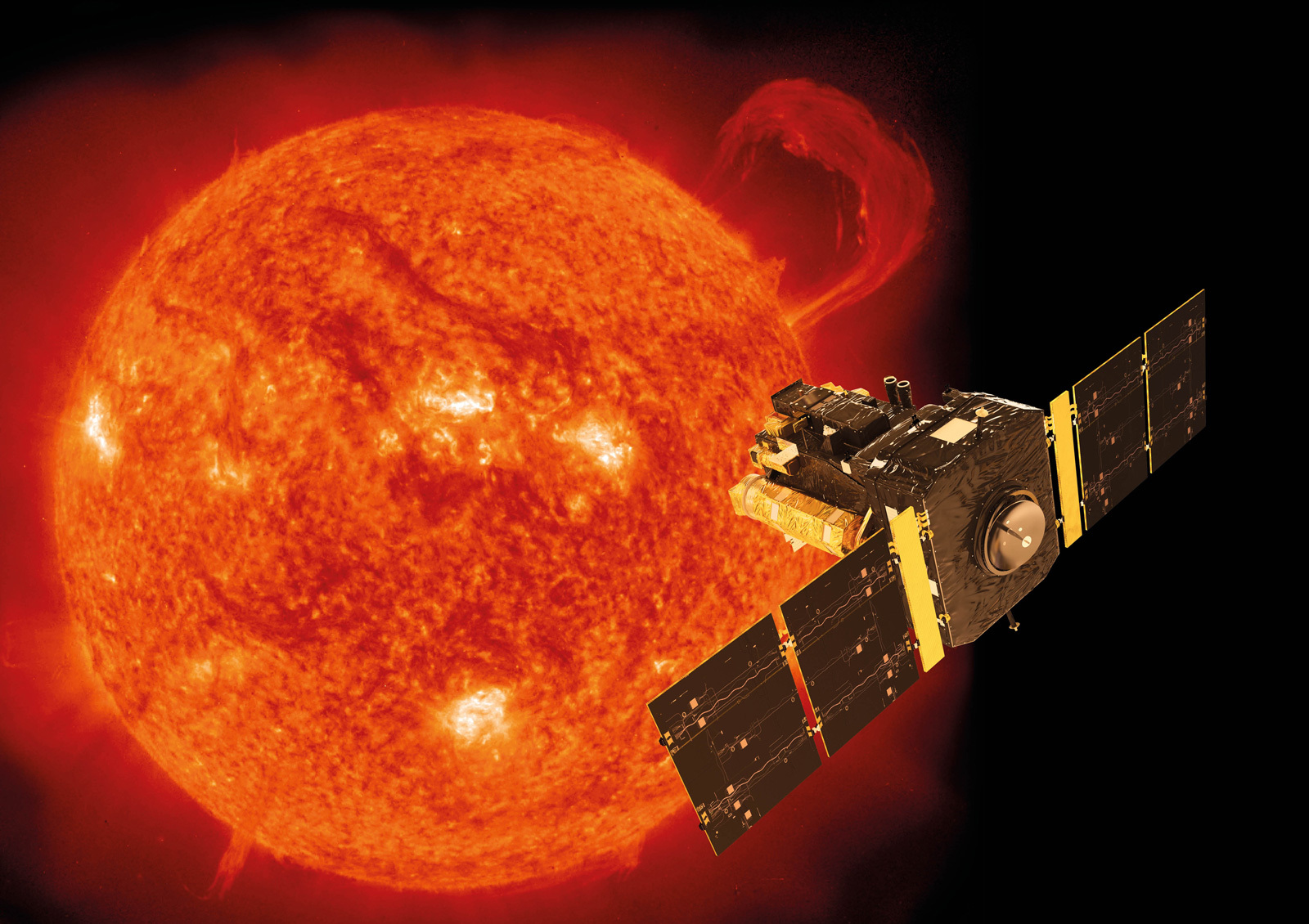
As ESA (European Space Agency) and NASA’s SOHO (Solar and Heliospheric Observatory) turns 30 on Tuesday, a lot has changed in how we understand our Sun and the space weather it creates since the mission’s launch.
When the SOHO mission began on Dec. 2, 1995, space weather — the conditions in space influenced by the Sun that can impact Earth — was a niche subject. But SOHO, designed to observe the Sun 24/7, quickly revolutionized space weather observations and forecasts.
Today, space weather has a much larger effect on our society through its impacts on GPS and communications, which rely on satellites that are more vulnerable to space weather than we are on Earth.
"The SOHO mission is a great example of the incredible partnerships between NASA and ESA,” said Nicky Fox, associate administrator, Science Mission Directorate at NASA Headquarters in Washington. "Congratulations to the NASA and ESA teams on an amazing thirty years working together."
The mission also provided the motivation for multiple successor spacecraft studying space weather, including the newly launched PUNCH (Polarimeter to Unify the Corona and Heliosphere) and the National Oceanic and Atmospheric Administration’s (NOAA’s) SWFO-L1 (Space Weather Follow On – Lagrange 1).
“The SOHO mission has shown us just how connected the Sun and Earth are and the influence the Sun has throughout the entire solar system,” said Nicole Rayl, the Heliophysics Division deputy director in the Science Mission Directorate at NASA Headquarters. “Insights from this mission — from the discovery of over 5,000 comets to unprecedented findings on solar phenomena — inspired the next generation of space weather missions, preparing us for future human and robotic explorations beyond Earth.”
By helping scientists better understand our Sun and model space weather, SOHO has also played a role in the next step in space exploration, as we look to return to the Moon and on to Mars as a part of the Artemis program.
“Astronauts living and working in space need to know what the Sun is doing,” said Jack Ireland, SOHO project scientist at NASA’s Goddard Space Flight Center in Greenbelt, Maryland. “The SOHO mission has kept an eye on the Sun for three decades, regularly sending back data that whole time.”
Three decades of discoveries
Originally launched as a two-year mission, SOHO was designed to study the Sun, inside to out. And it quickly delivered, becoming a powerhouse for observations of solar activity and making discoveries from the inner workings of the solar core to the material the Sun blows across the solar system called the solar wind.
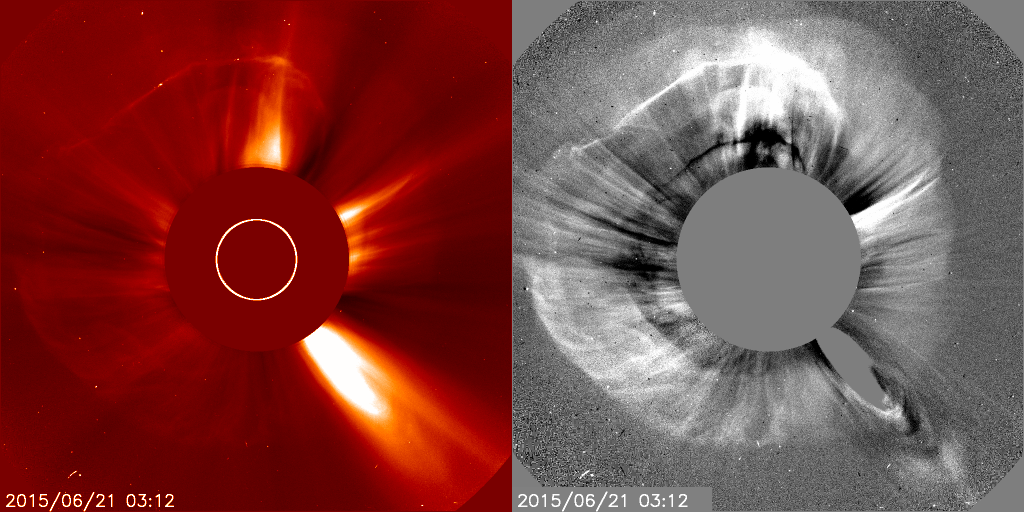
From its location at Lagrange point 1 (L1), which is approximately one million miles toward the Sun, SOHO has provided an invaluable look at space weather headed toward Earth. Notably, SOHO provided the first detailed look at giant eruptions from the Sun called coronal mass ejections, or CMEs, which can affect our technology when they reach Earth. The mission’s observations of the Sun have been so valuable to space weather prediction models the cadence of sending data back to Earth every eight hours was increased to every four hours in 2022.
Among SOHO’s other successes is the mission’s insights into the magnetic component of the Sun’s upper atmosphere and contributions to solving the long-standing solar neutrino problem, a major step forward in understanding fundamental particle physics. The mission was the first to detect sunquakes — seismic waves that across the Sun’s surface triggered by powerful solar activity and it revolutionized the study of helioseismology, which uses oscillations not unlike sound waves that travel through the Sun’s interior.
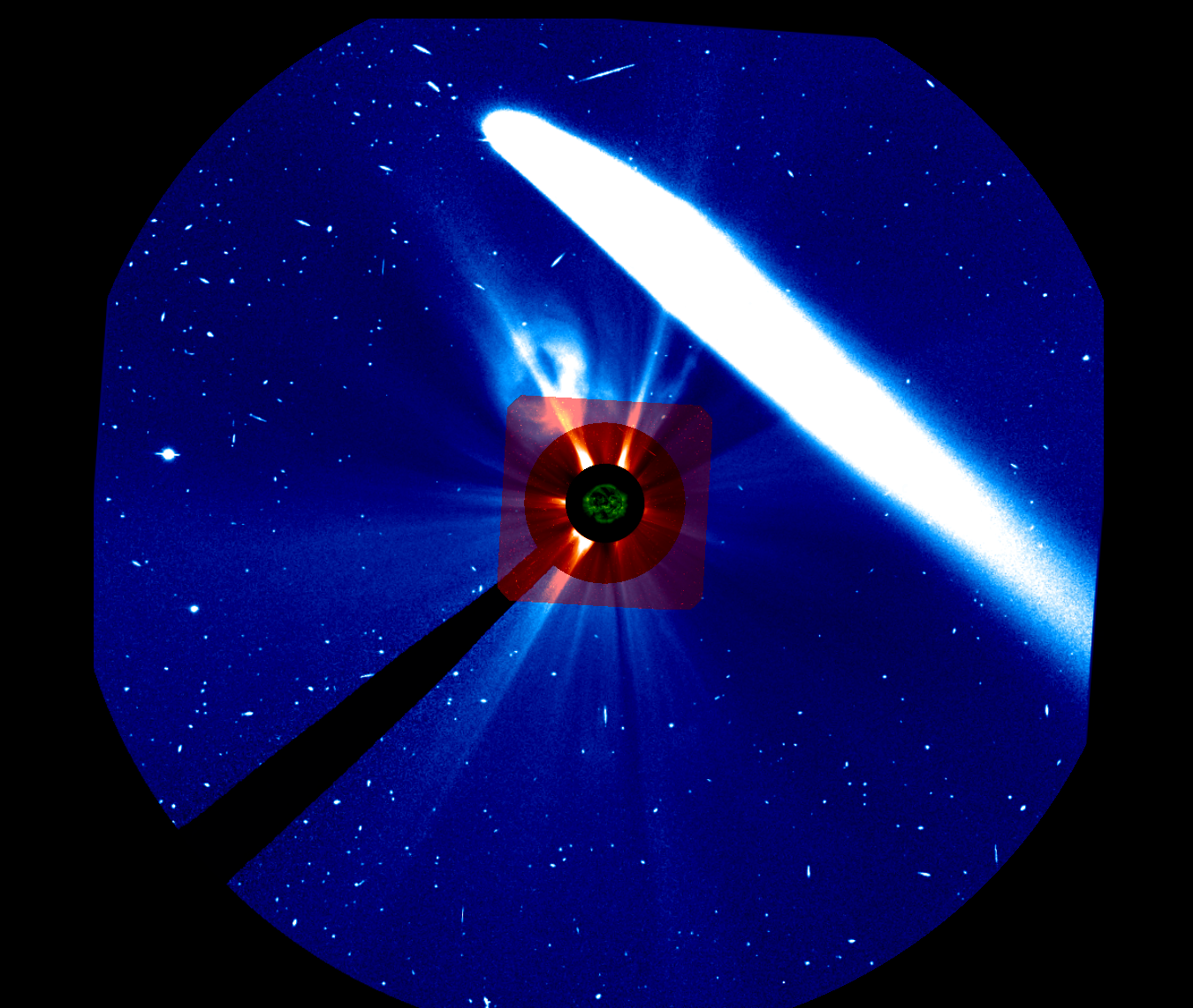
Surprisingly, SOHO also became a dominant comet hunter, discovering over 5,000 new comets in its three decades, many of which were spotted in SOHO data by citizen scientists. The mission also provided an unblinking eye on the Sun for nearly three full 11-year cycles of solar activity, allowing scientists to study how the Sun changes over time. During its three decades, more than 5,000 scientists have worked with SOHO data, resulting in over 7,000 scientific publications and 250 doctorate theses.
Inspiring next-generation observatories
One of the most important parts of SOHO’s legacy is its Large Angle and Spectrometric Coronagraph (LASCO), which blocks the bright disk of the Sun, allowing scientists to see the material the Sun ejects into space. The instrument gave scientists the first detailed look at the shape and structure of a CME. Images from LASCO are a critical part of space weather prediction models that scientists rely on today.
“The SOHO mission has demonstrated the importance of studying space weather and having a coronagraph at L1,” Ireland said. “It’s showed us we need observations from L1 24/7.”
With its multitude of accomplishments, SOHO served as the inspiration for multiple next-generation missions including NASA’s SDO (Solar Dynamics Observatory), STEREO (Solar Terrestrial Relations Observatory), and Solar Orbiter (a joint mission between ESA and NASA). The SWFO-L1 spacecraft, currently en route to join SOHO at L1, has an instrument called the Compact Coronagraph-2 that’s a direct descendent of SOHO’s LASCO instrument which includes miniaturizing innovative technology.
The success of SOHO is dependent on a dedicated staff of flight engineers and instrument operators who have kept the spacecraft going strong for decades. The mission faced challenges over the years, including the loss of control and contact with the spacecraft and its recovery over several months in 1998 and the failure of gyroscopes that keep the spacecraft pointed in the right direction. The SOHO mission continues returning observations of the Sun longer than anyone thought possible while paving path for the next generation of Sun-watching spacecraft.
By Mara Johnson-Groh
NASA’s Goddard Space Flight Center, Greenbelt, Md.